Bidspirit auction | Catalogue of an Antisemitic Exhibition
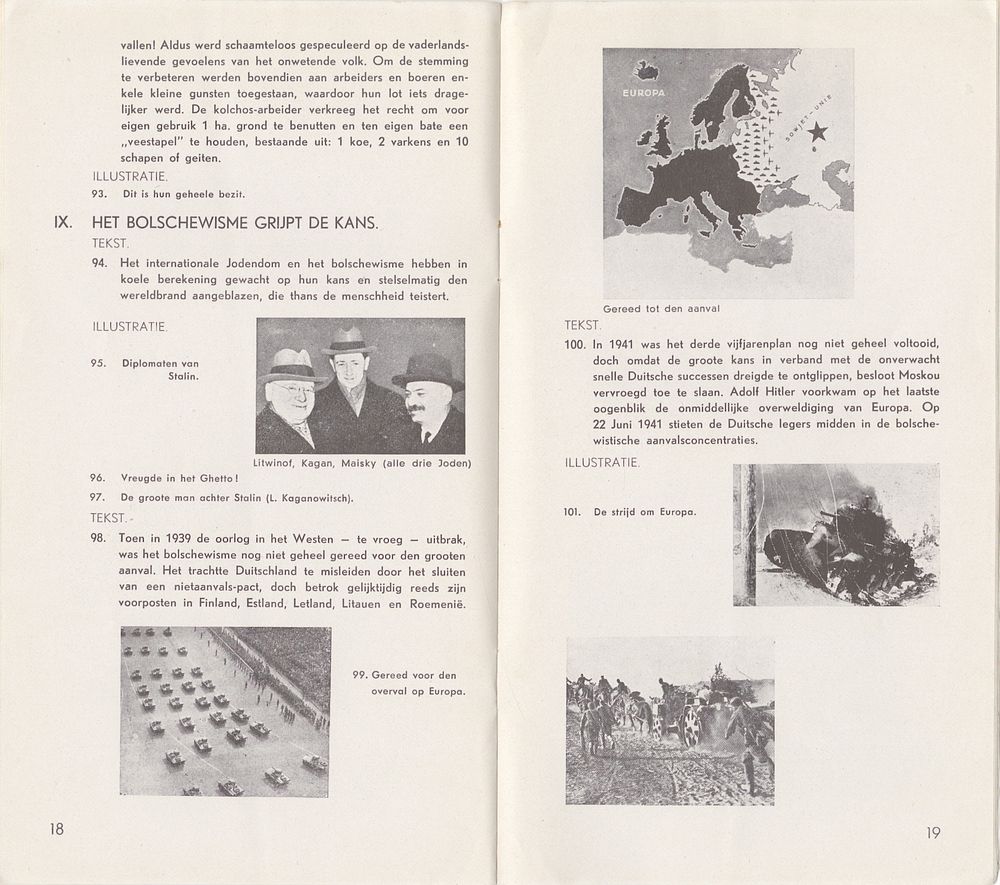
Catalogue of an Antisemitic Exhibition Held by the Nazis in the Occupied Netherlands. The Netherlands, 1943 - First Edition - Catalogus van de tentoonstelling ”Is het Bolschewisme een gevaar?” - ”Is Bolshevism a Danger? - Catalogue of the Exhibition.” A rare catalogue of a travelling exhibition established by the Germans in the occupied territories with the aim of convincing the local population that Russian Communism was Europe's greatest enemy and that it was entirely controlled by the Jews (Judeo-Bolshevism” - Jewish Bolshevism”). The Netherlands, [1943]. Dutch. Extremely rare. ”The international Jewry and Bolshevism waited in cold calculation for their opportunity and systematically fanned the flames that are now destroying humanity throughout the world...” . A Dutch Nazi propaganda document from the war years (C. 1943), intended to incite the Dutch public against the Soviet Union and against the Jews by portraying the Soviet regime as a murderous Jewish conspiracy. The catalogue accompanied a travelling exhibition organized by the Nazis in the occupied countries with the aim of inciting the local population and enlisting its assistance in the persecution of the Jews. It provides a brief description of the exhibits on display. The booklet opens with an explanation of Imperial Russia before the Revolution (the Russian Empire) by presenting classical Russian figures in order to illustrate the ”old culture”: the writer Dostoevsky (Dostojewsky), the composer Tchaikovsky (Tschaikowsky), Tsar Nicholas II, and the influential monk Rasputin (Raspoetin). Later, alongside photographs of Jews described as the ”leaders of the Bolshevik system, ” appears the antisemitic text: ”The Jews constituted a large majority in the leadership of the Bolshevik Party; their aim was the conquest of world power through the aid of Bolshevism.” The illustration depicts Lenin alongside the Bolshevik ”leaders of the system.” Beside the names of many of them (such as Trotsky, Kamenev, Zinoviev, and Radek), their original Jewish names are given in parentheses (for example: Trotsky (Bronstein) or Kameneff (Rosenfeld)) in order to emphasize their Jewish origins. Exhibit no. 18 describes the brutal murder of the Tsar and his family in July 1918 and notes in section 22 that the perpetrator of the murder was ”Joerowsky (Jood)” (Yurovsky - Jew). Later, under the heading ”Lenin in Power, ” the following appears in parentheses: (Oeljanow, vermoedelijk kwart-Jood) - ”Ulyanov, presumably one-quarter Jewish.” Another page presents senior Soviet officials of the 1930s under Stalin's rule, where the text (sections 44-46) explains how the ”Jewish clique” (Trotsky, Kaganovich, Zinoviev) attempted to use Russia's wealth and resources to impose Jewish-Bolshevik rule upon the world by means of arms, and how Stalin made use of them. Also presented are leading figures of the army and the secret police (the Gulag - the forced labor camp system - is mentioned by name). Beside each figure, his alleged Jewish origin is emphasized in parentheses: Genrikh - ”Jew, ” former head of the NKVD; Rapoport - ”Jew”: Yakov Rapoport, one of the senior administrators of the Gulag system; Frenkel (Jood): Naftaly Frenkel, the man who devised the labor system of the Gulag; Pirin (Jood): Semyon Pirin, director of a labor camp within the Gulag system. Another page ”explains” the background to the outbreak of the Second World War and the signing of the Molotov-Ribbentrop Pact from the Nazi point of view. The illustration depicts three senior Soviet diplomats: Maxim Litvinov, Kaganovich, and Ivan Maisky. Beneath the photograph appears the blunt caption: (alle drie Joden) - ”all three are Jews.” The text claims that ”international Jewry” and Bolshevism had coldly planned to set the world ablaze. Another text asserts that in 1941 Moscow was on the verge of invading and conquering the whole of Europe, and that Adolf Hitler, through his foresight, ”prevented this at the last moment” and, two days before the planned Soviet attack, launched Operation Barbarossa (June 22, 1941) in order to defend the continent. A further page attacks the Western leaders (Britain and the United States) for their alliance with Stalin. It features a photograph of Stalin, Roosevelt, and Churchill at the Tehran Conference (late 1943). The caption beneath the image is the sarcastic: Bondgenooten! (”Allies!”). The accompanying text explains that during the harsh winter of 1941-1942 the Red regime was saved from destruction, and that Moscow now makes use of symbols of faith and tradition in order to portray the war as a patriotic ”War of the Fatherland” and thereby deceive the masses. Likewise, under the heading Het Europeesche afweerfront (”The European Defensive Front”), the Germans present the war against Russia as a common pan-European undertaking. Further on appears a photograph of Yemelyan Yaroslavsky (head of the ”League of Militant Atheists” in the Soviet Union).