Bidspirit auction | ”People of the Soil” -
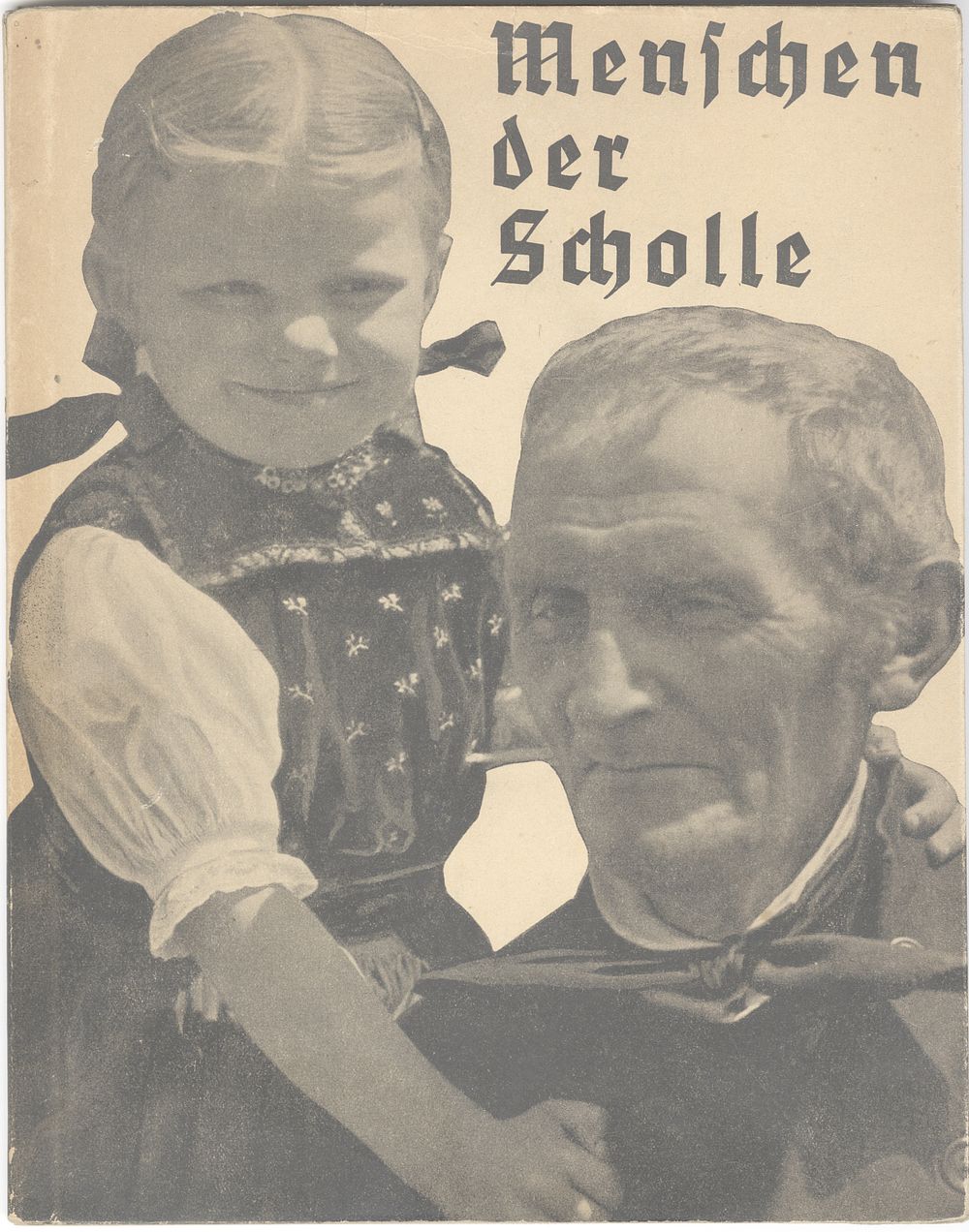
”People of the Soil” - An Ethnographic Photographic Album Presenting the ”People of the Countryside” as the Human Ideal of the Aryan Race. Berlin, [1936] - ”Menschen der Scholle” - People of the Soil - A German ethnographic and propaganda photographic album from the Third Reich period. Published by Verlag Ludwig Simon. Accompanying text by Dr. Hans-Ulrich Lüning. Berlin, [1936]. An album utilizing artistic portrait photography to serve political and racial agendas in light of the Nazi 'Blood and Soil' ideology. Throughout the album appear photographs of peasants, farmers, young men, and children from rural Germany. Under the guise of depicting ”village life, ” the purpose of this photographic collection was to present what the regime defined as ”the healthy, pure, and racial core of the German people.” The text accompanying the photographs emphasizes the ideal Aryan and Nordic characteristics of the subjects. Thus, beside a photograph showing the profile of a young girl appears the caption: ”Dem nordischen Schönheitsideal gleicht sie, dieses Friesenmädchen” (”She resembles the Nordic ideal of beauty, this Frisian girl”). Beside another photograph of a young farmer gazing toward the horizon is written: ”Und dieser Jungbauer ist ein artechter Niedersachse” - ”And this young farmer is a pure-blooded/true son of Lower Saxony.” The album also contains photographs of small children from the agricultural countryside, whose captions emphasize their future as peasants safeguarding the land and the ”proper” (racial) structure of their faces and skeletal features. Beside a photograph of a robust man appears the text: ”The mountains have produced a bold and fearless race.” There are also photographs of a mother with her daughter, accompanied by the caption: ”The younger daughter, of hereditarily healthy Frisian blood, ” and beside the mother's portrait: ”The understanding and ever-kind mother, healthy in body and soul, ” as well as similar captions throughout the volume. The text at the bottom of the pages describes an idealized reality of sturdy and wise people endowed with perfect character traits associated with the Aryan race and living an exalted rural life. A rare example of the manner in which the Nazi regime harnessed the art of photography - through techniques of dramatic light and shadow, heroic camera angles, and concentrated gazes - in order to establish its racial theories visually before the general public. Nazi ideology regarded the agricultural and rural classes as the true biological and moral foundation of the German people, and this conception stands at the center of the visual effort to present the ”People of the Soil” as the perfect human model of the Third Reich. Through photographic projects of this kind, the regime sought to give tangible form to the doctrine of Blut und Boden (Blood and Soil), which held that the mental and physical qualities of the Aryan race were preserved in their purest form only among those directly connected to the cultivation of the land and removed from the supposedly ”degenerate” influences of the great cities and modern urban life. The photographs deliberately emphasized sharp facial features, determined gazes directed toward the horizon, and a distinctly Nordic ideal of beauty in order to create a direct association between physical vigor, pioneering labor, and genetic purity. The rural German was no longer portrayed merely as a simple manual laborer, but as a ”free peasant on free soil” - the guardian of the cultural and biological frontiers of the nation, whose historic mission was to ensure the continuity of future generations and the expansion of the German people's living space. The camera employed dramatic effects of light and shadow to endow the figures with a heroic, almost mythical appearance, thereby transforming the local peasant from a regional symbol into the official and eternal face of the race, serving as an absolute counterweight to everything the regime defined as foreign, weak, or inferior to the authentic German spirit. 51 pages. 27 cm. Original cardboard binding with the dust jacket, all complete. Very good condition.