Bidspirit auction | Buchenwald: Things Seen - The
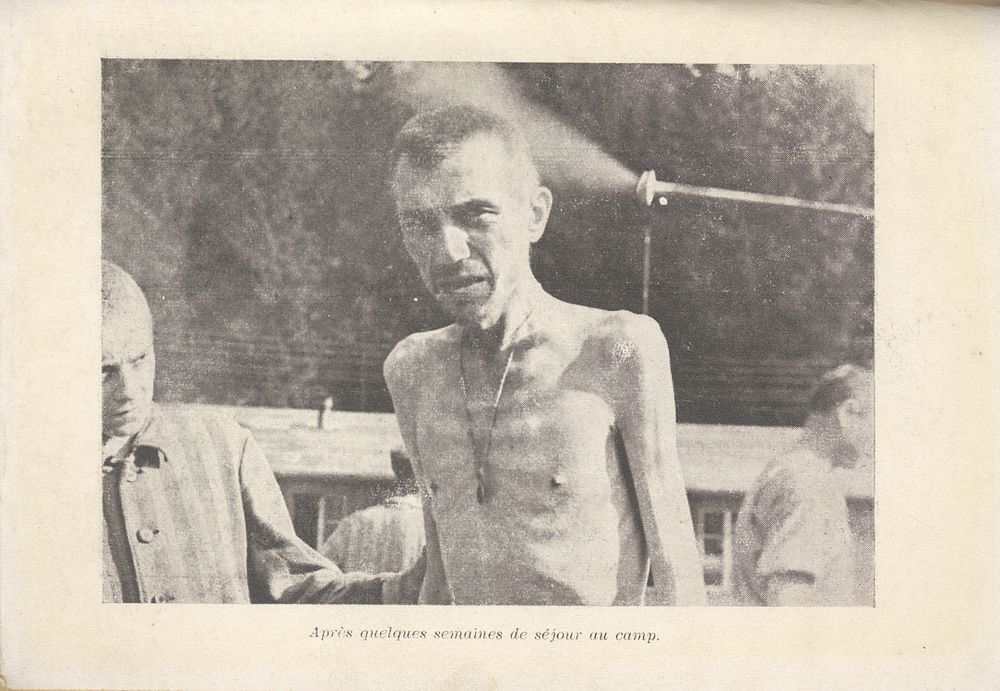
Buchenwald: Things Seen - The Harrowing Testimony of Buchenwald and Ravensbrück Concentration Camp Prisoner Jean Fontaine. Brussels, 1945 - First French Edition - ”I witnessed an endless game in which the SS threw clods of earth, using a prisoner's head as the target after covering it with a bucket...”. Buchenwald: Choses Vues (Buchenwald: Things Seen) - A harrowing testimony by Buchenwald and Ravensbrück concentration camp prisoner Jean Fonteyne. Published one month after the liberation of the camp by the Allied forces. Brussels, May 20, 1945 - First French edition. Accompanied by harsh photos depicting severely injured prisoners at Buchenwald, the bodies of victims, property looted by the Nazis from their victims, and more. Fonteyne was a lawyer, Communist politician, filmmaker, and member of the Belgian Resistance during the Nazi occupation. He was arrested by the Gestapo in Brussels on July 6, 1943. After spending nine and a half months in the Breendonk torture camp, he was transferred to Buchenwald on May 8, 1944. Fonteyne was liberated by the U.S. Army on April 11, 1945. Following repeated requests from members of the Belgian community - his fellow prisoners - that he preserve his story for future generations, he first published his experiences in the camps in the postwar camp newspaper, in installments over a two-week period between April 23 and May 4. Shortly thereafter, his complete testimony was published in its entirety in the present volume. It is among the earliest memoirs by a concentration camp prisoner, published less than a month after his liberation. The first part of the testimony is structured as a series of paragraphs, each beginning with the words ”I saw, ” in which the author recounts numerous horrific events that he witnessed firsthand in the camp - atrocities that had become part of everyday life: ”I saw Germans force Jews to crawl on their stomachs for hours, while they stood in the middle like horse trainers, whipping them and stabbing the victims again and again... I witnessed an endless game in which the SS threw clods of earth, using a prisoner's head as the target after covering it with a bucket... I saw them force prisoners to remain bent over for hours with their arms outstretched... I saw them trample corpses and heads, and crush faces into the dust... I saw and experienced how we struggled to push heavy carts for hundreds of meters, and at the points where the effort was greatest, they threw sand into our eyes... I saw how, with a single knife stroke, he slit the ear of one of my comrades... I saw prisoners of every age brought out of the bunker suspended by their wrists, their arms bound behind their backs... The Nazis did all these things not in fits of rage, but always coldly and calmly, deliberately inflicting pain on those parts of the body where the suffering would be most severe and prolonged, and at the sight of the prisoner's tortured face they rejoiced... I saw them laughing as our comrades were executed... On one occasion, after the execution of a Jew who had been dear to his fellow prisoners, they forced them to sing while they laughed...”. Fonteyne provides the exact number of prisoners who arrived at Buchenwald and those who were murdered there. He describes the layout of the camp, the manner in which prisoners were employed in forced labor, the various methods of starvation imposed by the Nazis and the prisoners' desperate attempts to obtain food, the different categories of prisoners and the badges by which they were identified, the various punishments inflicted on prisoners who attempted to escape, the severe psychological condition of the inmates, and more. Toward the end of his account, he describes the days of liberation and how many prisoners, whose strength had been completely exhausted, died during the liberation itself. He also recounts the incident in which the residents of Weimar were compelled to visit the camp and witness with their own eyes what their countrymen had done. They passed through barracks where hundreds of dying prisoners lay screaming in agony: ”Where is my wife? Where are my children? Why were my brothers burned?... Some of the residents burst into tears, others fainted, but the American soldiers lifted them up and forced them to continue through the camp, while several prisoners shouted: ”We endured this for ten years! You can bear to look at it for one hour...”, and more. 63 pages + 8 plates of harsh photos. Minor staining to the cover. Good condition.