Bidspirit auction | ”There Are Too Many of
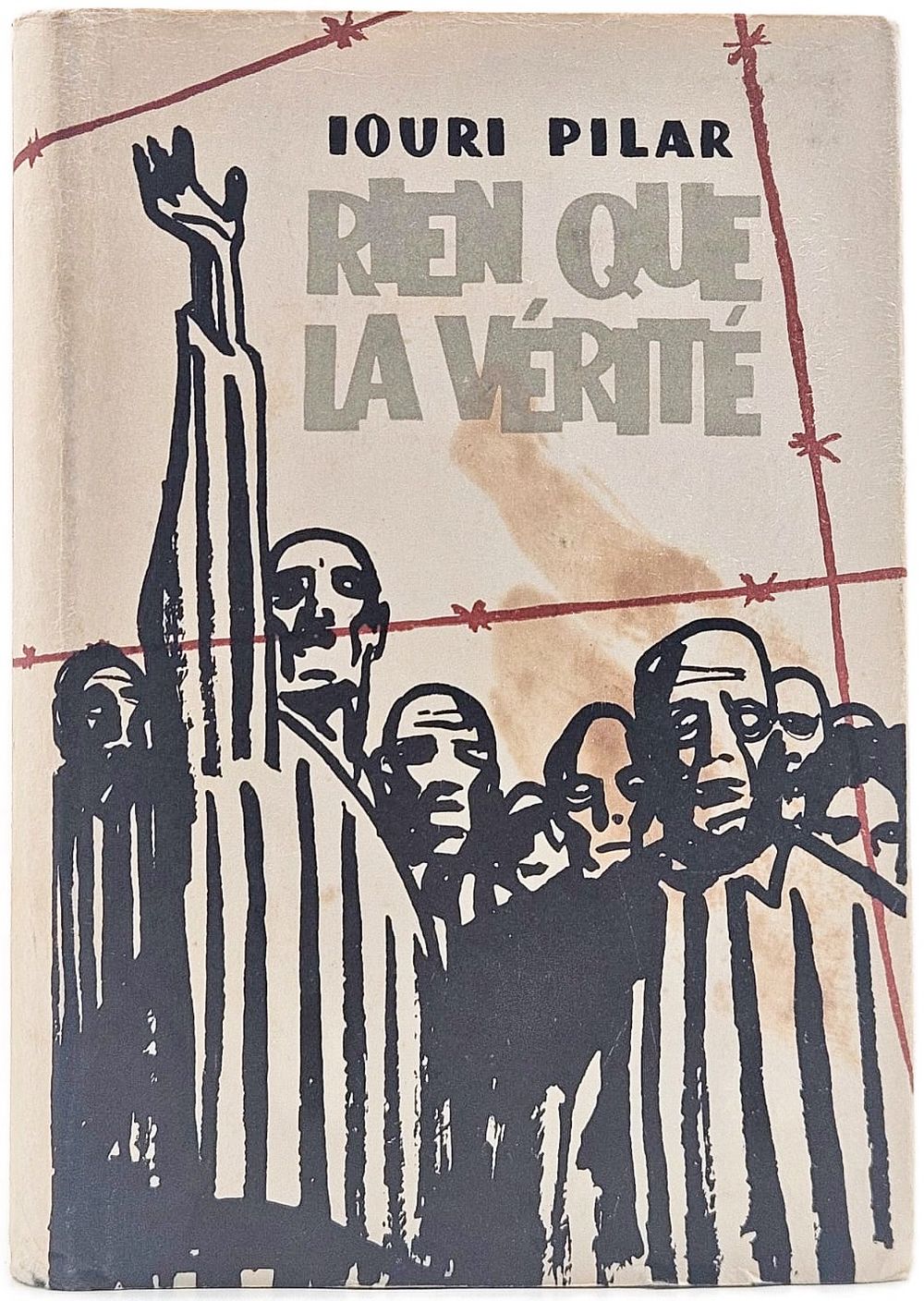
”There Are Too Many of Us for a Cattle Car...” - ”Nothing but the Truth” - Yuri Pilar's Account of His Imprisonment in the Death Camps. Moscow, 1955 - First French Edition - Rien que la vérité (Nothing but the Truth), by Yuri Pilar (Iouri Pilar / Yuri Pilyar). First French edition, published in Moscow by Éditions en langues étrangères (Foreign Languages Publishing House), the Soviet state publishing house that disseminated important Soviet works to Western readers. Moscow, 1955 - First French edition. Extremely rare. Yuri Pilyar was conscripted into the Red Army during the Second World War at the age of just seventeen. He was seriously wounded in combat against the Nazis and was taken prisoner in July 1942. After two escape attempts from a German prisoner-of-war camp, he was brutally beaten and transferred to the notorious Mauthausen Concentration Camp in Austria. There, like other political prisoners, he endured forced labor, severe starvation, and the terror inflicted by the Nazi SS. Pilyar retained a remarkably vivid memory of his experiences in the camp, and throughout the book he records, in continuous narrative, countless events that occurred on an almost daily basis. The book describes the harshest of experiences - the daily moments of terror on the roll-call square, where hundreds of prisoners stood with blood dripping from their fingers in the bitter cold, while the murmur of hushed conversations in every language of Europe filled the air, and the question hanging over everyone was: Which prisoner will be murdered today? He recounts the humiliating morning inspections conducted by the kapos, the meager rations of soup, and the brutality of the camp authorities. One of the most harrowing passages in the book is his description of the forced labor in the camp's notorious stone quarry, where he and his fellow prisoners were compelled to carry heavy stones up the steep staircase each day: ”It feels heavier with every step. It seems to weigh not thirty, but at least fifty or sixty kilograms... A painful groan, the sound of a stone crashing down the steps, cries of terror, more stones tumbling... Far below, four sharp pistol shots echo... As we climb the last of the one hundred and eighty-six steps, three more shots ring out below. I can no longer feel my arms, my legs are trembling, I am half dead... Seven men have fallen. That is the count. At last I begin to understand what has happened...”. Pilyar also describes the prisoners' nightly conversations, during which they would speak about what would happen if one prisoner or another died the following day, for it was understood that someone might die every day. He recounts the loss of all sense of time and place among prisoners subjected to relentless daily torture, and their struggle to remain alive despite the unimaginable suffering. At one point, he was assigned as a guard at one of the entrances to the camp crematorium, where he witnessed the process of exterminating the Jews deported to the camp from across Europe: ”With meticulous precision, convoys of prisoners arrive every week. If the camp administration summons barbers from all the blocks, it means the transport is a large one. An hour, an hour and a half later, a line of gaunt men, their heads shaved, begins to make its way behind the kitchens toward the crematorium. Their hair is then collected in sacks and sent to the warehouse. The following day, by day and by night, a glow of flames rises from the crematorium chimney. From this mass of prisoners, scarcely a few hundred, most of them young men, usually reach our blocks... All those who are not killed immediately are assigned to various labor detachments...” The illustrations accompanying the book document the horrific reality of life in the camp. Extremely rare. Not recorded in the WorldCat global library catalog. 193, [2] pages. Original hardcover with the original dust jacket, complete. Stain to the dust jacket. Book in good - very good condition.