Bidspirit auction | Official Postal Card Sent from
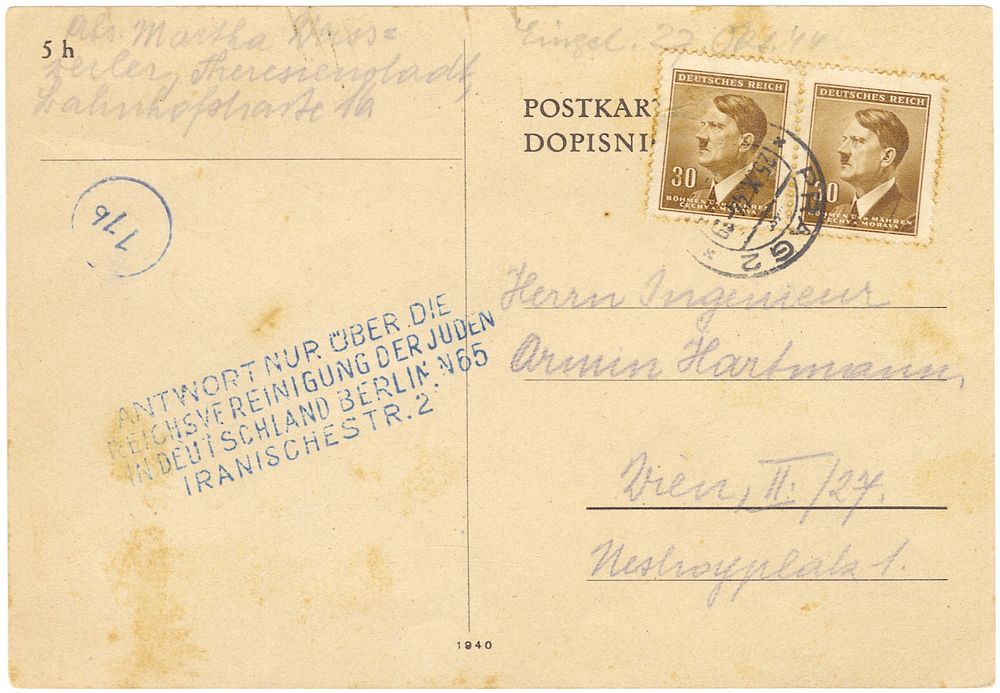
Official Postal Card Sent from the Theresienstadt Ghetto to Vienna - September 1944 - Official censored postal card sent from the Theresienstadt Ghetto in the occupied Czech territories (the Protectorate of Bohemia and Moravia) to Vienna, Austria, in September 1944. Rare. The postcard exposes the system of deception and strict censorship imposed by the Nazis on the correspondence of Jewish prisoners in the ghetto. It was sent from the ghetto to Herr Ingenieur Armin Hartmann, residing in Vienna at Nestroyplatz 1. In the upper left-hand corner appear the sender's handwritten details - Martha Weiss-Ziler - together with the fictitious address that the Nazis compelled prisoners to use in order to conceal the existence of the ghetto: Theresienstadt, Bahnhofstraße 1a. The text, written in German on September 16, 1944, predates the postcard's actual dispatch from the ghetto by approximately six weeks. Martha writes to Armin under the strict rules imposed by the German authorities - limitations on the number of words, a restrained style, and an absolute prohibition against describing the true conditions, the starvation, or the deportations. The letter is divided into official sections, as Jews were compelled to do in order to facilitate censorship: ”Theresienstadt, September 16, 1944. – Dear Armin, today I must convey the following information to you: The general postal restrictions also apply to Theresienstadt, which means that we are permitted to receive mail only once every four weeks, while we may write only once every eight weeks. Please send us mail only by using the address printed on the reverse of this postcard [referring to the Berlin imprint on the front]. Only parcels should continue to be sent directly to Theresienstadt. Parcels must not contain any written messages. We acknowledge receipt of all parcels by means of a postcard with pre-printed text. My mother replied to your letter of July 17 on or about August 25. How are you? How is Röschen? We have not heard from her for quite some time. Please convey our warm regards to her as soon as possible. – Emil Goldschmidt passed away peacefully in April, at nearly 85 years of age! – Many thanks for everything. Warm regards to both of you from the three of us. Martha.” Affixed to the postcard are two Protectorate of Bohemia and Moravia postage stamps, each bearing the portrait of Adolf Hitler with a denomination of 30 heller. They are cancelled with the local Theresienstadt postmark dated October 25, 1944 - the actual date of mailing, following the deliberate censorship procedures and delays imposed by the Gestapo. In the upper left corner appears a small circular handstamp bearing the number 776, identifying the internal examiner or censor of the Jewish Council (Judenrat) or the SS within the ghetto. Also on the front is the large dark-blue rectangular cachet. This mandatory Nazi handstamp is a striking reminder of the regime's system of surveillance. Its German text reads: ”ANTWORT NUR ÜBER DIE REICHSVEREINIGUNG DER JUDEN IN DEUTSCHLAND BERLIN N 65, IRANISCHESTR. 2” - ”Reply only through the Reich Association of Jews in Germany, Berlin N 65, Iranische Str. 2.” The significance of this instruction was that the recipient in Vienna was forbidden to reply directly to the ghetto. Every reply had to be sent first to the central office of the Reich Association of Jews in Germany in Berlin, which operated under the direct supervision of Eichmann's department within the RSHA (Reich Main Security Office). Only after rigorous screening and censorship were approved letters forwarded to the ghetto. The date on which the postcard was written (September 1944) and the date on which it was actually mailed (late October 1944) correspond to one of the darkest and most tragic periods in the history of the Theresienstadt Ghetto. During September and October 1944, the Nazis abandoned the illusion of the ”model ghetto” and launched a massive and intensive wave of deportations directly to the Auschwitz-Birkenau extermination camp. Most of the ghetto's prominent figures, community leaders, women, and children were sent to their deaths in the gas chambers during the very weeks in which this postcard was awaiting censorship approval. The Nazis used such correspondence as a propaganda tool aimed at both the outside world and the families left behind, creating the false impression that those deported to the East were alive and well, while in reality the machinery of extermination had already been set in motion against them. [1] postcard. Minor stains. Good condition.