Bidspirit auction | Buchenwald: The Organization and Underground
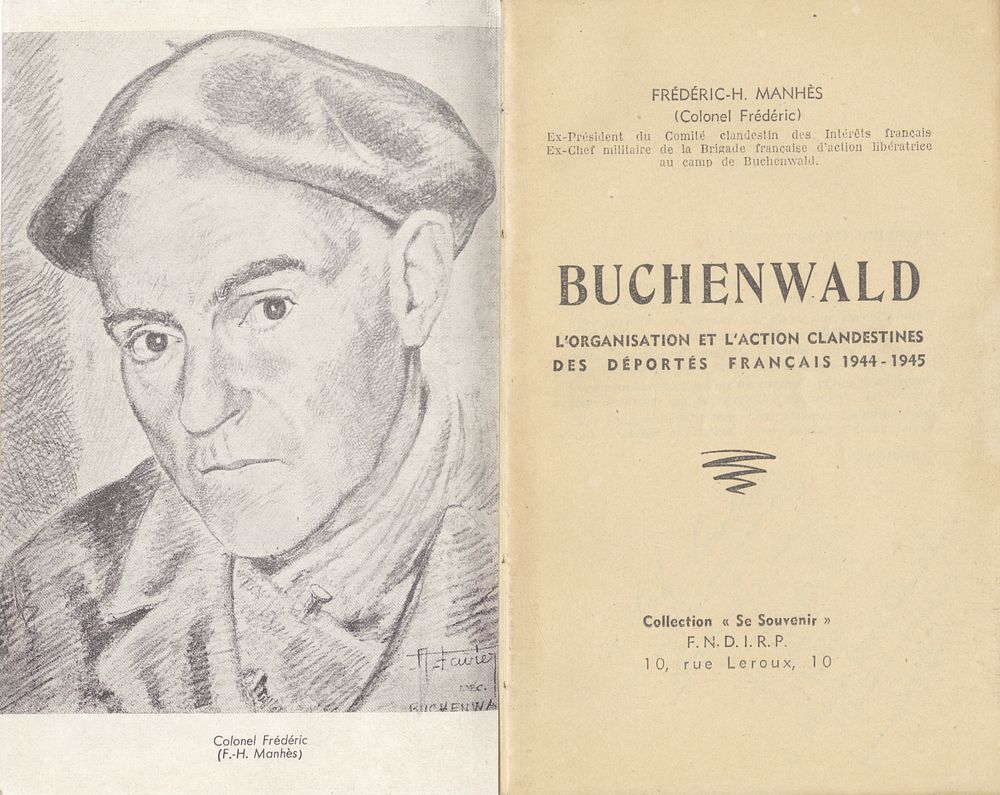
Buchenwald: The Organization and Underground Activities of the French Deportees, 1944–1945 - An Important Study of the French Resistance Movement in Buchenwald Concentration Camp. Presentation Copy Inscribed and Signed by the Author - Buchenwald: L'organisation et l'action clandestines des déportés français 1944–1945 (Buchenwald: The Organization and Underground Activities of the French Deportees, 1944–1945) by Frédéric-Henri Manhès, one of the leaders of the underground organization in the camp. Published by the Fédération Nationale des Déportés et Internés Résistants et Patriotes (F.N.D.I.R.P.), France. Paris, [1946] - First edition. Presentation copy inscribed and signed by the author. Rare. ”Buchenwald Concentration Camp was established on July 19, 1937. I speak of it because I spent nearly fifteen months there, and circumstances led me to become involved in most of its clandestine activities... In this concentration camp, as in the others, it was not enough for the Hitlerites and their SS men merely to condemn deported patriots to forced labor. Their first objective was to strip them of every vestige of individuality, even its outward appearance... to deprive a man completely of his identity... to shave him from head to toe... to dress him absurdly in worn-out clothing... to leave him with nothing that connected him to his past...”. Manhès, known by his Resistance alias ”Colonel Frédéric, ” was a key figure in the French Resistance. He served as the deputy of Jean Moulin and, after his arrest and deportation to Buchenwald, became the head of the French military underground within the camp, leading the internal organization of the French prisoners in their struggle against the camp administration. ”We had two principal missions to fulfill: 1. To enable as many Frenchmen as possible to return to France, and to do so in the best possible condition. 2. To slow down, and even sabotage, German war production, ” he writes, before describing in detail the methods by which the underground operated within the camp. His foremost concern was to save prisoners who had been assigned to work details that almost invariably ended in death. Once a prisoner was assigned to certain types of labor, he knew that he had entered a path leading to certain death. As Manhès explains: ”Outdoor labor: earthworks, quarrying, railway construction. There, nothing stopped: one had to endure rain, wind, and snow, with their inevitable consequences - pleurisy, pneumonia, pulmonary congestion, and... the Revier [camp infirmary], and then, more often than not... the crematorium!” Using his contacts among members of the camp administration, he sought to reduce the unbearable overcrowding in the wooden barracks, arguing that prisoners required minimal living conditions in order to perform their daily labor efficiently. At the same time, through an extensive sabotage network that he directed, he slowed the recruitment of workers for the various factories and even succeeded in bribing certain SS supervisors to exercise ”measured brutality” in their treatment of prisoners. Through covert instructions, he also managed to slow the production of weapons in order to undermine the German war effort. In Hall 8, for example, production fell to 35 percent; of the 12,000 rifle barrels manufactured there, 9,000 were rejected - all as a result of the extensive underground activities he coordinated within the camp. The underground organization also arranged for food to be smuggled to prisoners in critical physical condition. The book further describes how members of the underground were responsible for the downfall of several particularly brutal block leaders. In cooperation with Marcel Paul, they instructed prisoners to behave in ways that caused the SS to lose confidence in these block leaders, with the result that one after another they were transferred away ”to the unknown.” In the closing pages, Manhès documents the activities of the French Liberation Brigade, composed entirely of camp prisoners, which played an active role in the liberation of the camp. Its members knew the weaknesses of the SS during those critical final days and exploited them on numerous occasions to accelerate the collapse of the camp's organizational structure. They also assisted the Allied forces in identifying SS personnel who had disguised themselves in prisoners' uniforms to avoid capture. Throughout, the book records this clandestine activity, the solidarity among the prisoners, and the methods of survival and resistance within the hellish conditions of the camp. At the beginning of the book is a portrait of Manhès by the artist and fellow prisoner Paul Fauvé, drawn in Buchenwald itself in December 1944. The author's presentation inscription is addressed to Colonel Colloc. In it, Manhès writes: ”In all friendship, cordially” (en toute amitié, cordialement). Beneath his signature and Resistance alias,