Bidspirit auction | On Petya Vorobyov - Set
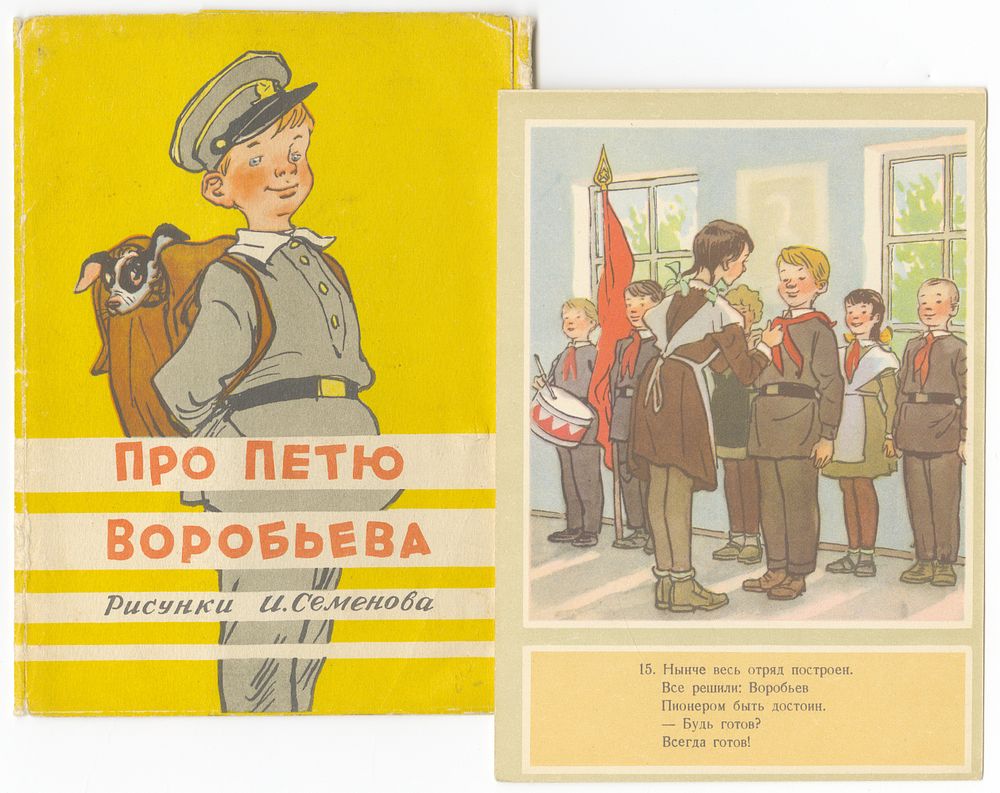
On Petya Vorobyov - Set of Soviet Re-Education Postcards - 1961 - Про Петю Воробьева (On Petya Vorobyov) - Complete set of 15 postcards for children in the original folder, published in the Soviet Union by the state publishing house IZOGIZ (ИЗОГИЗ), one of the principal art and graphic publishing houses in Moscow, and printed at the First Exemplary Printing House named after A. A. Zhdanov. Soviet Union, 1961. The postcards tell a serialized moral tale about a lazy and mischievous boy named Petya, who undergoes a process of reform, re-education, and transformation into a model Soviet citizen - a member of the Young Pioneers - through the influence of society and the educational system. The striking illustrations, characteristic of the period, were created by the renowned artist Ivan Semyonov (И. Семенов), the principal illustrator of the celebrated Soviet satirical magazine Krokodil and one of the founders of the popular children's magazine Vesyolye Kartinki. The accompanying verses were written by the children's author and poet Yuri Yakovlev (Ю. Яковлев). The postcards present a serialized story about Petya Vorobyov, a lazy and mischievous boy who struggles to get up for school because he stays up late watching television and ignores his grandmother's wishes. His lack of discipline extends beyond the home, as he runs about the yard frightening helpless animals for his own amusement. In the classroom, he displays open disrespect, failing to answer basic geography questions such as the location of Moscow, and attempts to copy his classmates' exam answers instead of making an effort himself. Petya also bullies those around him; one particularly cruel prank involves sneaking up behind three schoolgirls and tying their braids together in a tight knot. The turning point comes when his fellow members of the Octobrists hold a public comrades' hearing, sharply reprimanding him for his behavior and exposing his misconduct before the group, leaving him deeply ashamed and remorseful. Under this social pressure, Petya gradually undergoes a process of re-education and embraces positive values. He begins to complete his homework diligently, keeps his books clean, and takes responsibility for household tasks such as cleaning his room and helping his grandmother. His transformation is also reflected in his schoolwork, where he excels in mathematics, and he ultimately overcomes his laziness through productive work in handicraft class, building wooden birdhouses. The story concludes with a celebratory educational triumph as Petya, now transformed into a model young citizen, is proudly admitted into the ranks of the Young Pioneers and receives the movement's traditional red neckerchief. The main message of the postcard series is a classic Soviet educational and ideological one, emphasizing the importance of shaping the young socialist citizen through the values of collectivism, discipline, and productive labor. The Soviet regime used publications of this kind to impress upon children that idleness and ”laziness” constituted the gravest social failing, and that the only way for an individual to fulfill his potential and become a valuable member of society was through active contribution and physical work for the common good, as illustrated by Petya's transformation when he begins to engage in productive work. The celebratory conclusion, in which Petya is admitted into the Young Pioneers and receives the movement's traditional red neckerchief, conveys the story's educational message: acceptance into the state's political and educational organization is the highest reward, transforming the once wayward and isolated boy into an integral part of the greater Soviet society. 15 postcards, each measuring 15×11 cm, with the original folder. Overall very good condition.