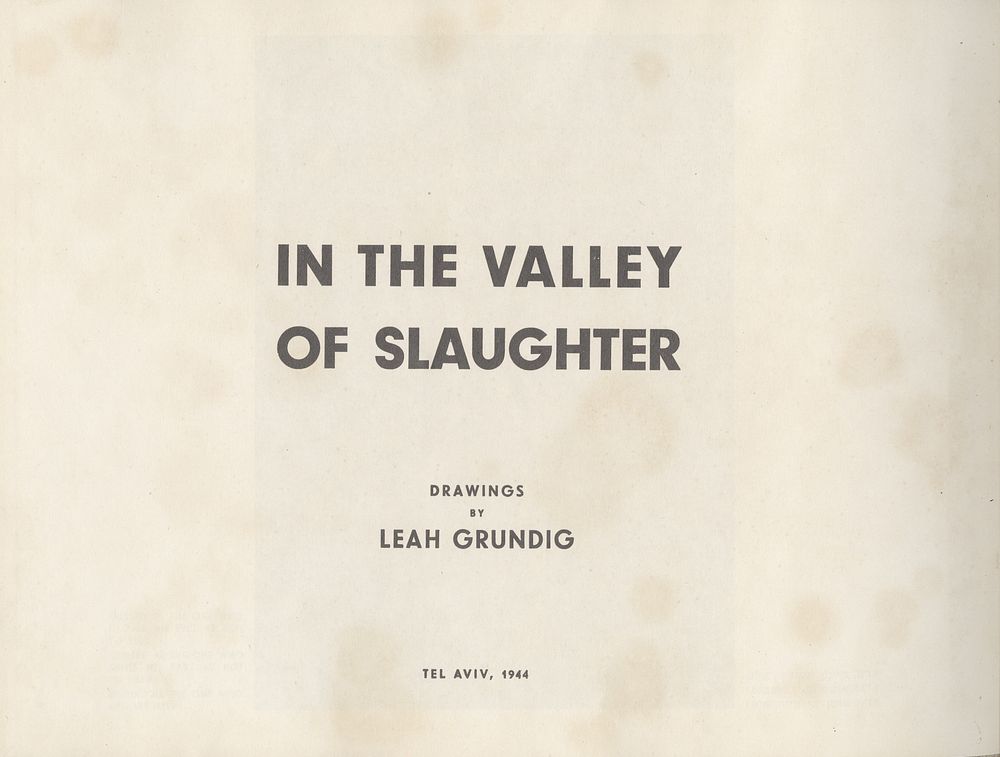
Bidspirit auction | ”In the Valley of Slaughter”
”In the Valley of Slaughter” – Album of Drawings Depicting the Horrors of the Holocaust. Tel Aviv, 1944 - In the Valley of Slaughter - Drawings by Lea Grundig, created in the midst of the horrors of the Holocaust. Haaretz Press, Tel Aviv, 1944. A series of stark drawings documenting the atrocities of the Holocaust, created by Grundig between 1942 and 1943 while these events were unfolding. Through these works, she depicted some of the most harrowing moments experienced by European Jewry on the path to annihilation—aboard the death trains, at Treblinka, pursued by savage dogs, the surrender of children, mothers torn apart in grief, and more. Lea Grundig (1906–1977), one of the leading artists of Dresden, combined throughout her life a profound ideological commitment to the German Communist Party with a powerful Expressionist artistic vision. Together with her husband, the painter Hans Grundig, she formed an integral part of Germany's political avant-garde circles, an involvement that led to the couple's arrest by the Nazi regime and their imprisonment in concentration camps. In 1940, Grundig succeeded in escaping war-torn Europe and reached Palestine (Eretz Israel) aboard the immigrant ship Pacific. Between 1942 and 1943, in the midst of the war, she created her monumental series of drawings, In the Valley of Slaughter, which became one of the crowning achievements of her career and one of the earliest and most powerful visual testimonies to the Holocaust produced in the art of the Land of Israel. Reflecting on the impulse that drove her to create these works during those dark years, Grundig wrote: ”The task seemed to have been laid upon me. I had to draw it. I had to cry out for those whose voices had been silenced.” Alongside her documentation of the Holocaust, Grundig left a lasting mark on the cultural life of the Land of Israel by producing incisive political cartoons for the press of the Communist Party of Palestine (PKP), as well as documentary landscape drawings and sensitive graphic works inspired by life on the kibbutz. In the late 1940s, upon receiving the joyful news that her husband Hans had survived the Nazi concentration camps, she chose to return to Germany to reunite with him, leaving behind in Israel a substantial body of work that stands as a rare artistic and historical memorial. [1] leaf, [9] plates (printed on both sides), [1] leaf. 34×25 cm. Bound in a handsome modern binding with gilt lettering. Good condition.