Bidspirit auction | An Issue of Kladderadatsch -
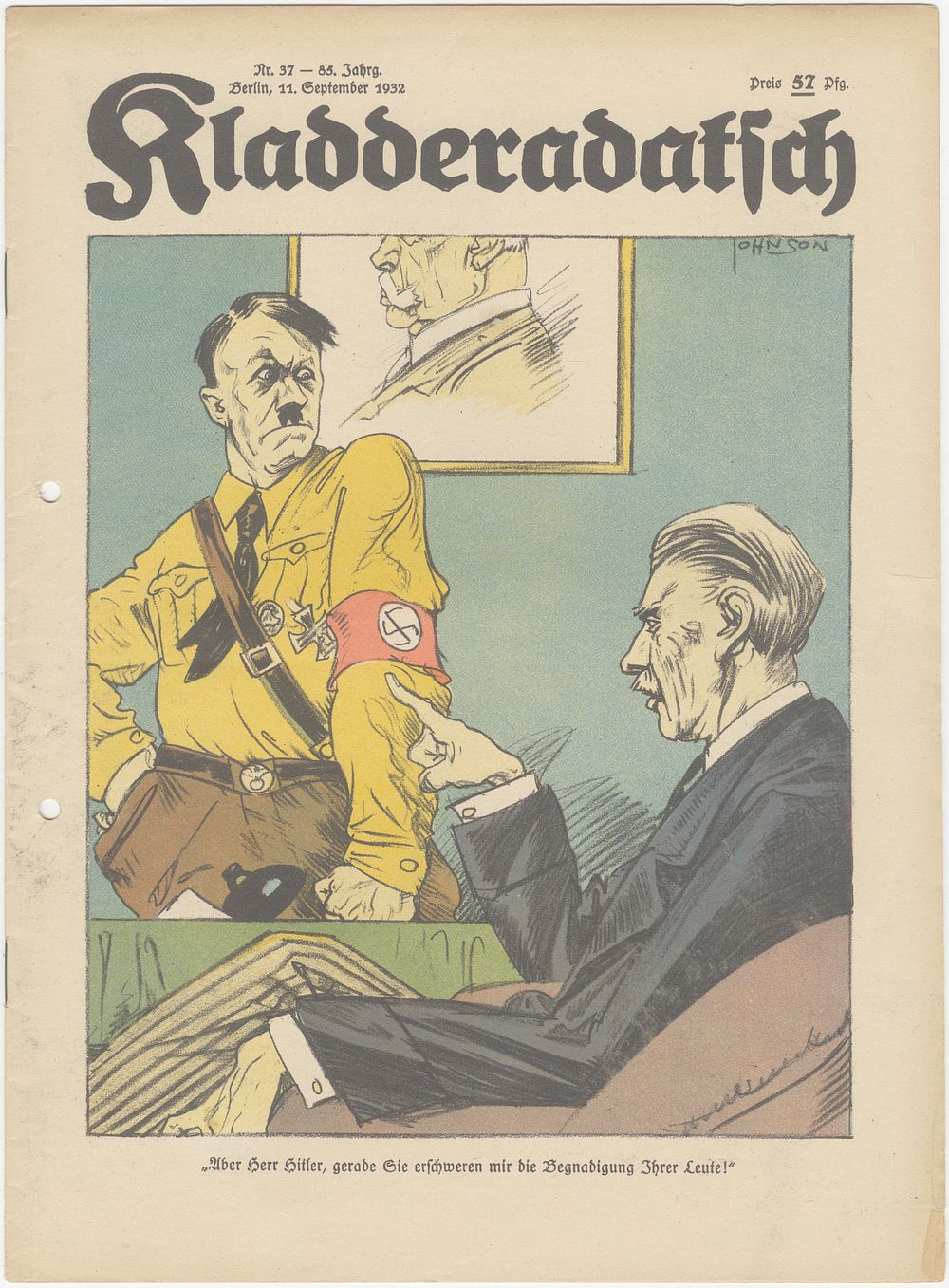
An Issue of Kladderadatsch - The Elimination of the Opposition on the Eve of the Fall of the Weimar Republic and the Nazi Rise to Power - September 1932 - An issue of Kladderadatsch, Berlin, dated September 11, 1932. The front cover depicts Franz von Papen groveling before Adolf Hitler following the Potempa murder, during the final days of the Weimar Republic, just months before the Nazis came to power. Throughout the issue are satirical cartoons and sharply critical content directed against the parties in the German Reichstag that opposed Adolf Hitler. The cover illustration depicts Adolf Hitler in the uniform of the Nazi Party (the Brownshirt), wearing a diagonal leather crossbelt, the Iron Cross, and a swastika armband, in a forceful and indignant pose. To the right sits German Chancellor Franz von Papen, dressed in elegant civilian attire, shown in profile as he points an accusatory and resolute finger toward Hitler. Von Papen served as Chancellor of Germany during those turbulent months of 1932 and sought to maneuver in the face of the Nazi Party's rapidly growing power. Hanging on the wall behind Hitler is a subtle portrait of the elderly President of Germany, General Paul von Hindenburg, looking down upon the scene as the supreme authority of the Republic. At the bottom of the page appears the following quotation (in German), spoken by von Papen and addressed to Hitler: ”Aber Herr Hitler, gerade Sie erschweren mir die Begnadigung Ihrer Leute!” - ”But Mr. Hitler, it is precisely you who are making it difficult for me to grant clemency to your people!” The cartoon, created by the newspaper's renowned political illustrator Arthur Johnson, refers to a dramatic political event that took place in August 1932 - the Potempa Murder. Five Nazi SA (Sturmabteilung) members brutally murdered a Communist worker before his mother's eyes in the town of Potempa. The court sentenced the murderers to death. Hitler reacted with fury to the verdict, sent the convicted men a public telegram expressing his support, and demanded that the government release them immediately. As Chancellor, von Papen found himself in a difficult position: on the one hand, he wished to uphold the rule of law; on the other, he sought to appease Hitler in order to secure his political support. Ultimately, under intense pressure from Hitler, the death sentences were commuted to life imprisonment (and after the Nazis came to power in 1933, the men were released). The cartoon captures the moment in which von Papen appears to rebuke Hitler, suggesting that his aggressive and demanding conduct was making it more difficult for the government to accommodate him and grant clemency to his followers as part of its political compromises. On the inside front page, the editorial attacks the movements opposed to Nazism. The upper section bears the title ”Die Alterspräsidentin” (”The Senior President”) - a parody of Clara Zetkin, the veteran Communist politician. In August 1932, approximately one month before the publication of this issue, Zetkin opened the session of the Reichstag in her capacity as its oldest member (Alterspräsidentin), and in her address called upon the workers of Germany to unite in the struggle against fascism. The poem ridicules her, sarcastically referring to her as a ”daughter of Elysium, ” and concludes with the jibe that beneath the starry Soviet heavens there apparently dwells a wretched cat trying to impose order. This is followed by a cartoon accompanied by an open letter from a disillusioned former German worker named Hans Michel, addressed directly to Joseph Stalin in Moscow. The letter presents the grievances of approximately 15,000 German workers who had been lured into emigrating to the Soviet Union with enticing promises, only to discover a harsh reality in which they did not receive the wages and conditions they had been promised. The text delivers a scathing attack on Stalin, referred to here by the dismissive name ”Soso Jughashvili, ” portraying him as an exploiter and a tyrant no different from those who had preceded him. Also included is a cartoon criticizing the heavy tax burden in the Weimar Republic. At the bottom of the page appear three additional short columns. On the left, the column entitled ”Nix deutsch!” (”Not German!”) mocks Hitler's opponents, who accused him of imitating Mussolini's mannerisms, and remarks ironically that the Nazi Party's use of foreign words and expressions proves that it takes whatever it needs from wherever it can, whether from Paris or from Rome. At the center of the issue appears a sharply satirical political cartoon directed against the Soviet Union and the German Communist Party under the main heading ”Treppenwitz der Geschichte” (”The Irony of History”). The central illustration, drawn by the artist Arthur Johnson, bears the dramatic caption: ”Moskau eröffnet den Deutschen Reichstag” (”Moscow Opens the German Reichstag”).