Bidspirit auction | ”More Than an Entire Archive
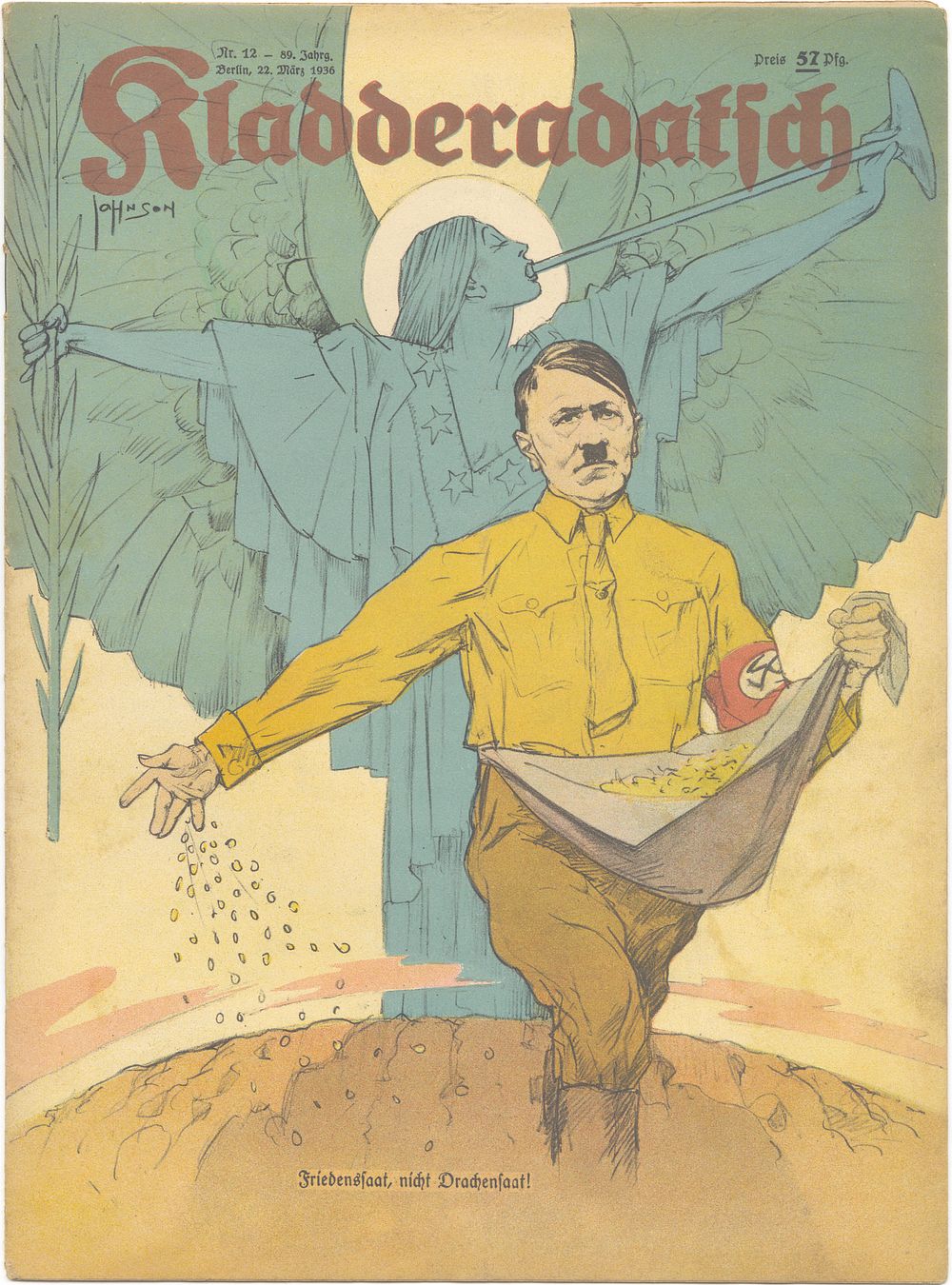
”More Than an Entire Archive of the League of Nations Is Contained in Every Sentence Hitler Utters!” - Antisemitic Issue of Kladderadatsch Following the Remilitarization of the Rhineland - Antisemitic issue of Kladderadatsch, Berlin, dated March 22, 1936. An entire issue supporting Adolf Hitler's policies following the entry of the German army into, and the reoccupation of, the Rhineland just two weeks earlier, on March 7, 1936, in blatant violation of the Treaty of Versailles and the Locarno Treaties, heralding a new era for Nazi Germany. Also reflecting the magazine's continuing antisemitic line: ”25 Jewish and Communist Agitators Expelled from the Country.” The cover illustration, created by the artist Arthur Johnson, presents Adolf Hitler in a messianic light. Hitler is depicted at the center as ”The Sower, ” dressed in the golden shirt of the Nazi Party and wearing a swastika armband. He strides across the furrows of the earth, scattering golden seeds from his hand. Towering behind him is the colossal figure of an angel with outstretched wings and a halo encircling its head. The angel is clothed in a star-adorned robe, raising one hand holding a palm branch (the traditional symbol of peace and victory), while with the other it sounds a long trumpet proclaiming the new message. The caption at the bottom of the page conveys the propagandistic message: ”Seeds of Peace, Not Dragon's Teeth!” (Friedenssaat, nicht Drachensaat!). The specific historical context behind the cover is the entry of the German army into, and the reoccupation of, the Rhineland (the remilitarization of the Rhineland) just two weeks earlier, on March 7, 1936, in blatant violation of the Treaty of Versailles and the Locarno Treaties. The cartoon was intended to dispel international fears of an impending European war and to present Hitler's aggressive military actions to the German public and the wider world not as an act of war (”dragon's teeth, ” which in mythology give rise to warriors), but as a justified assertion of national sovereignty that would ensure peace and stability. The editorial is devoted entirely to a lengthy propaganda poem entitled ”The Voice of Reason” (Die Stimme der Vernunft), serving as a forceful defense of the German army's entry into the Rhineland in March 1936. The poem addresses French Prime Minister Albert Sarraut directly, accusing France of hypocrisy, of suffocating Germany ever since the Treaty of Versailles, and of entering into a dangerous military alliance with the Soviet Union, described as ”the Red Devils of Moscow.” At the same time, the text ridicules the League of Nations, dismissively referring to it as ”the soap bubble of Geneva, ” and declares that the old European diplomatic order is collapsing under the weight of its own falsehoods. The poem concludes with a messianic glorification of Adolf Hitler, portraying him as ”a man of truth” who embodies supreme reason, while asserting that every sentence he utters contains more wisdom than the entire archives of the League of Nations: ”The profound understanding of Adolf Hitler! More than an entire archive of the League of Nations is contained in every sentence Hitler utters!... If a nation follows him, it will live forever! And whoever refuses him will perish.” This is followed by a virulently antisemitic cartoon under the title ”Fear, Hatred, and Greed” (Angst, Haß und Habgier). The illustration depicts three grotesque figures representing the enemies of Nazi Germany leaning over a cradle: a weeping and frightened woman wearing a Phrygian cap (representing France), a wild-looking Russian soldier with a red star on his cap (representing the Communist Soviet Union), and a classic antisemitic caricature of a Jew with grotesque features, sharp teeth, and spectacles, representing the supposed international Jewish financial establishment. These three figures stretch out their greedy and possessive hands toward the cradle, in which lies a deformed creature clutching a bomb marked with a globe, while beside the cradle are ribbons symbolizing the Franco-Soviet military alliance (Russen-Pakt). The propaganda on this page was intended to portray the Franco-Soviet alliance and the League of Nations as a joint conspiracy of communism, French capitalism, and world Jewry, aimed at bringing destruction and fear upon Europe. Alongside it appears a bright, almost pastoral propaganda illustration by the artist Oskar Garvens, entitled ”Home Again” (Heimgekehrt). The illustration depicts two German cavalrymen (Wehrmacht soldiers), wearing steel helmets and carrying rifles slung across their backs with swords at their sides, riding their horses through the waters of a river. In the background rises the unmistakable skyline of Cologne Cathedral with its famous twin spires, while above the scene a great eagle soars through the sky, symbolizing German sovereignty and power.