Bidspirit auction | The Nuremberg Trials - Contemporary
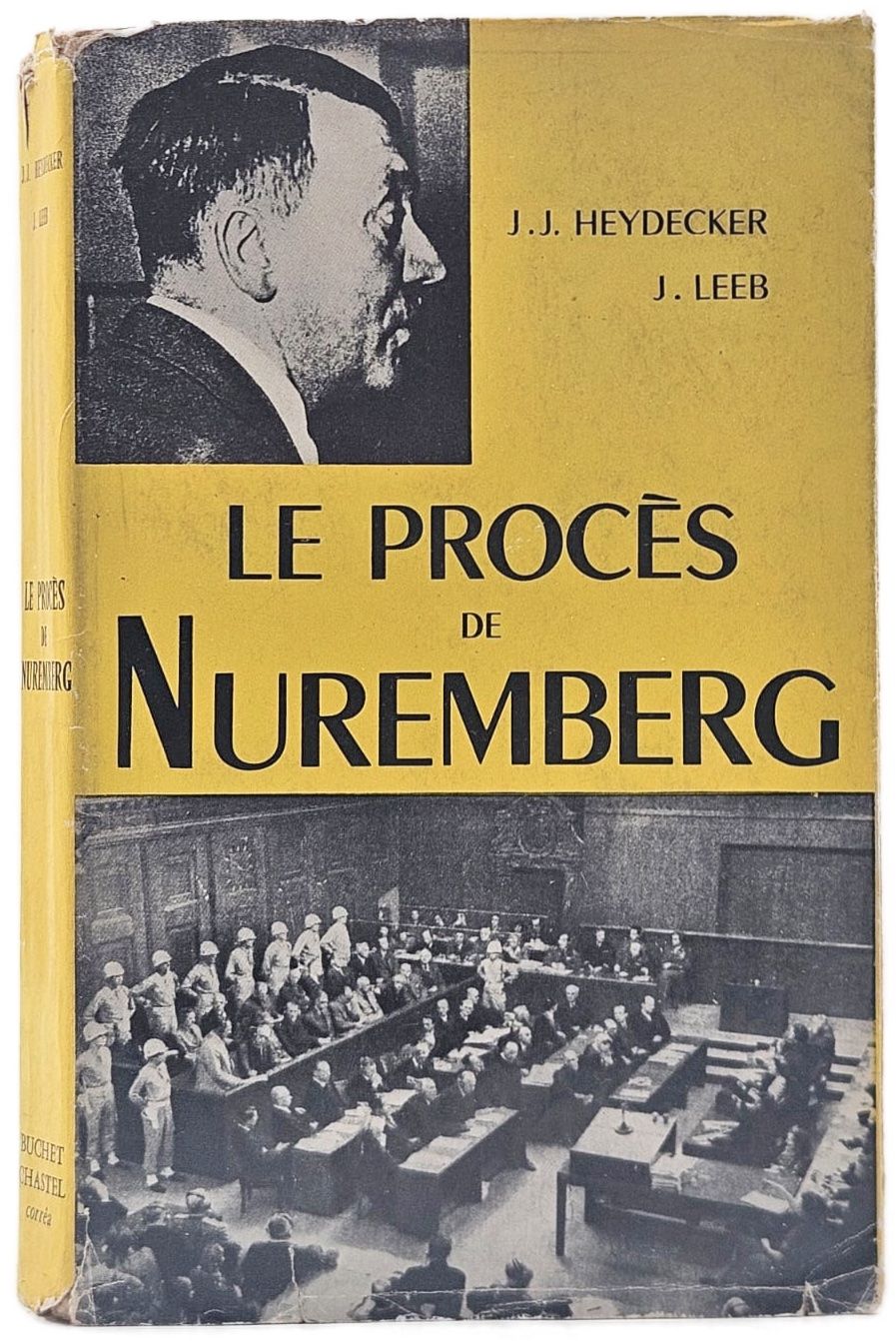
The Nuremberg Trials - Contemporary Documentation of the Trial and Transcripts of the Interrogations of Nazi War Criminals by Journalists Present in the Courtroom - Le Procès de Nuremberg (The Nuremberg Trials) by the German journalists and researchers Joe J. Heydecker and Johannes Leeb, who were present in the courtroom throughout the proceedings and also documented the internal interrogations of the Nazi war criminals. Published by Buchet/Chastel, Paris, 1959 - First French edition. French translation by Max Roth. Extremely rare. ”On November 20, 1945, the Palace of Justice in Nuremberg resembled a bustling beehive. Two hundred and fifty journalists from around the world crowded into the press gallery, not to mention the British, French, and American war correspondents... Fluorescent tubes cast a cold light, in sharp contrast to the powerful beams of twenty-two spotlights directed toward the judges' bench. The newsreel cameramen faced a demanding day's work. They would require vast quantities of ink and film to cover the greatest trial in history. The defendants, seated in two rows on long wooden benches, converse among themselves or with their defense counsel. The dock faces the judges' bench, behind which, suspended between the tall windows, hang the flags of the United States, Great Britain, France, and Russia. At the foot of the bench sit the court stenographers for the four official languages. The Germans and the Soviets still use the traditional notebook and pencil, while the French and the Anglo-Saxons employ silent stenotype machines. To the right of the defendants' dock... The official record of the proceedings will comprise four million words and fill sixteen thousand pages. The prosecution will submit two thousand six hundred and thirty documents...”. An important work by journalists who were present in the Nuremberg courtroom throughout the proceedings. Heydecker himself was a German journalist and photographer who was conscripted into the Wehrmacht, secretly documented the atrocities of the Warsaw Ghetto, and later attended the Nuremberg Trials in person as a radio correspondent. The authors' intimate familiarity with the documentary evidence and official transcripts enabled them to produce a dramatic account of the historic trial, interweaving the harrowing testimony, the legal strategies of both the prosecution and the defense, and vivid portraits of the leading Nazi war criminals who sat in the dock. The book reproduces the most significant transcripts from the proceedings and presents them in a manner that is both compelling and meticulously documented. Everything is drawn from the most reliable sources and the official archives; every quoted word was actually spoken. The book authentically documents the Nazi war criminals from the moment of their capture, including detailed accounts of how each was apprehended by the Allied forces. Hermann Göring (including transcripts of his interrogations from the very moment of his arrest. Question: ”Are you aware that you are on the list of war criminals?” Göring: ”News to me! I really do not understand why my name would appear on such a list.”), Joachim von Ribbentrop (”Ribbentrop recoiled during the reading of the catalogue of atrocities and crimes against humanity; he turned pale and lost consciousness. No one had realized he was so sensitive...”), Julius Streicher, Hans Fritzsche, Wilhelm Keitel, Alfred Rosenberg, Rudolf Hess, Baldur von Schirach, and others are portrayed not only through their responses during interrogation, their conduct before the Tribunal, and their defense strategies, but also through the reports of the psychiatrists who examined them, the testimony of those who knew them, and the record of their actions from the Reichstag Fire to Hitler's suicide. Among the documents presented before the Tribunal and reproduced here are materials containing explicit statements attributed to Adolf Hitler expressing his intention to commit genocide: ”We shall have to develop a technique for reducing the population. By 'reducing the population, ' I mean the extermination of entire groups—I am speaking of ethnic groups - and I am determined to carry out this work of extermination because it constitutes one of my tasks. Nature is cruel; therefore, we too have the right to be cruel. If I have the right to send the flower of the German nation into the hell of war without sparing blood of immeasurably greater value, then I certainly have the right to exterminate millions of people belonging to an inferior race who multiply like vermin.” (From documents submitted to the Tribunal by the Soviet prosecution.) The transcript of Julius Streicher's interrogation recounts how the interrogator confronted him with his own published words after Streicher claimed that he had been unaware of what had taken place in the Warsaw Ghetto, citing a horrifying document bearing Streicher's own signature.