Bidspirit auction | Issues of Simplicissimus Mocking Winston
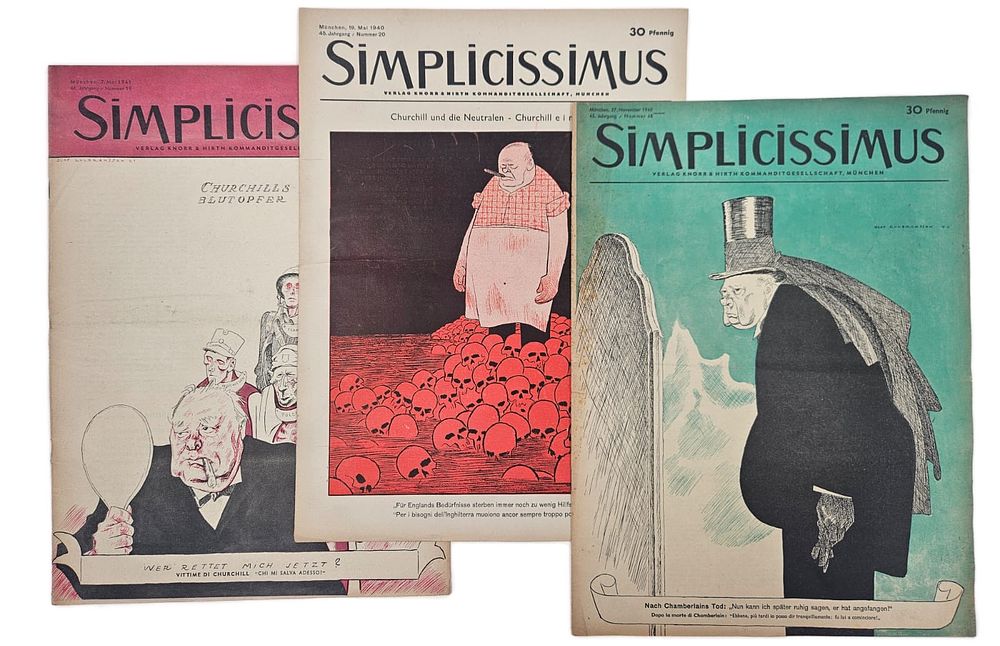
Issues of Simplicissimus Mocking Winston Churchill and Great Britain During the Height of the Second World War - Three issues of the German weekly Simplicissimus (”Quite Simple”), published by Verlag Knorr & Hirth, Munich. The covers and interior pages of all three issues feature cartoons mocking Winston Churchill and Great Britain during the height of the Second World War. By this period, the weekly was entirely under the control of Nazi Party propagandists and served the regime's anti-British propaganda line throughout nearly all of its pages. Issue dated May 19, 1940 - published at the height of the German invasion of France and the Low Countries, and only days after Winston Churchill became Prime Minister of Great Britain (on May 10, 1940). German propaganda exploits the moment of political transition in London and the collapse of the Allied front to portray Churchill both as a ruthless warmonger and as a helpless, bewildered leader. Cover illustration: ”Churchill and the Neutral States.” The foreground depicts Churchill wearing a bloodstained butcher's apron, smoking a cigar, and gazing downward with a cold, indifferent expression. He stands atop an enormous mound of human skulls sinking into a sea of blood. At that very time, the German army had invaded and occupied the neutral countries of Belgium, the Netherlands, and Luxembourg (following the earlier invasions of Denmark and Norway). At the bottom of the cover appears the sarcastic quotation attributed to Churchill: ”Für Englands Bedürfnisse sterben immer noch zu wenig Hilfsvölker!” — ”For England's needs, too few auxiliary peoples are still dying!” Nazi propaganda completely reverses the reality of events: rather than accusing Germany of invading the neutral states, it accuses Churchill and Great Britain of using the smaller nations of Europe as ”cannon fodder” and dragging them to their deaths in the service of the British Empire. Another cartoon on the interior pages, under the title ”The Oracle” (Orakel), depicts three leading British politicians seated on a lawn plucking the petals of daisies in a parody of the familiar ”loves me, loves me not” game, here transformed into a game about victory in the war. Winston Churchill appears on the right; standing behind him is Neville Chamberlain (the outgoing Prime Minister, portrayed as a thin, long-necked, and pathetic figure); on the left sits another British politician, most likely Clement Attlee or another member of the Cabinet. Beneath the illustration appears the caption attributed to them as they pluck the flowers: ”Wir siegen – ein bißchen – ein wenig – oder gar nicht!” - ”We shall win - a little - a bit - or not at all!” The cartoon mocks the helplessness, uncertainty, and lack of confidence of both the old and the new British leadership in the face of the power of the German Blitzkrieg. They are portrayed as having lost control of events, leaving the outcome of the war to chance and pathetic guesswork. On the back cover is another anti-British cartoon continuing the magazine's mockery of Churchill's strategic failures and those of the British Army, this time in connection with the unsuccessful Norwegian campaign. Under the title ”The Return from Norway, ” wounded British soldiers are shown dejectedly disembarking from a ship as they return to Britain following their defeat in Norway. In the background, a crowd of anxious British civilians watches them. At the bottom of the illustration appears the soldiers' sarcastic remark: ”Mit einem wärmeren Kriegsschauplatz wären wir schon einverstanden, aber wie will's der Churchill machen, daß dort keine Germans sind?” - ”We wouldn't mind a warmer theater of war, but how is Churchill going to make sure there won't be any Germans there?” The cartoon ridicules both the British mentality and Churchill, who is portrayed as promising the public and the army a more favorable theater of operations (an allusion to British plans to open new fronts, whether in the Mediterranean or elsewhere). The Nazi propagandists' message is that British soldiers are afraid to face the German army; they would gladly fight anywhere else, provided Churchill could somehow guarantee that the Germans would not appear there as well and defeat them again. The remainder of the issue contains German morale-boosting poems and additional anti-British articles. Issue dated May 7, 1941. The cover illustration, under the title ”Churchill's Blood Sacrifices, ” depicts Winston Churchill, recognizable by his trademark cigar, looking into a mirror while behind him stretches a long line of terrifying skeletal figures dressed in military uniforms. Each skeleton represents a different European country that had been conquered by Nazi Germany after relying on Britain's promises of assistance or alliance. Hanging from the skeletons' necks are placards bearing the names of the countries: Poland (Polen), Norway (Norwegen), France (Frankreich), Holland (Holland), Belgium (Belgien),