Bidspirit auction | Press Photograph of the Capture
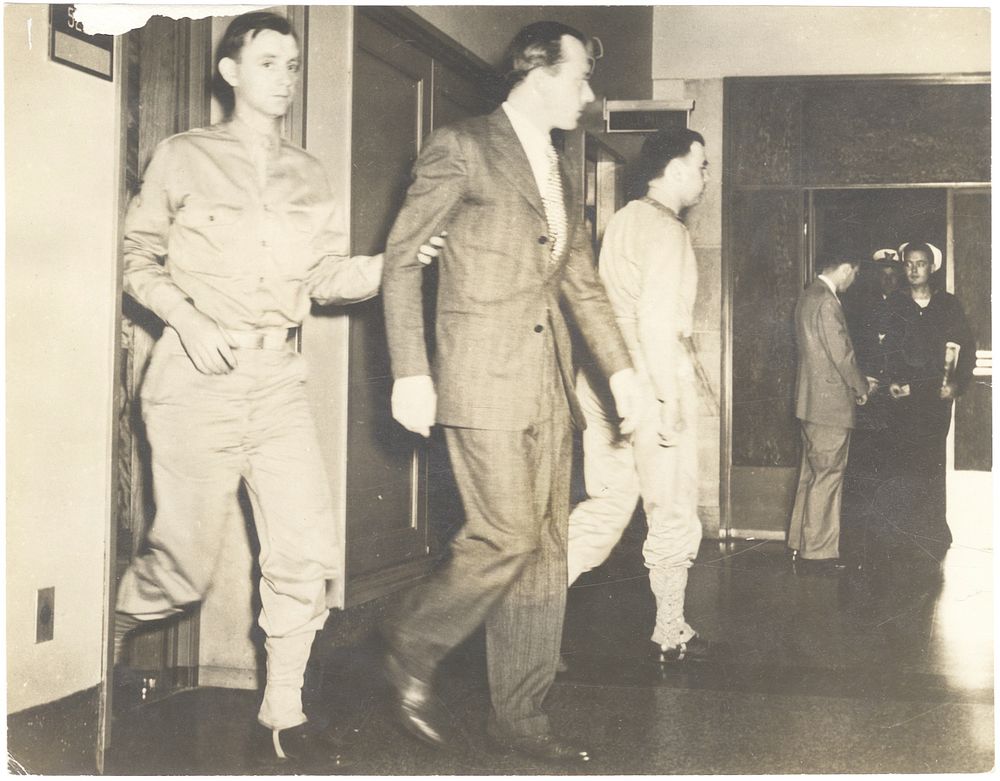
Press Photograph of the Capture of Nazi Spy Heinrich Harm Heinke Prior to His Execution - October 1942 - Press photograph of the capture of the Nazi spy Heinrich Harm Heinck prior to his trial and execution in the United States. Heinck was one of the eight Nazi agents who organized a mission to sabotage the American war industry following the United States' entry into the war, in what became known as Operation Pastorius, which ultimately failed. The photograph is dated October 4, 1942. (Heinrich Harm Heinck had been executed in the electric chair approximately two months before the date stamped on the photograph, on August 8, 1942. The date shown is the day on which the military censors authorized public disclosure of the affair.) Photograph depicting Heinrich Harm Heinck, aged 35 at the time it was taken. Heinck was a German citizen who had previously lived in the United States. He was recruited by the Abwehr (German military intelligence) and sent back to America to carry out acts of strategic sabotage against factories, railroads, and civilian infrastructure. He was captured and subsequently executed. The photograph was taken on the fifth floor of the U.S. Department of Justice Building in Washington, D.C., where the courtroom had been established. On the reverse, an attached news agency caption reads: ”NAZI SEES MEN WHOSE TESTIMONY MAY DOOM HIM.” Heinck is photographed at the precise moment he looks toward members of the United States Coast Guard (visible in the background on the right, wearing sailors' uniforms) as they enter the courtroom to testify against him. (The editor's note states that Heinck and the seven other Nazi agents were tried before a special military commission of seven generals appointed by President Roosevelt.) Operation Pastorius: Following the Japanese attack on Pearl Harbor on December 7, 1941, Germany's declaration of war against the United States four days later, and the subsequent American declaration of war on Germany, Hitler authorized a mission to sabotage the American war effort and attack civilian targets in order to undermine the morale of the American population within the United States. The mission was entrusted to Admiral Wilhelm Canaris, head of the Abwehr, Germany's military intelligence service. Eight operatives were selected for the operation. All were German citizens who had previously lived in the United States, were familiar with the language and culture, and had been recruited by the Abwehr. Under Operation Pastorius, they were dispatched to cripple the American war industry by destroying factories, power stations, railroad lines, and strategic bridges. In June 1942, two German submarines secretly landed the eight agents - four on the coast of Long Island, New York, and four on the coast of Florida. They came ashore carrying large quantities of explosives, timing devices, cash, and forged identity documents. Within days, however, the entire operation collapsed because of a human factor. The leader of one of the landing teams, George Dasch, feared for his life and decided to betray the mission. He traveled to Washington, contacted the FBI, and surrendered himself along with the entire network. Within only two weeks, all eight agents had been arrested by the American authorities before they had succeeded in carrying out a single act of sabotage. To prevent the affair from becoming public while it was unfolding and to ensure swift capital punishment, President Roosevelt established a special military commission of seven generals to try the defendants behind closed doors. The trial was conducted with remarkable speed. Six of the eight agents (including Heinrich Harm Heinck) were sentenced to death and executed in the electric chair in August 1942. The two agents who cooperated with the investigation (including Dasch) were spared execution, received lengthy prison sentences, and were deported back to Germany after the war. 20×16 cm. Minor surface loss in the upper left corner of the photograph. Good condition.