Bidspirit auction | Six Photographs from the Nazi
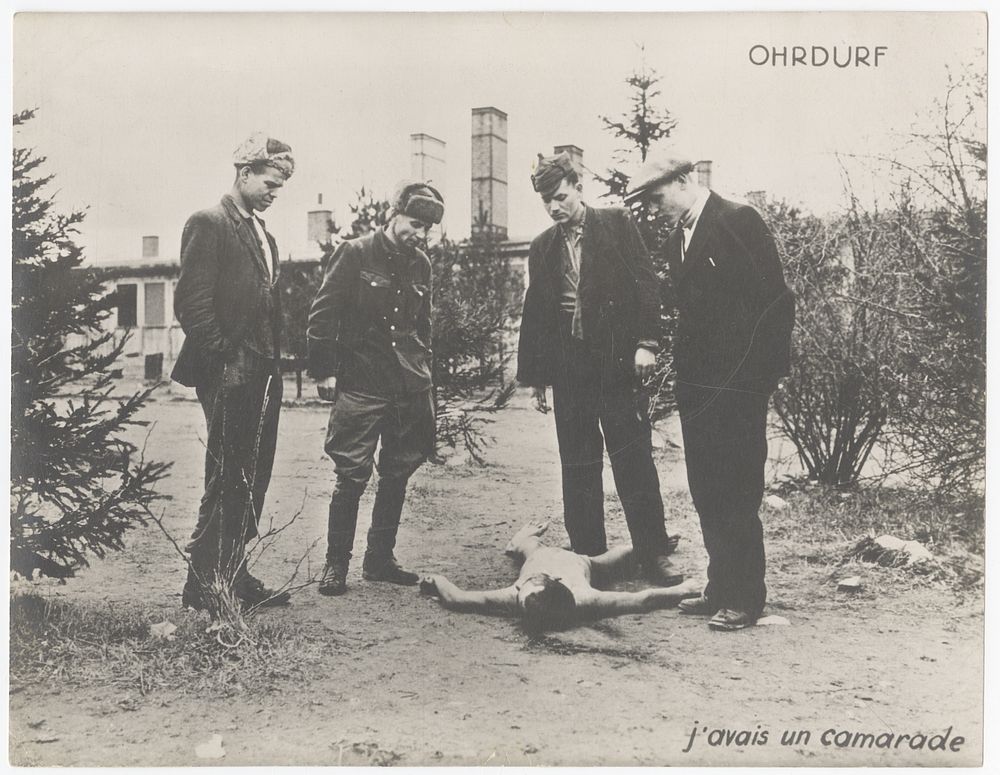
Six Photographs from the Nazi Death Camps Taken by the Allied Forces at the End of the Second World War - Six harsh photos taken in the Nazi death camps at the time of their liberation by the Allied forces, some bearing the ink stamp of the Ministère de l'Information on the reverse. Germany, 1945. Photographs: Bodies of victims at Bergen-Belsen Concentration Camp (two photographs). Bergen-Belsen Concentration Camp, in Germany, was not originally designed as an extermination camp with gas chambers, but toward the end of the war it became a vast death trap characterized by starvation, neglect, and rampant typhus epidemics. During late 1944 and the first half of 1945, the Nazis crowded tens of thousands of prisoners evacuated on death marches from camps farther east into Bergen-Belsen, resulting in the complete collapse of the camp's infrastructure and the deaths of tens of thousands of people. On April 15, 1945, the camp was liberated by the British Army's 11th Armoured Division. Bodies of victims lying on the ground at Ohrdruf Camp. As American forces approached at the end of March and the beginning of April 1945, the SS began hastily evacuating prisoners on death marches toward the main camp at Buchenwald. During the evacuation, intended in part to conceal evidence of Nazi crimes, the guards murdered hundreds of prisoners who were too ill or too exhausted to continue marching. Bodies of victims of the Gardelegen Massacre. April 1945. As Allied forces advanced deeper into Germany, approximately 4,000 prisoners from the Dora-Mittelbau and Hannover-Stöcken concentration camps were evacuated on death marches and by freight train. When Allied air raids disabled the railway lines near the town of Gardelegen in Saxony-Anhalt, more than 1,000 prisoners—most of them Poles, Russians, Frenchmen, and Jews—were stranded there. Local SS personnel, together with members of the Volkssturm (German civilian militia), the Hitler Youth, and Luftwaffe guards, gathered the exhausted and starving prisoners in a military compound. On April 13, 1945, only hours before the arrival of the U.S. Army, the Nazi commanders murdered the prisoners to prevent them from serving as witnesses to their crimes. A total of 1,016 prisoners were forced at gunpoint into a large brick-and-timber barn (Isenschnibbe). The guards locked the heavy doors from the outside, piled fuel-soaked straw around the structure, and set it on fire. American soldiers helping a young female prisoner stand on her feet at Penig Camp. Penig Camp, located in Saxony, Germany, was a subcamp of Buchenwald Concentration Camp (later administered under Flossenbürg). It was the first women's camp liberated by the United States Army, exposing conditions of extreme starvation and severe medical neglect. The body of a prisoner murdered at Leipzig-Thekla Camp following the Barn Massacre. Leipzig-Thekla Camp, located in Saxony, Germany, was a major subcamp of Buchenwald Concentration Camp. In mid-April 1945, as the U.S. Army approached, the SS evacuated most of the prisoners on brutal death marches. The camp's most horrific crime occurred on April 18, 1945, only days before liberation, when the Nazis gathered approximately 300 sick, weak, and exhausted prisoners who were unable to march, locked them inside a large barracks, and set it ablaze using flamethrowers and incendiary materials. The liberation photographs taken by the U.S. Army's photographic units played a decisive role in shaping the collective visual memory of the Holocaust. The decision to send military photographers into the camps to document the atrocities served two principal objectives pursued by the Allied powers. First, to reveal the crimes of the Nazi regime to the public, thereby justifying the total wartime mobilization and the immense sacrifices demanded by the war. Second, and no less importantly, to gather as much evidence as possible for the prosecution of Nazi war criminals in the trials held after the war. This visual documentation was indeed introduced by the prosecution and became a significant factor in securing the convictions of the defendants. Following the trials, the Allied authorities distributed these photographs among the German population so that they would confront the atrocities committed by their own people in the name of Nazi ideology, reinforcing the enduring message: Never Again! Uniform size: 23 × 17 cm. Very good condition.