Bidspirit auction | ”Telegram” Addressed to the Archbishop
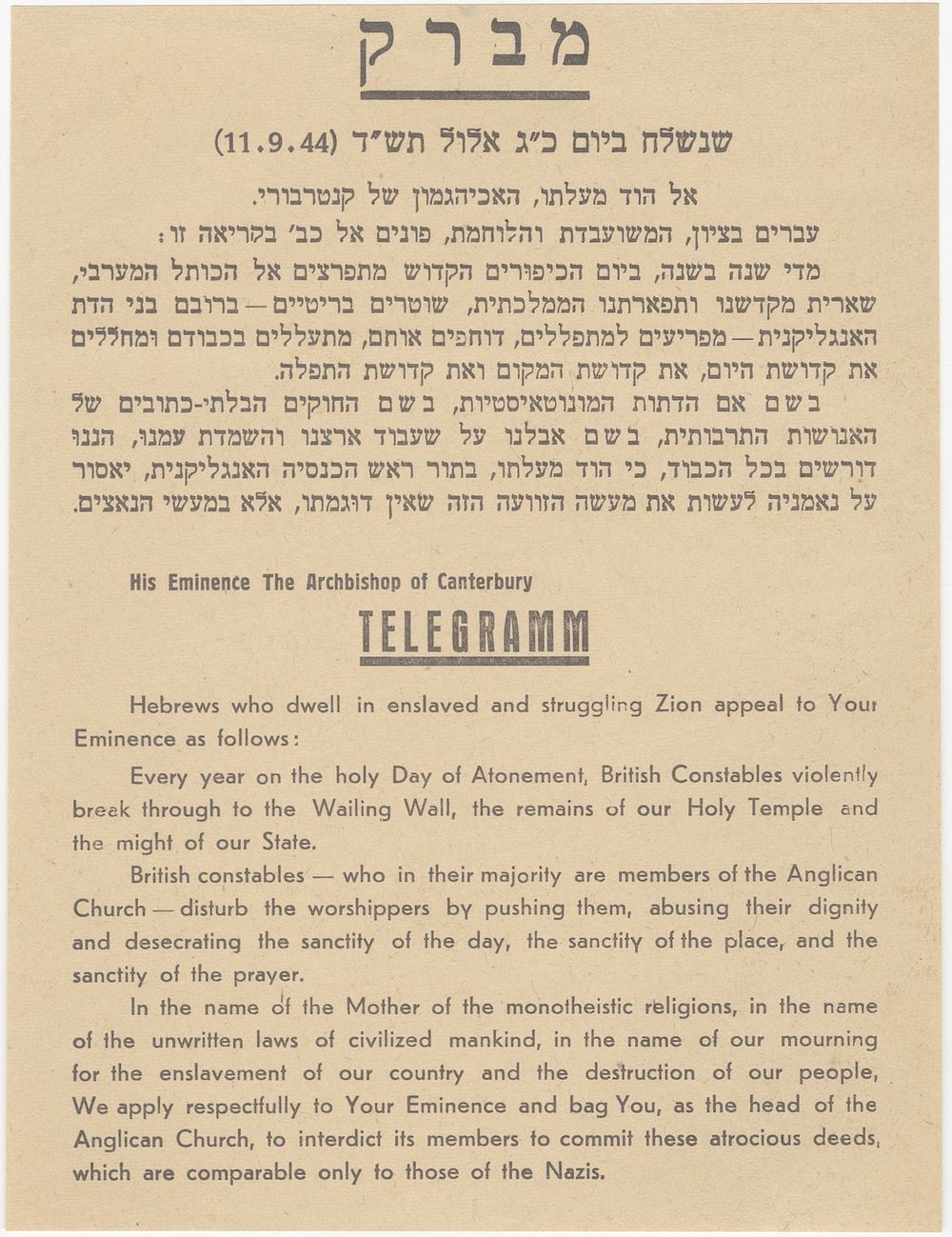
”Telegram” Addressed to the Archbishop of Canterbury Urging Him to Forbid Christian British Policemen from Entering the Western Wall Plaza During Yom Kippur - ”Telegram Sent on the 23rd of Elul, 5704” – Rare broadside designed in the form of a TELEGRAM, addressed to the Archbishop of Canterbury, head of the Anglican Church in London, calling upon him to forbid British policemen of the Anglican faith from participating in violent incursions into the Western Wall Plaza during Yom Kippur. September 11, 1944. Hebrew and English. Rare. The broadside is addressed ”To His Grace, the Archbishop of Canterbury, ” in the name of ”The Hebrews in Zion, Enslaved and Fighting”, a designation used by the Jewish underground movements, particularly the Irgun (Etzel), which was actively engaged in armed resistance against the British Mandate that year. It constitutes a forceful protest against the conduct of the British police at the Western Wall. According to the text, every year on Yom Kippur British policemen, most of them members of the Anglican Church - ”burst into the Western Wall, the remnant of our Temple and the glory of our ancient kingdom, ” pushing Jewish worshippers, violating their dignity, and desecrating the sanctity of the day, the holy place, and the prayers. Invoking the principles of the monotheistic religions, the laws of humanity, and mourning over both the subjugation of the Land of Israel and the destruction of the Jewish people (against the backdrop of the Holocaust then unfolding in Europe), the authors appeal to the Archbishop, in his capacity as head of the Anglican Church, to forbid his faithful and the policemen under his spiritual authority from committing ”this shocking act, unparalleled except in the deeds of the Nazis.” Beginning in the late 1920s (particularly after the 1929 Palestine riots), the British authorities imposed increasingly restrictive and discriminatory regulations at the Western Wall in an effort to appease the Supreme Muslim Council. Jews were prohibited from erecting a partition between men and women, bringing benches or Torah arks to the site, and, most notably, from sounding the shofar at the conclusion of Yom Kippur. The ban on the shofar came to be regarded by the Jewish community and the Zionist movement as a profound national and religious humiliation. Beginning in 1930, members of the Betar youth movement and the Jewish underground organizations secretly smuggled shofars into the Western Wall plaza each Yom Kippur and sounded them publicly at the conclusion of the prayers. In response, armed British policemen would violently force their way into the crowd during the holy day or immediately afterward in an effort to arrest those who had sounded the shofar, confiscate the instruments, and disperse the gathering. The present ”telegram, ” sent in September 1944 - only days before Yom Kippur of that year, formed part of a sophisticated campaign of psychological and public diplomacy conducted by the Hebrew underground. Rather than addressing the military authorities of the Mandate government in Palestine, the organization deliberately appealed directly to the highest spiritual authority of the British Empire in London. The striking comparison to Nazi atrocities was intended to shock British and international public opinion, while underscoring the irony that Britain was itself then at war with Nazi Germany. The message sought to make clear that the Jewish community in the Land of Israel would no longer tolerate the desecration of its holiest site in its own homeland. [1] leaf. 20 × 15 cm. Very good condition.