Bidspirit auction | Medical Laboratory Mortar from the
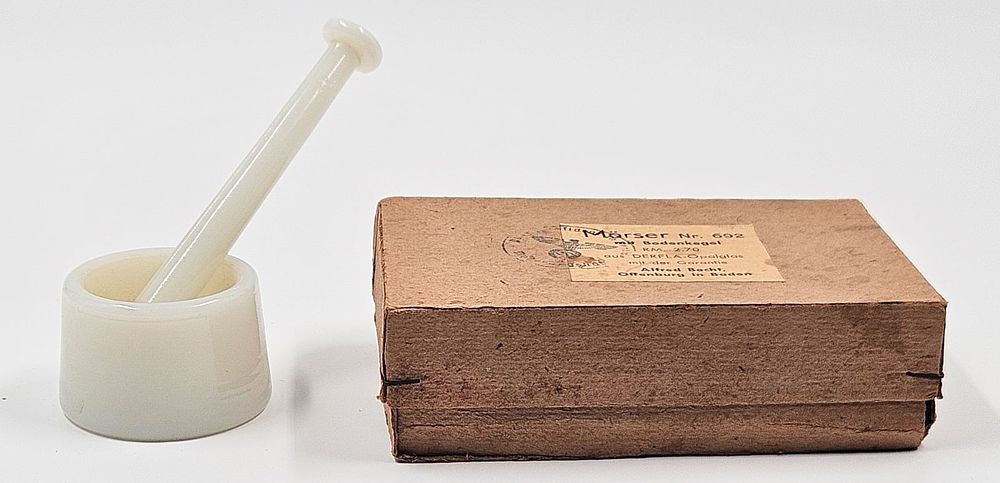
Medical Laboratory Mortar from the Chełmno Extermination Camp - Medical laboratory mortar used by SS physicians at the Chełmno Extermination Camp. Chełmno, early 1940s. Laboratory mortar (Mörser), no. 692, with a conical base (mit Bodenkegel), made of opal glass (milk glass) by the DERFLA brand. Manufactured by Alfred Becht, a long-established producer of medical and dental equipment based in Offenburg, Baden, Germany. The original box bears a circular Nazi ink stamp featuring the Reich eagle clutching a swastika, together with the words ”Dienststelle ... Berlin” (”Office/Agency ... Berlin”), while the lower portion is stamped ”Musterungsstab” (”Wehrmacht Recruitment and Medical Examination Staff”). The underside of the box bears a circular stamp of the Chełmno Extermination Camp. The stamp features the Reich eagle and swastika, surrounded by the clearly legible Gothic inscription ”Kulmhof”—the German name for the Chełmno Extermination Camp in occupied Poland. The lower part of the stamp reads ”Arbeitslager-Krankenstation” (”Labor Camp Infirmary”). This medical mortar and pestle was used in the camp infirmary by medical personnel who conducted experiments on the bodies of Jewish prisoners. It is a standard laboratory instrument commonly employed in chemical, medical, pharmaceutical, and biological laboratories. The mortar is designed as a deep bowl with thick, durable walls. Its primary function is the crushing, grinding, and pulverizing of solid materials. Through manual grinding, crystals, granules, or coarse solid substances are reduced to a fine, uniform powder. Nazi physicians in the camps conducted numerous experiments involving the poisoning of prisoners and the testing of various drugs and chemical substances on the human body. The mortar was used to grind solid compounds, crystals, or tablets into a fine powder so that they could be dissolved in liquid, injected directly into prisoners, or mixed into their food. It was also used in the preparation of ointments and chemical compounds for burn and inflammation experiments. Some experiments carried out in the camps, including those involving mustard gas or phosphorus at Chełmno, were intended to evaluate methods for treating severe burns and battlefield wounds or to study the effects of caustic substances on the skin. Mortar and pestle were the classic laboratory tools for grinding and blending active chemical powders into a fatty base to produce experimental ointments that were applied to prisoners' wounds. In experiments designed to test the effectiveness of new medicines, such as antibacterial drugs from the sulfonamide group, or, alternatively, to evaluate disinfectants, the mortar was used to grind and mix precise dosages of active compounds before they were administered to prisoners who were ill or who had been deliberately infected with diseases such as typhus or tetanus. In cases involving biological or pathological research, sometimes following the deliberate killing of prisoners selected for particular physical characteristics, laboratory mortars were used together with sterile quartz sand or solvents to grind and homogenize internal organ tissues in order to extract compounds, fluids, or other substances for analysis and further research. The instrument's design allowed considerable physical force to be applied without risk of breakage, while the materials from which it was manufactured were specifically chosen to avoid chemical reactions with the substances being processed and to facilitate cleaning and sterilization. As is well known, the Chełmno (Kulmhof) Extermination Camp, established in December 1941 in occupied Poland, was the first Nazi extermination camp to employ systematic methods of mass murder, primarily through the use of mobile gas vans, in which approximately 150,000 people were murdered, the overwhelming majority of them Jews from the Łódź Ghetto and the surrounding region. Although the camp did not maintain a fully developed laboratory, since nearly all prisoners were murdered immediately upon arrival, with only a small group of forced laborers (Sonderkommando) temporarily kept alive to dispose of the bodies, it did have several physicians who also exploited the continuous flow of victims arriving at the camp for purported ”medical” purposes. Their activities were directed primarily toward providing medical care to the forced laborers in order to prevent epidemics that might disrupt the ongoing killing operations, as well as conducting research intended to benefit the German military. In addition, as noted above, following the deliberate killing of prisoners selected for particular physical characteristics, portions of organs were ground and prepared for transfer for further ”research.” Provenance: The box was evacuated together with crates of medical equipment collected by the retreating German Army as the Red Army approached the camp, and was recovered by the Allied forces at the end of the war.