Bidspirit auction | Shulchan Aruch - The Sacred
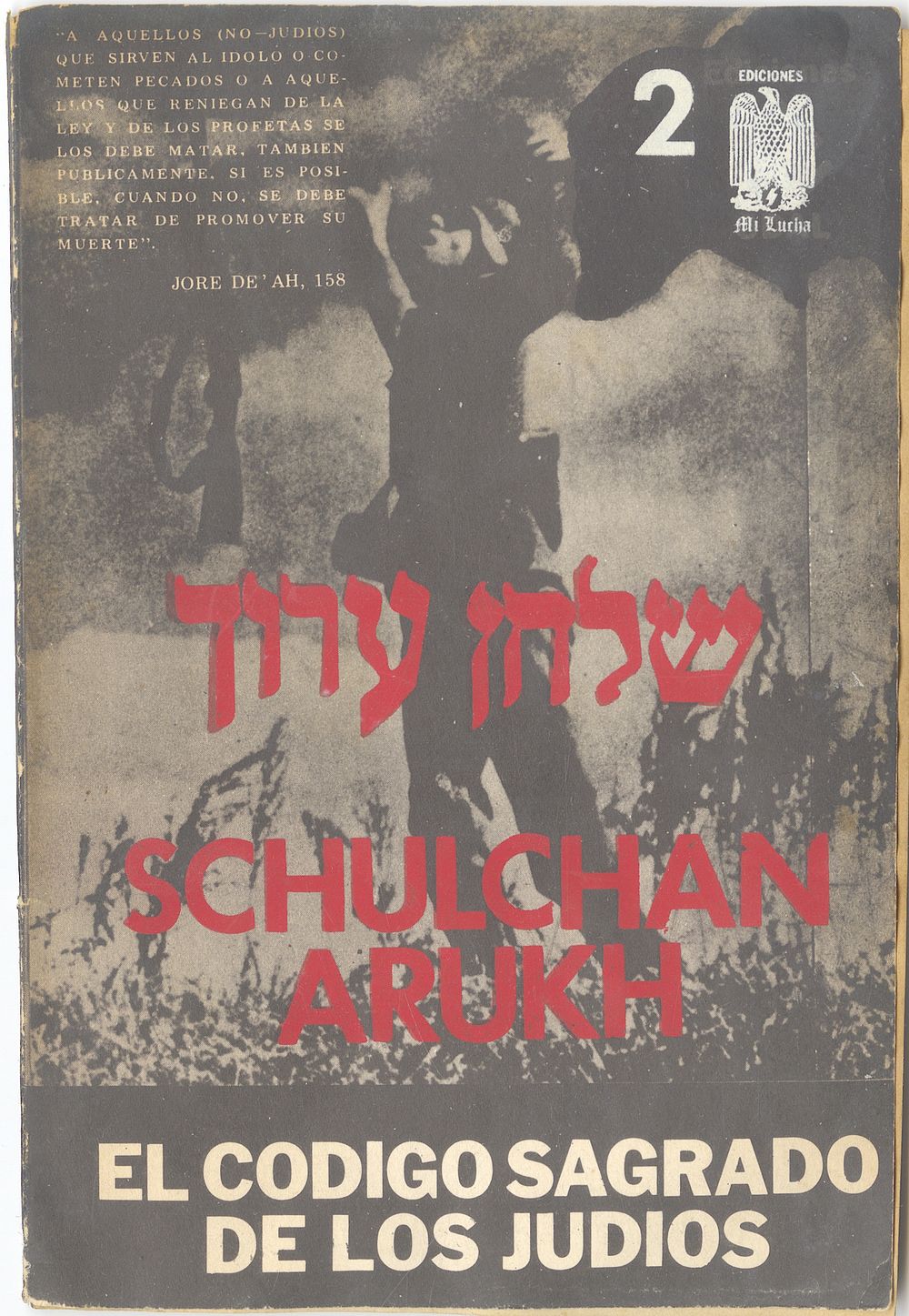
Shulchan Aruch - The Sacred Code of the Jews - Antisemitic Publication Based on the Deliberate Distortion of Jewish Law for Incitement. Buenos Aires, 1977 - ”Schulchan Arukh – El Codigo Sagrado de los Judios” - Shulchan Aruch – The Sacred Code of the Jews - an antisemitic incitement booklet that distorts passages from the Jewish Shulchan Aruch - the Spanish version. Published by Mi Lucha - ”My Struggle” (named after Hitler's book ”Mein Kampf”). Editor: Federico Rivanera Carlés - Argentine journalist and neo-Nazi activist. Buenos Aires - 1977. First Spanish edition, translated by Eva Pardo de la Cruz and Magda Justa Aguilera. Extremely rare. An antisemitic booklet that systematically distorts passages from the ”Shulchan Aruch” and the Talmud, with the aim of portraying Jewish law as ostensibly a racial doctrine, hostile and dangerous toward the nations of the world. At the beginning of the booklet it states: ”The Jew is obliged, when asked about the meaning of any expression in rabbinic literature, to interpret it falsely in order to avoid contributing a true explanation of these expressions to the enrichment of others' knowledge in the interpretation of the Holy Scriptures, because according to the Talmud, the latter are condemned to death.” The methodological approach employed throughout the booklet consists of compiling half-sentences, taking statements out of context, distorted and tendentious translation of Aramaic and Hebrew terms (such as ”worshippers of stars and constellations” or ”Gentiles”), and presenting rabbinic discussions or aggadic passages as binding criminal laws. In order to lend an aura of credibility, it is stated that the quotations in the booklet are taken from the 1929 Leipzig edition of the Shulchan Aruch. Throughout the booklet, the author chose to emphasize passages that ostensibly express instructions to distance oneself from Gentiles, with the aim of inciting the reader to believe that Judaism commands hatred of Gentiles and complete separation from them in every respect. It contains distorted ”explanations” of holidays such as Sukkot, Hanukkah, and Purim. Thus, for example, the story of the Book of Esther and the custom of striking Haman are presented as symbols of Jewish violence and vindictiveness against the nations of the world. The laws of kosher slaughter (the knife, the cutting of the trachea and esophagus) are presented in almost brutally technical detail, as part of the classic antisemitic narrative intended to imbue religious practices with a hostile ritual character. The booklet emphasizes laws concerning relations between Jews and ”idolaters” (worshippers of stars and constellations), presenting them as though Jewish law forbids Jews from litigating in the general judicial system or testifying in favor of a non-Jew. Terms such as ”lending at interest”, ”returning lost property”, and ”informer” are presented in a one-sided manner in order to create the impression that the law described permits fraud or harm against anyone who is not Jewish. Likewise, the booklet presents allegorical descriptions of the wars of the End of Days and miracles as a political-military plan of action by the Jewish people for the destruction of the ”Gentiles” and Christianity. The editor Federico Rivanera Carlés: one of the prominent figures in the neo-Nazi and antisemitic movements in Argentina in the second half of the 20th century. He led extreme right-wing organizations such as the Movimiento Nacional Socialista Argentino and founded the Ediciones Mi Lucha publishing house (named after Adolf Hitler's book, ”Mein Kampf”) - this publishing house used the original symbol of the Nazi swastika. The booklet was published as part of a propaganda series intended to disseminate Spanish-language neo-Nazi ideology in South America. The series attempted to present purported ”revelations” about Judaism, Zionism, and Marxism in order to warn the Latin American public against a ”Jewish takeover”, making absurd use of omissions, abbreviations, and substitutions of terms (such as ”idolater”, ”Gentile”, ”Samaritan”, ”apostate”) to make it easier for the uninitiated reader to draw a connection between Jewish law and modern racial propaganda. The booklet is not an original work, but rather an adaptation of a tradition of German antisemitic propaganda whose roots lie in the late 19th century and the Nazi period, during which antisemitic agitators in Germany published booklets claiming that the ”Shulchan Aruch” contains secret commandments to harm non-Jews. Among those on whose work the booklet is based is Hermann Schröer - an editor at the Institute for the Study of the Jewish Question in Nazi Germany. His 1936 work (Blut und Geld im Judentum - ”Blood and Money in Judaism”) served as a principal source for the Argentine text. Extremely rare. Only one copy is listed in the WorldCat global library catalog. 66 pages. Minor wear to the cover. Wear on the pages. Good condition.