Bidspirit auction | ”Sun-Drenched Land of Youth” -
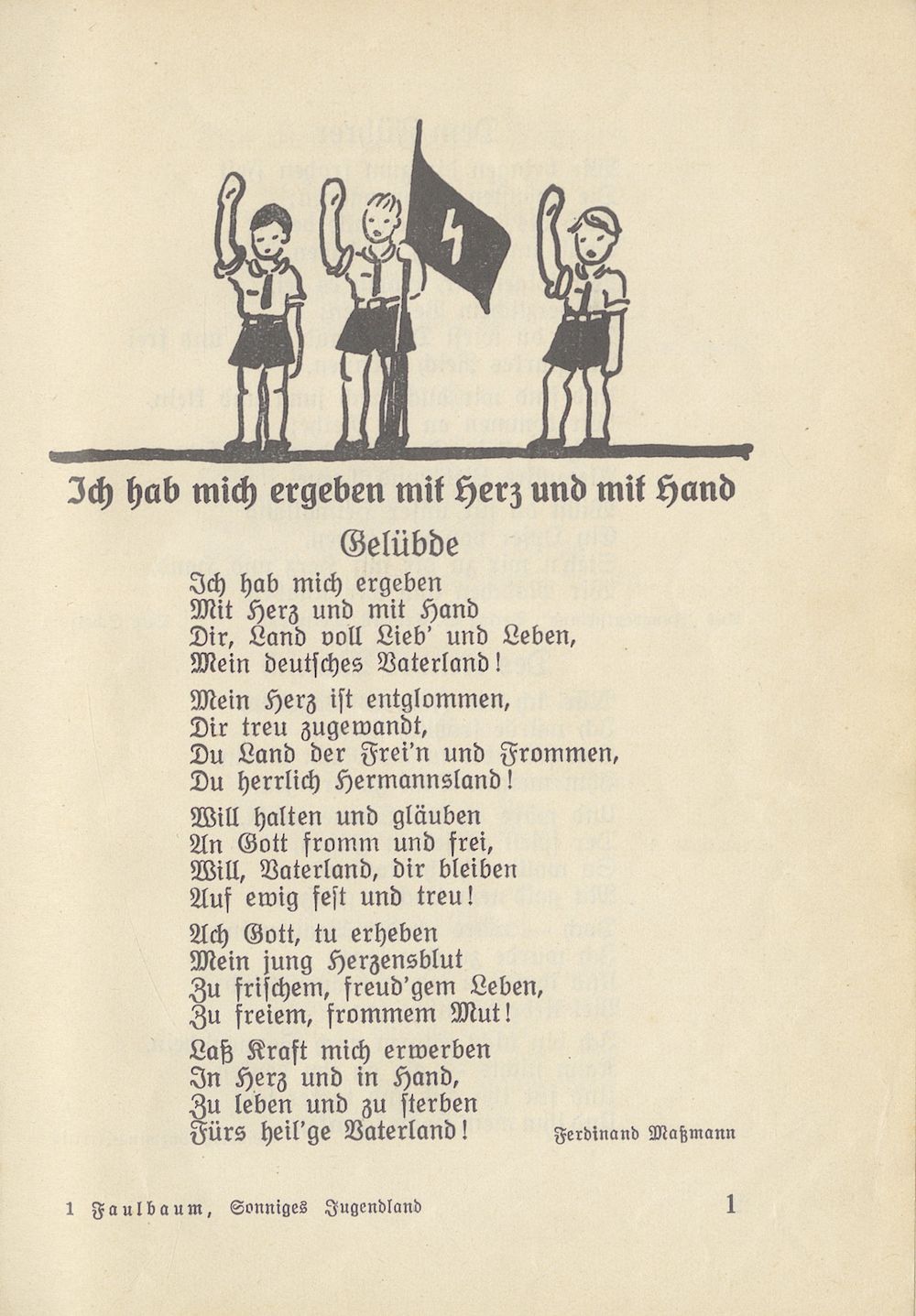
”Sun-Drenched Land of Youth” - Book of Poems for Children in Nazi Germany. Berlin, 1938 - ”If I were the Führer's little bird, I would sing joyfully from the early morning hours until late at night to thank him... I will give him my heart.” Sonniges Jugendland Gedichte, Kinderlieder und Reime zum Vorlesen und Lernen für das 1. und 2. Schuljahr - ”Sun-Drenched Land of Youth: Poems, Children's Songs and Rhymes for Reading Aloud and Learning in the 1st and 2nd School Years” - a book of poetry for children edited by Paul Faulbaum, published by A.W. Zickfeldt in Berlin and Osterwieck - 1938. Rhyming poems for children in Nazi Germany, including songs praising Adolf Hitler and Nazi Germany. Accompanied by illustrations by Erika Haensch-Fiebelkorn. German. A book of children's poems intended for reading and study in elementary school by first- and second-grade pupils in Germany. Although the outer cover presents an innocent illustration of children, a stream, and farm animals, the interior pages demonstrate how German children's literature of that period served as an instrument of Nazi indoctrination and propaganda. Among innocent poems such as ”Helping the Winter Relief Fund” and the poem ”School”, one finds songs of praise for Adolf Hitler, such as ”Dem Führer” - ”The Führer” - ”Nothing in Germany shall be greater than our love and loyalty”, and ”Am Geburtstag des Führers” - ”On the Führer's Birthday” - ”There is one who guides us all, one to whom all thanks are due; one to whom we turn each day, full of love and full of trust. Pray that God may preserve him, our Führer, for many more years!” There are prayers for Adolf Hitler's well-being (”Deutsches Gebet”), and the poem ”The Child's Wish”, expressing blind adoration of the Führer: ”If I were the Führer's little bird, I would sing joyfully from the early morning hours until late at night to thank him... I will give him my heart.” There is also a prayer for Adolf Hitler's success: ”Give strength and power to our Führer in his arduous work!...” Likewise, there are poems glorifying service in Nazi youth organizations, such as the poem ”I Have Pledged Myself with Heart and Hand”, accompanied by an illustration of uniformed children giving the Nazi salute and raising the flag of the Deutsches Jungvolk: ”Let me gain strength in heart and hand to live and die for the sacred Fatherland!” There are also patriotic poems (for first-grade children!) such as: ”Let us grow and become strong upon this earth, so that we may fight for our Germany alongside the Führer.” Poems expressing love for the German homeland include ”Why I Love Germany”. The poem ”I Am a German Child” reads: ”I am a German child (a German girl), I have a true German spirit, and Germany is the name of the land in which I was born. My dear father is German, my mother is German. That is why I so dearly wish to be a German child.” The poem ”Youth Marches” reads: ”The flag flies high, soldiers are coming... Thus the entire army marches, the cannons and weapons of the new Reich. And joyfully, young and old cheer: 'Oh, what a joy it is to be a soldier for the German people and for the Führer!'” And many more. The inculcation of a personality cult and violent nationalism among six- and seven-year-old children - first- and second-grade pupils who had scarcely learned to read - represents one of the most horrifying aspects of the Nazi regime: the theft of the innocent realm of childhood. At an age when a child's mind absorbs reality as it is, without any mechanism of filtering, critical judgment, or political reasoning, traditional children's songs were replaced with songs of hatred, prayers for the leader, and glorification of the willingness to die for the ”Führer” and the Fatherland. By cloaking its destructive ideology in lighthearted rhythms, innocent rhymes, and charming illustrations, the regime succeeded in instilling fascism as a natural, self-evident, and almost religious reality, thereby turning the young generation of the future into disciplined, obedient individuals, blind to injustice, even before they had learned to distinguish between good and evil. VII, 144 pages. Minor wear to the cover. Stains on some of the pages. Good condition.