Bidspirit auction | Adolf Hitler: A Path Forged
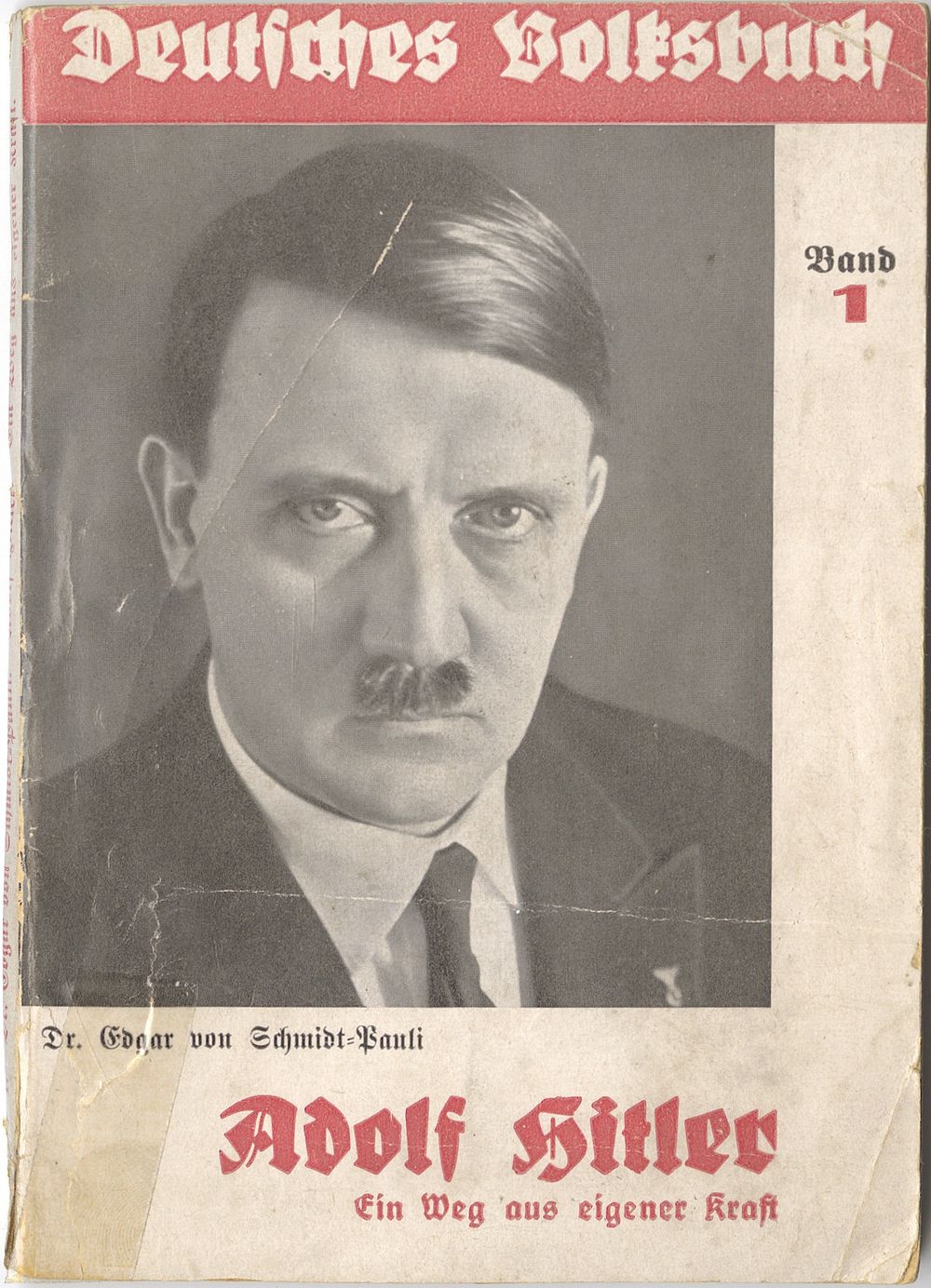
Adolf Hitler: A Path Forged by His Own Strength - The Official Biography Glorifying the Führer upon His Assumption of Power in 1933 - ”Adolf Hitler: Ein Weg aus eigener Kraft” - ”Adolf Hitler: A Path Forged by His Own Strength” - a biography of Adolf Hitler as part of the construction of the Führer's personality cult upon his rise to power, by Dr. Edgar von Schmidt-Pauli - a publication distributed in Nazi Germany in 1933. Published by Verlag Deutsches Volksbuch G.m.b.H. Berlin, August 1933. Rare. ”This book is intended for the overwhelming majority of Germany's citizens. It is intended to convey an impression of the great German man Adolf Hitler and of his life's work thus far, which, with impassioned momentum, is sweeping an entire people from the depths of confusion and subjugation to the heights of German clarity and German liberation. Hitler is no field marshal. He is no conqueror of worlds by the sword. He does not seize imperial glory. He imposes nothing from above. He ignites Germany from below. With a torch, he mines the shaft of the German people's soul. He is the passion of the people incarnate in flesh and blood. He leads and shows the way, yet he is inseparably bound to the national identity. Before the national flame burning here, everything that is not German, genuine, filled with faith, and prepared for the future melts away. This fire, rising from the depths of German existence, cannot be extinguished by any November storm. It may encounter hostile forces from without. But they, too, will be extinguished...” (From the introduction). A biography of Adolf Hitler as published in Germany shortly after he came to power. The biography presents a systematic and carefully constructed propaganda narrative tracing Hitler's political development from its beginnings and the Nazi Party's rise to power. Throughout the book, Hitler is portrayed as a fearless hero sent by Divine Providence to save Germany. Throughout the book appear statements such as: ”Hitler's combative nature fully embraced Germany's defensive struggle”, or, for example: ”When Hitler sees the opportunity to prove his love for his German people through deeds, he falls to his knees in fervor”, ”Hitler was a soldier in every sense of the word; he was extraordinarily courageous.” ”Adolf Hitler walked this path alone. No one helped him but his own will. No one guided him but the star within his breast.” In the introduction and the opening chapters, the German yearning, sense of frustration, and search for a legendary savior in Germany after World War I are presented. Hitler's early years are described with blind admiration - from his pursuit of art in Munich to his military service and fighting on the Western Front in World War I, in a chapter intended to portray him as a courageous soldier sacrificing himself for the Fatherland. With the end of the war and the outbreak of the German Revolution, the book proceeds to survey Hitler's first political steps and the founding of the Nazi Party, tracing its growth from a marginal sect into a broad national movement. The culmination of this period is described in the attempted putsch of November 1923 in Munich, which is presented as a laudable national uprising. Within this context, attention is devoted to the well-known incident in which Hitler fired into the ceiling of the beer hall in order to impose his leadership, and subsequently to his highly publicized trial before the People's Court, a trial that became for him a major propaganda platform from which he expounded his doctrine before the nation. The next part of the biography deals with the restoration and rebuilding of the Party following Hitler's release from prison, emphasizing the development of its well-oiled propaganda apparatus, the staging of mass rallies, and the relentless struggle against public apathy and political rivals in the streets. At the climax of the book, the author describes the awakening of the German nation and its fervent march toward the political decision, focusing on the events of the year of struggle, 1932, during which tense and violence-ridden election campaigns were held. The biography focuses in particular on the chapter devoted to the political victory and Hitler's appointment as Chancellor in early 1933, and concludes with remarks presenting the seizure of power as the historical fulfillment of the will of the people and the beginning of a new and glorious era for Germany. The book, published in August 1933 under the title ”A Path Forged by His Own Strength” (Ein Weg aus eigener Kraft), was intended to instill in the general public the myth of the ”Führer”: a man who emerged from among the people, made himself through his own efforts without the assistance of the old elites, and sacrificed himself for the German nation. Biographies of this kind were very widely distributed in order to bring Hitler's personality cult into every home in Germany immediately after the seizure of power. The author, Dr.