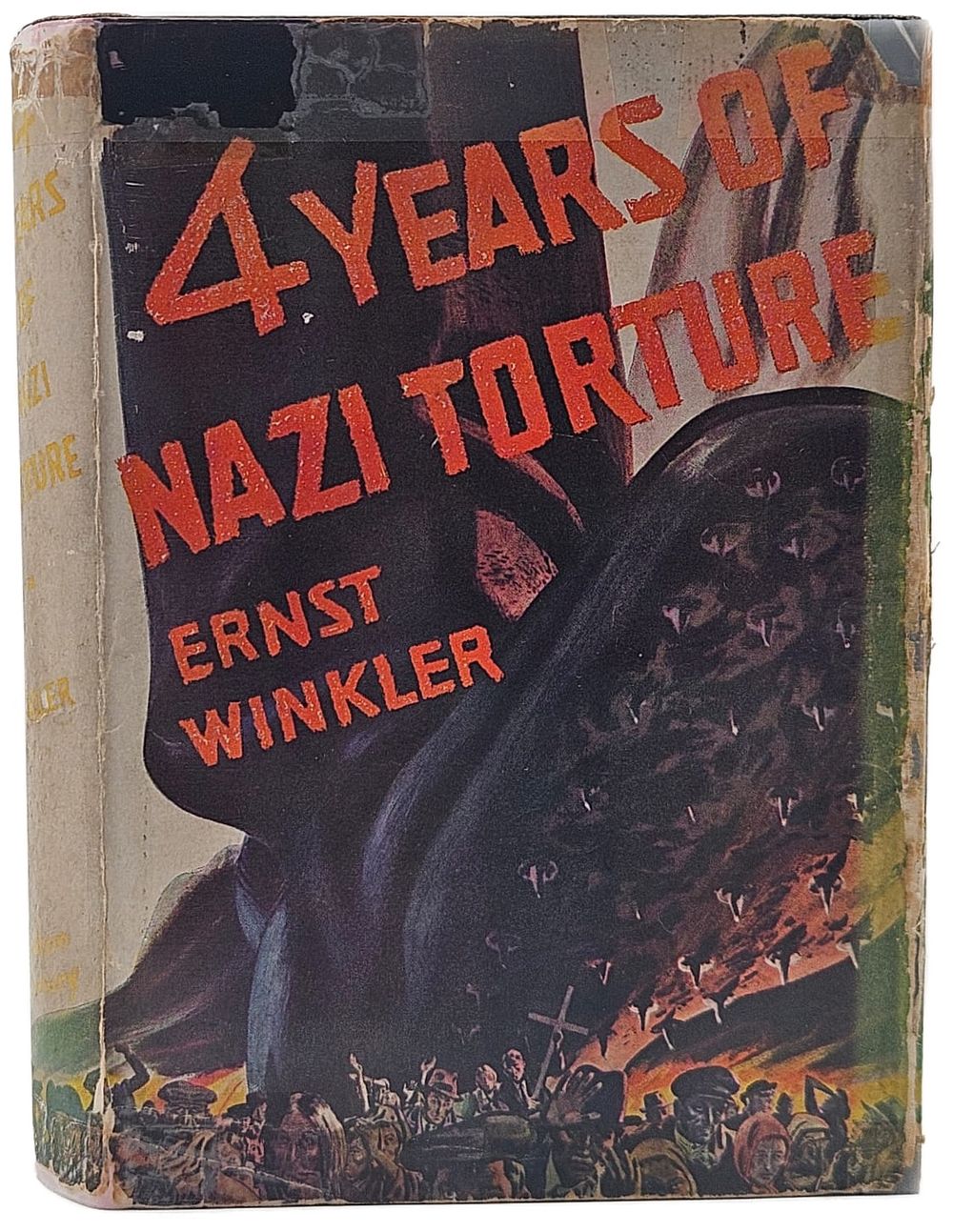
Bidspirit auction | Four Years of Nazi Torture.
Four Years of Nazi Torture. New York and London - 1942 - First Edition - Copy Inscribed and Signed by the Author - ”The trucks returned with a tragic cargo - one hundred Jewish boys and men whose faces already bore the marks of Nazi whips and Nazi fists...” - ”Four Years of Nazi Torture” - a testimony on Nazi crimes published at the height of World War II. New York and London, published by D. Appleton-Century, 1942 - first edition - copy inscribed and signed by the author. Writing under the pseudonym Ernst Winkler, the author recounts in detail the difficult years he endured under Nazi torture after refusing to swear allegiance to Adolf Hitler. A fascinating and incisive testimony by Ernst Winkler (a pseudonym), a former officer and pilot in the army of the Weimar Republic, recounting his persecution, arrest, and survival through four years of imprisonment and torture at the hands of the Gestapo and the Nazi apparatus of terror. When the Nazi regime came to power in 1933, Winkler refused to swear allegiance to Adolf Hitler or resume his military service, out of fidelity to his conscience and his Roman Catholic faith. He withdrew from military service and joined the leadership of the Catholic Youth Movement - a movement that during those years served as a center of spiritual and ideological resistance to the Nazi regime's attempts to gain control over Germany's youth. In 1934, Winkler was arrested by the Gestapo and imprisoned in a series of early concentration camps and heavily guarded prisons - including the Esterwegen, Moringen, and Dachau camps. During his four years of imprisonment (1934–1938), he was subjected to severe torture, brutal interrogations, and extreme physical violence, which he describes in his book. Throughout his imprisonment, the Nazis attempted by various means to extract from him a confession concerning anti-Nazi activities in which he had been involved in the early 1930s, but despite all the suffering and torture he endured, he did not break. At Dachau, he witnessed the torture and execution of Jews who arrived at the camp in several transports. On one occasion, he witnessed a group of Jews arriving at the camp after having been subjected to abuse: ”During the night, five trucks loaded with storm troopers went out through the main gate to spread terror through the countryside. By the middle of the following afternoon, the trucks returned with a tragic cargo - one hundred Jewish boys and men whose faces already bore the marks of Nazi whips and Nazi fists... Something held me spellbound at my window hour after hour. The details of what I saw are too horrible to write, even today. The screams did not cease until sunset. Then, their faces swollen and their backs bleeding, the Jews were herded into the cellar of one of the buildings, where they were locked up for the night.” He also witnessed on several occasions the executions of prominent figures in the Christian Church, and recounts the Gestapo's manipulation of trials against clergymen on false charges, demonstrating how the entire German judicial system had been mobilized in the service of Nazi ideology. False accusations and implicating people in events in which they had never participated were everyday occurrences, as were, of course, the punishments imposed for those acts they had never committed. After his release in 1938, he discovered that his family's circumstances had deteriorated under the influence of Nazi propaganda and that some of his brothers had joined the Party. Winkler went underground and joined active resistance efforts, participating in the operation of mobile clandestine radio stations (”Freedom Broadcasts”) that transmitted anti-Nazi propaganda. As the manhunt for him intensified, he escaped through Switzerland, France, and Spain, eventually arriving in New York with his wife and daughter in late 1941. The book was published in the United States in 1942 (by D. Appleton-Century) and served as an important means of informing the American public, at the height of World War II, about the methods of terror, suppression of religious freedom, and torture employed in the concentration camps of the Third Reich. The name ”Ernst Winkler”, with which he also signed the copy before us, is a pseudonym intended to protect his identity and the members of his family who remained in Europe. In the inscription he wrote: ”To Annie / regards / Ernst Winkler / Jan. 1944”. [6], 200 pages. Hardcover with the original dust jacket featuring an illustration of a Nazi boot trampling a congregation of worshippers. Wear to the dust jacket (minor restoration with pasted paper). Overall good condition.