Bidspirit auction | Olympic Torch Relay - Matchbox
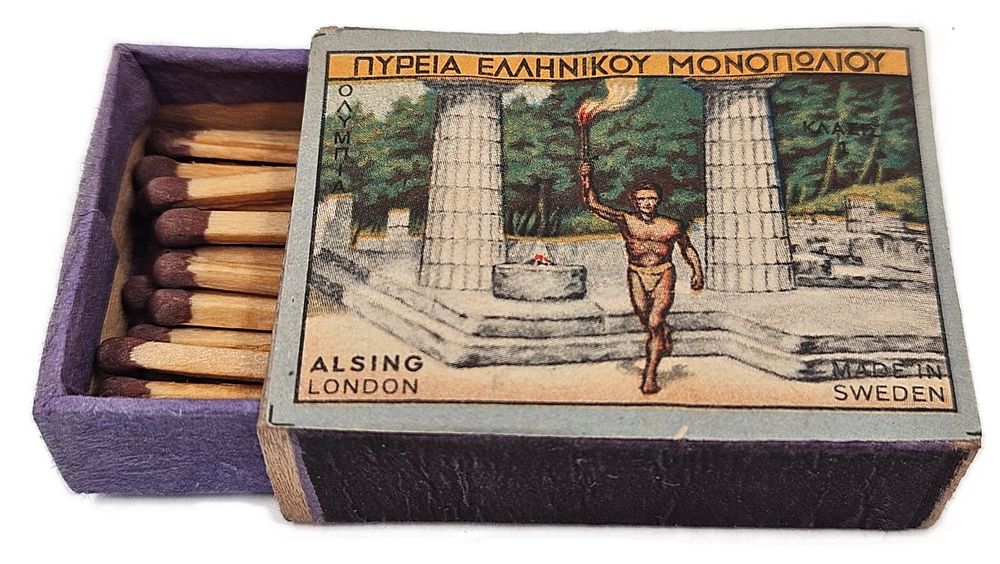
Olympic Torch Relay - Matchbox Issued for the 1936 Olympic Games Held in Nazi Germany - Olympic Torch Relay - Historic matchbox issued by the Greek Match Monopoly especially for the 1936 Berlin Olympic Games held in Nazi Germany. Box full of matches. The illustration depicts Konstantinos Kondylis, the first Greek Olympic torchbearer in the history of the Olympic Games, holding a burning torch against the backdrop of the columns of the temple at ancient Olympia. The ceremony of lighting the torch at Olympia and carrying it in a relay was held for the first time in the summer of 1936 in preparation for the Berlin Games. This version (bearing the inscription ALSING LONDON in the lower left corner) is the first of three versions issued that year. The inscription at the top: ΠΥΡΕΙΑ ΕΛΛΗΝΙΚΟΥ ΜΟΝΟΠΩΛΙΟΥ (”Matches of the Greek Monopoly”). The text on the sides: ΚΛΑΣΙΣ (”Series”) on the right and ΟΛΥΜΠΙΑ (”Olympia”) on the left. At the lower right: MADE IN SWEDEN. At the lower left: ALSING LONDON - the London-based Alsing Trading Co. was the principal international trading and export arm of Swedish match manufacturers to Britain and the Mediterranean countries. The image of a modern torch relay originating in ancient Olympia was introduced for the first time at the Berlin Olympics (1936), and has since become a sporting and cultural icon. The Olympic torch relay, as we know it today, was born in the summer of 1936 in a dramatic gesture linking ancient Greece with the modern arena. The relay was introduced in the modern era by Dr. Carl Diem, Secretary General of the Organizing Committee of the Berlin Olympic Games, and the specially designed torch carried by Kondylis became one of the most powerful, influential, and memorable visual symbols in the history of the Olympic Games held in Nazi Germany. The first runner to inaugurate this historic tradition was Konstantinos Kondylis, a Greek athlete chosen to carry the Olympic flame immediately after it was kindled by focusing the sun's rays with a concave mirror among the ruins of the temple at Olympia. From there, Kondylis set out holding the burning torch, launching an unprecedented relay of approximately 3,000 runners that passed through seven countries and covered more than 3,000 kilometers before reaching the main stadium in Berlin. The route passed through seven countries: Greece, Bulgaria, Yugoslavia, Hungary, Austria, Czechoslovakia, and Germany. Ironically, most of these countries surrendered to or were occupied by Nazi Germany only a few years later. The Nazi regime sought to create a direct link between ancient Greece and the Third Reich. The relay served as a display of diplomatic power and a means of extending influence throughout Central and Eastern Europe. Nazi ideology regarded the classical Greeks as ancient ”Aryans”, and the transfer of the flame from Olympia in Greece to Berlin symbolized, in Nazi eyes, the transfer of the legacy of culture and racial superiority into the hands of Nazi Germany. The regime's filmmaker, Leni Riefenstahl, documented the relay and the lighting of the torch in an aesthetic and dramatic manner in her famous propaganda film Olympia (1938). Approx. 5x3.7x2 cm. Box full of matches. Good condition.