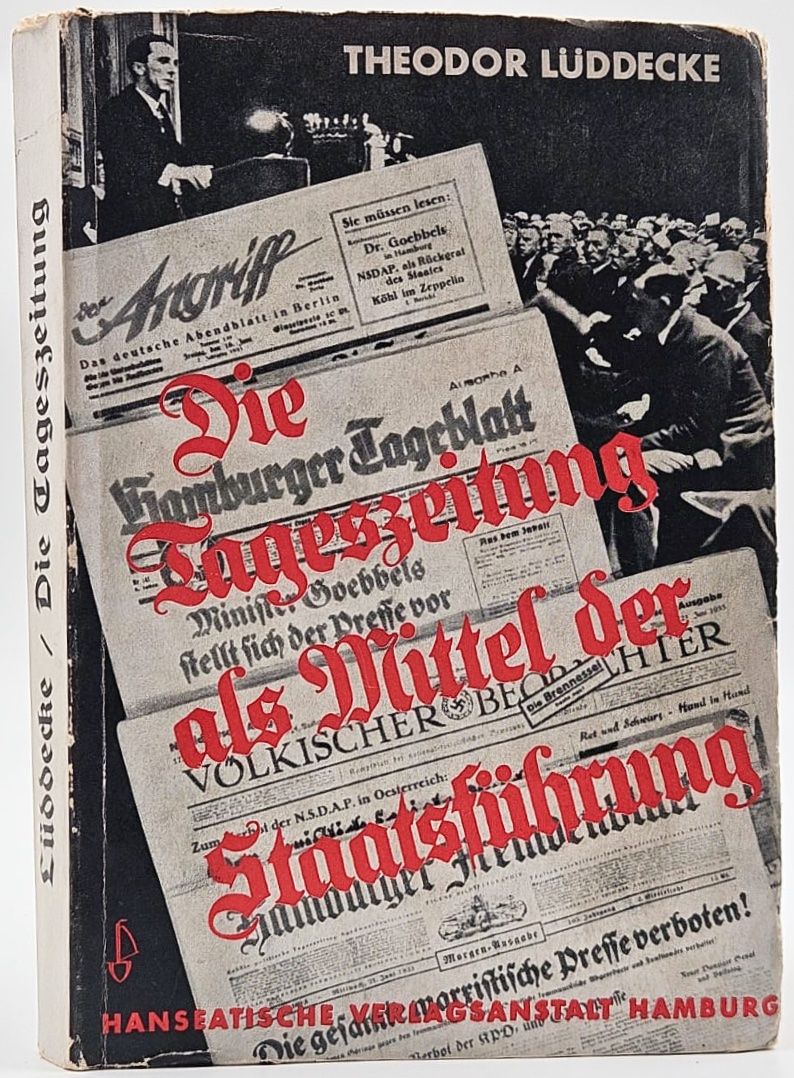
Bidspirit auction | The Daily Newspaper as a
The Daily Newspaper as a Means of Governing the State - Hamburg, 1933 - Copy Inscribed and Signed by the Author - Die Tageszeitung als Mittel der Staatsführung - ”The Daily Newspaper as a Means of Governing the State” - a rare and early publication proposing techniques for controlling mass communications through the daily press, which would shape public opinion in Nazi Germany, by Theodor Lüddecke. Published by Hanseatische Verlagsanstalt Hamburg, Hamburg, 1933 - first edition. Copy inscribed, signed, and dated by the author: ”To my 'elder brother' Gottfried Kessel, as a memento of our shared national struggles ('vaterländische Kämpfe'). Potsdam, December 18, 1942. Theodor Lüddecke.” Extremely rare. ”In the National Socialist state, the press must be integrated into the overall structure of the nation and become an instrument for the modern shaping and control of the masses, placed at the disposal of the state for the realization of its exalted aims. The author sees examples of such a transformation of the press already existing in Italy and Russia. The question of controlling the press is of paramount importance. The connection between the (Propaganda) Ministry and the press must be emphasized and actively shaped so that mass influence can be achieved in the shortest possible time. The aim is no longer merely to inform interested parties or Party members, but rather to work purposefully toward the education of the citizen. The National Socialist conception of a comprehensive state organization necessarily leads the press toward new tasks. All relationships are now undergoing transformation, and it is of the utmost importance that the press, the most powerful force in shaping public opinion and will, be reorganized so decisively that it becomes a reliable pillar of the new state. The purpose of this work is to describe the fundamental features of this reorganization. It will therefore spare anyone directly or indirectly involved with the press many detours and errors” (from the book). A rare and early publication proposing techniques for controlling mass communications and the ways in which the daily press would serve as a central instrument in the hands of the regime for shaping public opinion, disseminating propaganda, and consolidating state power in Nazi Germany. Lüddecke writes explicitly that the German press must be totally harnessed to disseminate the Nazi idea, while abandoning the values of objective reporting and its role as an economic mouthpiece. The press must become activist in shaping public opinion, while recognizing its decisive power to influence the worldview of German citizens. A rare example demonstrating that the mobilization of the press in the service of the Nazi dictatorship was undertaken deliberately and systematically from the very first days after the Party seized power. Regarding the Jews, the author writes that an end must be put to the phenomenon of their regarding themselves as part of Germany, and that only through a strident and unequivocally antisemitic press would they come to understand their true place. As an example, he cites the absurd fact that Jews themselves were selling flags bearing swastikas and Nazi Party paraphernalia, fully confident that, ultimately, they would be integrated into the new Nazi era as part of the German population. This is a reality he seeks to change through the press. In the chapter ”Methods of Manipulation in the Press, ” he explains how ”innocent” advertisements should be integrated with the ideology openly disseminated by the newspaper, in order to implant the message in people's minds almost incidentally. He also explains what the relationship between the newspaper's main headline and its subheadings should be, so that they serve the central message being instilled in the readers. He further writes that new journalists must be trained who will undertake to serve the Nazi idea in their writing over time. He further explains how the Nazi press should create deliberate emotional manipulation - newspaper propaganda should focus on simple, unequivocal, and repetitive messages, with the aim of appealing to emotion rather than reason. The standardization of content across all newspapers in the country would create the psychological impression of unanimous support for the regime. An individual citizen who might harbor reservations would suppress his opinions for fear of social ostracism. The national trauma stemming from the humiliation of the Treaty of Versailles and the economic crisis should be harnessed to present the Nazi regime as the sole solution for restoring pride, order, and national security. Various groups, such as communists, Jews, and political opponents, should be designated as enemies of the state and the public. The construction of the image of the enemy was intended to unite the majority around the regime while dehumanizing those targeted. The author, Theodor Lüddecke, was a German thinker, sociologist, economist,