Bidspirit auction | William L. Shirer - The
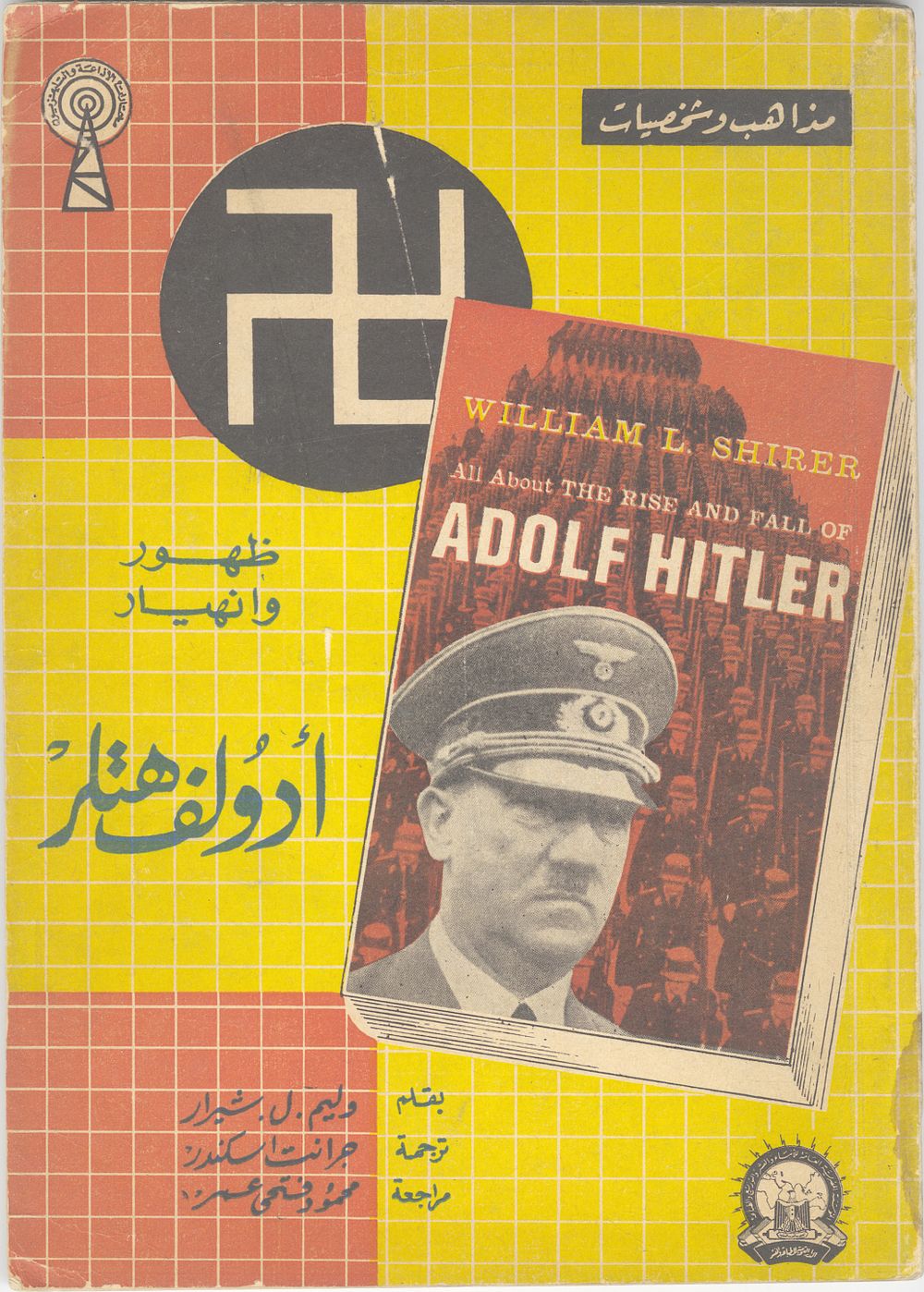
William L. Shirer - The Rise and Fall of Adolf Hitler - Arabic Edition Published in Egypt - ظهور وانهيار أدولف هتلر - The Rise and Fall of Adolf Hitler. Official Egyptian/Arabic translation of the renowned book by the American journalist and historian William L. Shirer, ”All About the Rise and Fall of Adolf Hitler” (written in 1961). Translated by ترجمة: جرانت إسكندر (Grant Iskandar). Edited by مراجعة: محمود فتحي عمر (Mahmoud Fathi Omar). Published by the Egyptian General Organization for Books, Publications and Printing - an Egyptian state publishing institution operating under the Egyptian Ministry of Information. Cairo, (1964). Extremely rare. The Egyptian introduction explains to the Arab reader that the book was written by an American journalist who lived in Nazi Germany, witnessed the events at close quarters, and presents an accessible journalistic-historical analysis of Hitler's path to power, his military campaigns, and his downfall, but that it is not an academic study of every aspect of Adolf Hitler's life. The introduction further states that the book focuses almost entirely on Adolf Hitler, without concentrating on the roles played by his senior advisers, aides, and military leaders, such as Foreign Minister Ribbentrop, Göring, Himmler, Goebbels, Norman, and others. The book ”All About the Rise and Fall of Adolf Hitler” by William L. Shirer, published in 1961 as part of the World Landmark Books series, and translated here into Arabic in its entirety, presents a chronological survey of the history of Hitler and the Nazi state, based on his renowned study ”The Rise and Fall of the Third Reich.” Shirer begins with an account of Hitler's childhood in Austria, his complex relationship with his father, and his unfulfilled ambition to become a painter in Vienna, where he was first exposed to antisemitic ideology. He then describes Hitler's service as a dispatch runner in the German Army during World War I, his injury in a gas attack, and the formative shock of Germany's surrender, which he perceived as an internal betrayal. The book continues with an account of his joining the Nazi Party, the failure of the Beer Hall Putsch in 1923, and the writing of his book ”Mein Kampf” in prison, in which he formulated his sinister vision of Lebensraum and his racial principles. It then surveys his rise to power in 1933 through the exploitation of the economic crisis, aggressive propaganda, and street terror, followed by the consolidation of the dictatorship, the dismantling of democracy, and Germany's rearmament in violation of international agreements. Shirer describes antisemitism as a core and inseparable component of Hitler's ideology, beginning with his years in Vienna and continuing through the chapters of ”Mein Kampf, ” and details in the book the principal stages that led to genocide: from the Nuremberg Laws, through the deprivation of the Jews of their rights and the events of ”Kristallnacht, ” to the establishment of the ghettos, concentration and extermination camps, and the implementation of the ”Final Solution” during the war. The narrative then proceeds to the unopposed annexations of Austria and Czechoslovakia, the outbreak of World War II with the invasion of Poland in 1939, and the initial Blitzkrieg victories in Europe. Finally, it analyzes the military turning points, foremost among them the invasion of the Soviet Union and the Battle of Stalingrad, the gradual defeat, the final days of the Nazi leadership in the Berlin bunker, and Hitler's suicide in April 1945, incorporating testimonies and diary excerpts that depict the disintegration of the Reich. Extremely rare. It does not appear in the WorldCat global library catalog. 124 [4] pages. Good condition.