Bidspirit auction | Official Program for the Nazi
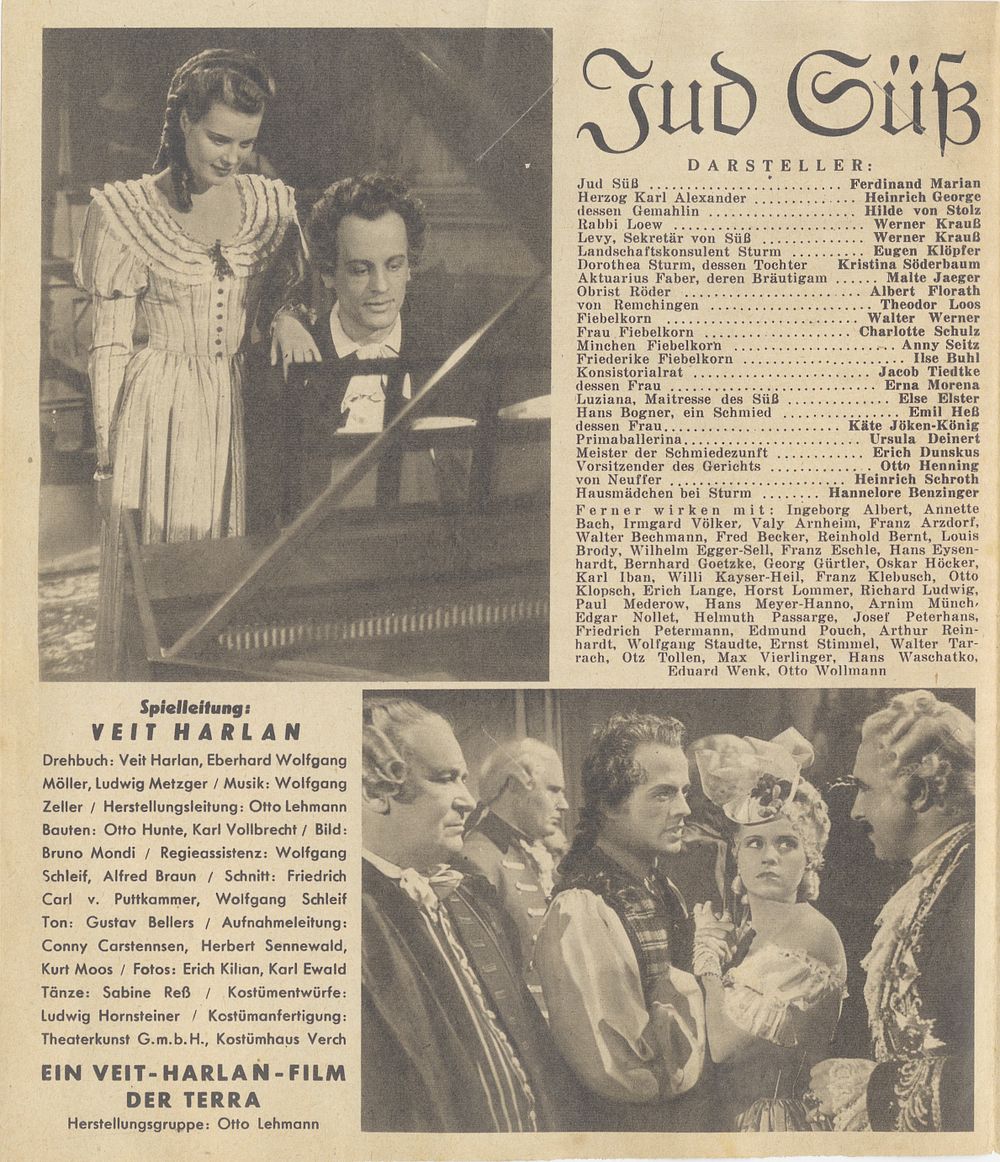
Official Program for the Nazi Antisemitic Propaganda Film ”Jud Süß, ” Released in Nazi Germany at the Initiative of Propaganda Minister Joseph Goebbels - Official program for the notorious Nazi antisemitic propaganda film ”Jud Süß, ” directed by Veit Harlan and produced by the Terra film company in 1940 at the initiative of Nazi Propaganda Minister Joseph Goebbels and his ministry - Berlin, 1939. Published and edited by Paul Ickes of Berlin-Steglitz. The program includes a complete listing of the film's cast and technical crew, as well as selected photographs of scenes from the film. The cover of the program features a dramatic photograph of actor Ferdinand Marian in the role of Joseph Süß Oppenheimer alongside actress Kristina Söderbaum as Dorothea Sturm. Through photographs from the set, the program illustrates the film's antisemitic message: Süß exploits the Duke's financial distress to accumulate power and abolish restrictions on Jews, while leading an ostentatious lifestyle and plotting against those around him and against Dorothea. The final section of the program documents his dramatic downfall: Dorothea's death, the revolt of the nobility and the Duke's sudden death, and finally Süß's trial and execution in an iron cage. At the head of the cast list is Ferdinand Marian as Süß, Heinrich George as Duke Karl Alexander, Werner Krauss in the dual roles of Rabbi Löw and Secretary Levy, and Kristina Söderbaum as Dorothea. Alongside the list is a photograph of Dorothea and her fiancé, Actuarius Faber (played by Malte Jaeger), as well as the production crew, including director Veit Harlan, the screenwriters, composer Wolfgang Zeller, cinematographer Bruno Mondi, and the set and costume designers, alongside a photograph from a court ball scene. The screenplay and filming of the movie began in late 1939 (following instructions from Joseph Goebbels after the outbreak of World War II), and therefore the copyright for the production stills and the program materials was registered as early as that year. Filming was in fact completed in the spring of 1940, and its world premiere took place on September 5, 1940, at the Venice Film Festival, followed by its Berlin premiere on September 24, 1940. In 1934, Michael Balcon produced the film ”Jew Süss” in England, starring Conrad Veidt, as a film intended specifically to warn against German antisemitism. This pro-Jewish film attracted the attention of Joseph Goebbels, who believed in the power of cinema to influence the public, and in 1939 sought to create a film that would help shape public opinion specifically against the Jews in preparation for the formulation of the ”Final Solution.” Goebbels initiated the production of a German version that became one of the most virulent and notorious antisemitic propaganda films ever made. He asked Harlan to direct the fiercely antisemitic work ”Jud Süß, ” based on a screenplay by Eberhard Wolfgang Möller, recounting the story of Joseph Süß Oppenheimer, but from a perspective that embraced the Nazi view of the Jews and served the Party's propaganda. Harlan was involved in writing the screenplay and undertook the direction of the film. Austrian actor Ferdinand Marian was chosen to portray Süß, a man without a typically Aryan appearance who had already acquired experience playing villains on stage and screen. Marian was reluctant to serve as an instrument of Goebbels's propaganda and did not wish to be identified with the Jewish character or with Nazi propaganda, but ultimately had no choice but to yield to Goebbels's pressure, in view of the substantial payment of fifty thousand marks offered to him for the role, twice any salary he had previously received. Here the roles were reversed - the film portrays Süß as a greedy and malevolent Jewish merchant living in the Frankfurt ghetto. Süß engages in moneylending at interest, and in order to advance himself economically and socially, he employs manipulation, corruption, and bribery. To disguise himself, he shaves off his beard and sidelocks and exchanges his long coat for Christian attire. His scheming seemingly pays off, and he attains an influential political position at the court of the Duke of Württemberg, where he continues to accumulate power and wealth. He succeeds in having the decree against the Jews revoked, and an entire group from Frankfurt arrives in Stuttgart and begins wreaking havoc there, plundering the Christians and exploiting the local economy. The Jew's scheming manipulations bring the duchy to the brink of civil war, but ultimately justice prevails and Süß's corruption is exposed. He is denounced, brought to trial, and sentenced to death by hanging. At the end of the film, the prohibition against the presence of Jews in Stuttgart is reinstated and they are expelled, while the girl's father implores future generations to uphold the law forever in order to spare themselves great suffering.