Bidspirit auction | Landsberg: A Documentary Report -
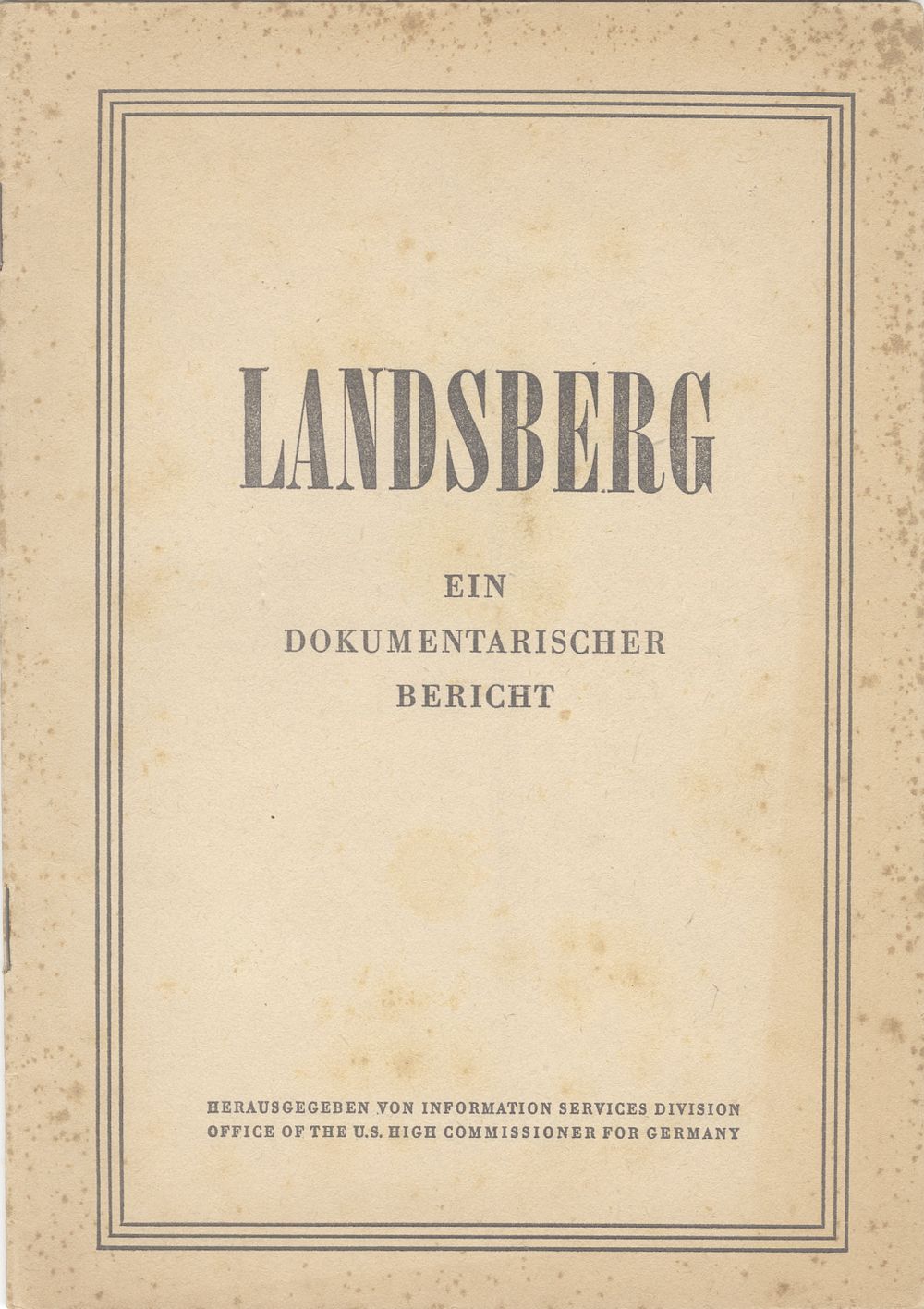
Landsberg: A Documentary Report - Detailed Account of the Ruling Concerning the Clemency Petitions of Nazi War Criminals Sentenced at Nuremberg. Munich, 1951 - Landsberg: Ein dokumentarischer Bericht - ”Landsberg: A Documentary Report, ” published by the Information Services Division of the U.S. High Commissioner for Germany (HICOG). An important publication compiling the official and historic decisions of U.S. High Commissioner John J. McCloy and Commander-in-Chief of U.S. Forces in Europe, General Thomas T. Handy, concerning the clemency petitions of Nazi war criminals tried in the Nuremberg Trials and Dachau Trials and imprisoned at that time in Landsberg Prison. Munich, 1951. German. The booklet includes McCloy's general statement concerning the clemency petitions of Nazi war criminals. McCloy appointed three jurists to review the clemency petitions of the Nazi prisoners and details here the principles that guided their decisions, the individual decisions regarding each prisoner, descriptions of the crimes committed by prisoners whose death sentences were not commuted, the report of the Advisory Board, as well as General Handy's decisions concerning those convicted in the Dachau Trials. These decisions, officially announced on January 31, 1951, constituted a dramatic and historic turning point in American postwar penal policy. As part of this process, McCloy established a special Advisory Board to review clemency petitions (particularly in light of intense political pressure from the German public and leadership). The result of the process documented in this booklet was a sweeping reduction in the sentences of numerous Nazi war criminals, including the commutation of death sentences to life imprisonment and the reduction of lengthy prison terms, leading to the early release of many senior figures in the Nazi industrial and military command apparatus. As detailed here, a total of fifteen of those convicted at Nuremberg who were being held at Landsberg at the time had been sentenced to death. Ten of the death sentences were commuted to terms of imprisonment. The remaining five death sentences were upheld. Four of these men were leaders of SS Einsatzgruppen or extermination units; they carried out the ruthless elimination of all those who might have been opponents of Nazism in the occupied territories. Their task was to murder all Jews, Gypsies, the mentally ill, and Communists who fell into their hands. Approximately two million defenseless people were killed in the operation for whose execution they themselves were responsible. Regarding them, McCloy explained that in these cases, the magnitude of the crimes for which these men were directly responsible precluded any clemency. McCloy significantly reduced the sentences of most of those convicted in the famous ”Doctors' Trial” by decades, and the prison terms of most of them were reduced by half - these were accomplices who were not directly engaged in medical practice. In this context he wrote: ”I have done everything in my power to decide each case objectively and individually. In the case of subordinate persons or those of lesser influence, I have endeavored to show greater leniency than toward defendants who held higher positions and bore greater responsibility.” Nevertheless, in the Einsatzgruppen and extermination squads trial, several death sentences were commuted to life imprisonment, as detailed here with regard to each of those convicted. This document constitutes a historical record of the highest importance for understanding the end of the denazification period and the shift in U.S. policy toward integrating West Germany into the Western defense system at the outset of the Cold War, as well as the first attempt to leave the Nazi era behind in terms of punishment. During January 1951, the clemency decisions of High Commissioner John J. McCloy in the Landsberg cases marked the practical end of the American denazification policy and the replacement of the legal approach by geopolitical considerations. Against the backdrop of the outbreak of the Korean War and the escalation of the Cold War, the United States sought to reestablish a West German army (the Bundeswehr) and integrate West Germany into NATO. This course required placating public opinion, the Church, and the political leadership in Bonn, which exerted considerable pressure for the annulment of sentences handed down by the Nuremberg tribunals. These decisions have been regarded by many historians as a profound moral and legal compromise, in which the demands of the security establishment and the Cold War prevailed over the principle of punishing Nazi war criminals. 31 pages. Stains to the margins of the cover. Good condition.