Bidspirit auction | Winston Churchill ”The Builder” -
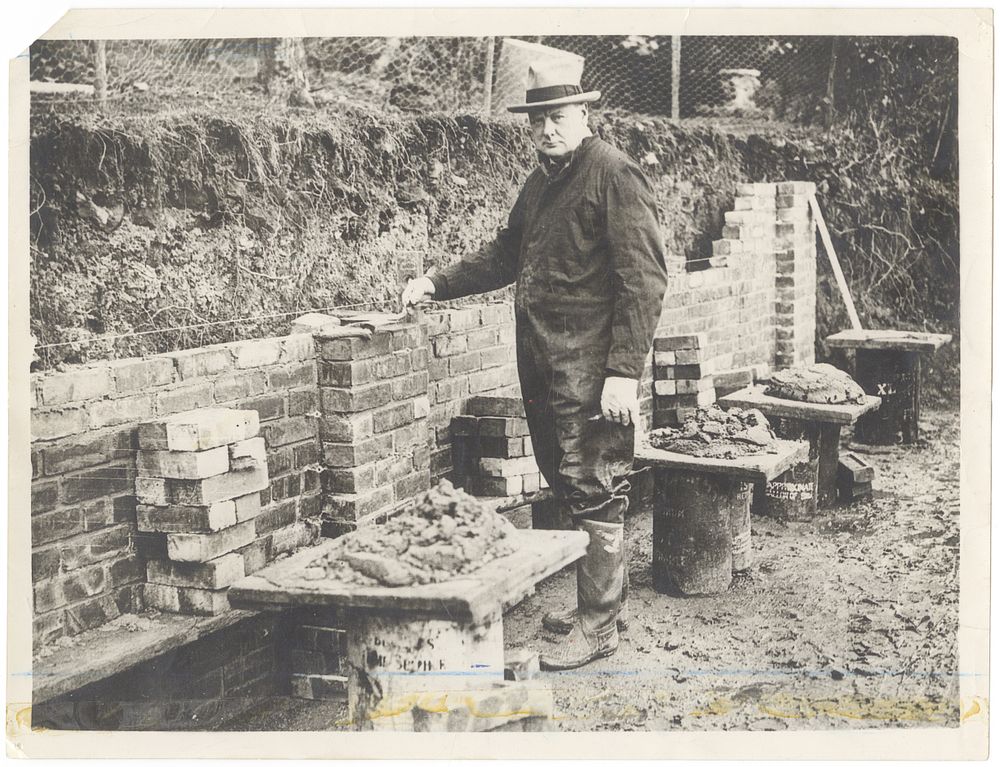
Winston Churchill ”The Builder” - Two Rare Early Photographs - September 1928 - Two fascinating press photographs (Silver Gelatin Press Prints) documenting the future British Prime Minister, Winston Churchill, engaged in his beloved and lesser-known pastime - bricklaying at his private estate, Chartwell, in Kent. From the renowned Topical Press & Keystone news agencies, September 1928. 1. Churchill wearing builders' overalls, rubber boots, and a hat, holding a bricklayer's trowel and working on the construction of a fence beam and a hut at his private estate, Chartwell, in Kent. On the reverse of the photograph: Keystone Press Agency stamps, alongside original editorial labels, a later 1964 date stamp in connection with his 90th birthday celebrations, and handwritten archival notations (”September 1928”). Size: 21x16 cm. Minor loss to the upper left corner. 2. Churchill in a tailored suit, wearing a hat and with a cigar in his mouth, laying bricks alongside his eldest daughter, Sarah Churchill, who is handing him a brick. On the reverse of the photograph is written: ”Since the outbreak of the war, the Prime Minister has had little time to devote to his favorite pastimes. But he looks forward to playing a practical part in the rebuilding of Britain at the end of hostilities.” It is also stated that in 1928 Churchill was formally admitted as a member of a builders' trade union after successfully passing a practical test of laying one brick every minute! On the reverse is a prominent purple stamp of ”THE TOPICAL PRESS AGENCY LTD, FLEET ST., LONDON, ” as well as a World War II military censorship stamp (”THIS PHOTOGRAPH HAS BEEN PASSED BY THE CENSOR”). Size: 21x16 cm. These photographs reveal one of the most intriguing facets of Churchill - a man of intellect and a great leader who found solace in strenuous manual labor. At the time, Churchill was already serving as none other than the British Chancellor of the Exchequer, while simultaneously working at Chartwell on Volume IV of The World Crisis. This was, in fact, a project involving the construction of the brick walls surrounding the kitchen garden at Chartwell and the building of a small playhouse for his daughters Sarah and Mary. The playhouse, a small room incorporated into the garden wall, became known as Marycot. His daughter Mary herself recalled that her father built the red-brick walls surrounding the garden and undertook the construction of the playhouse. Churchill expressed it wonderfully in a letter to Prime Minister Stanley Baldwin dated September 2, 1928: “200 bricks and 2000 words a day.” - that is, approximately 200 bricks and 2,000 words a day. Churchill wrote to Baldwin that he had enjoyed a wonderful month during which he built a cottage while continuing to write his book. He regarded hobbies of this kind as a means of exchanging one form of mental exertion for another. The photographs were taken from the archives and published in the contemporary press on the occasion of Churchill's 90th birthday. The reverse sides of the photographs, rich with archival stamps, trace their history: their original distribution in 1928, their use as morale-boosting material during World War II (as evidenced by the censorship approval), and their publication in the press to mark Churchill's 90th birthday in the 1960s. Both photographs are in good condition.