Bidspirit auction | “Never Again!” – Prisoners’ Testimonies
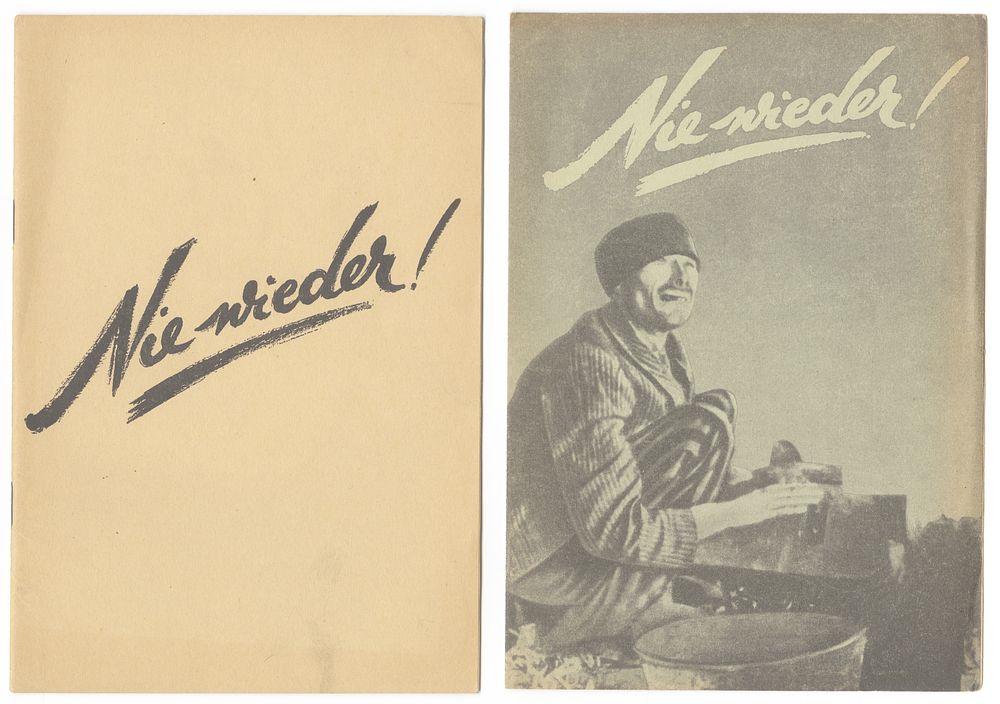
“Never Again!” – Prisoners’ Testimonies at an Exhibition Held in Switzerland to Aid Survivors Immediately after the War – Booklet and Prospectus - Nie wieder! – “Never Again!” An early booklet of survivors’ testimonies published by the Bund ehemaliger Konzentrationslager-Häftlinge – Association of Former Concentration Camp Prisoners in Zurich, with the aim of exposing to the public the magnitude of the crimes of Nazi Germany and raising support for the survivors. Zurich (Switzerland), 1946 – only edition. German. Extremely rare. Includes the promotional prospectus for the exhibition. A rare publication issued in 1945 in Zurich, Switzerland, by the Association of Former Concentration Camp Prisoners, accompanying the memorial and educational exhibition of the same name, organized by the French Information Service and held in most of Switzerland’s major cities. Its primary purpose was to document the crimes of the Nazi regime, raise public awareness of the horrific crimes of Nazi Germany, and mobilize humanitarian and financial assistance for the rehabilitation of survivors. At the heart of the booklet is detailed historical and geographical documentation, including a map showing the locations of 791 concentration camps, extermination camps, and Gestapo prisons throughout Germany and the occupied territories (including Auschwitz, Buchenwald, Dachau, Ravensbrück, and Majdanek). Alongside the map are harrowing personal testimonies by survivors and their family members from Germany, Czechoslovakia, and Luxembourg, describing persecution, imprisonment, the murder of their loved ones by the Gestapo, and the financial and health difficulties they faced after the war. A prisoner named Leo Roth provides an extensive account entitled “A Night in a Concentration Camp, ” describing an execution carried out for no apparent reason one night in the camp, as well as his anguish over his mother, who was being held in the women’s barracks nearby, not knowing whether she was alive or dead. One after another, the former prisoners recount the horrors they endured in the death camps and appeal for urgent psychological and physical assistance. The booklet also contains disturbing photographs from the death camps. It is remarkable to read how the former prisoners expressed the extent of their deprivation at the end of the war. One of them wrote: “As a former prisoner of the Buchenwald and Theresienstadt concentration camps, I take the liberty of submitting the following request. My wife and I are currently living in a refugee camp and are about to be released, as we are exhausted from our experiences in the camps. We intend to emigrate to America. As a qualified carpenter, it is now of the utmost importance to me to obtain a complete set of tools once again, since this is the most essential prerequisite for establishing a new life overseas. Unfortunately, we are completely destitute, but I can assure you that the loss of all my other possessions pains me less than the loss of my toolbox. I would be most grateful if you could apply on my behalf to the appropriate authority so that I might receive an advance for the purchase of new or used tools, thereby enabling me to earn a livelihood. ”Another former prisoner writes: “I spent four years in the Theresienstadt concentration camp, as well as in Ravensbrück and Dachau. My husband, formerly a merchant, unfortunately never returned. Some of my relatives remained in Germany, while others perished in Auschwitz. When I returned from Dachau on May 24, 1945, I was left with nothing: no home, no bedding, no clothing.” The opening pages contain introductory articles and calls to action by representatives of the association, including Benno Schachter (President of the Central Committee) and human rights activist Gertrud Kurz. The writers emphasize the moral obligation not to forget the catastrophe, to combat Nazism and manifestations of terror, and to provide immediate assistance to orphans, widows, the sick, and the destitute. At the beginning of the booklet appears an appeal by Swiss human rights activist Gertrud Kurz, calling upon the public not to stand idly by and to assist in the rehabilitation of the survivors: “Help ensure that such a terrible event never happens again!” The accompanying leaflet, bearing the name of the exhibition, was intended to raise donations and financial assistance and was distributed alongside the booklet by the same association in Zurich. Its front features a famous historic photograph of prisoners on wooden bunks on the day the Dachau concentration camp was liberated by the U.S. Army, alongside an impassioned appeal to the public to contribute toward the rehabilitation of survivors recuperating in Switzerland. The inner and rear sections of the prospectus consist of an official Swiss postal payment slip, featuring a portrait photograph of an elderly woman from the Ravensbrück concentration camp and a space for entering the amount of the donation.