Bidspirit auction | Elie Wiesel – An Unknown
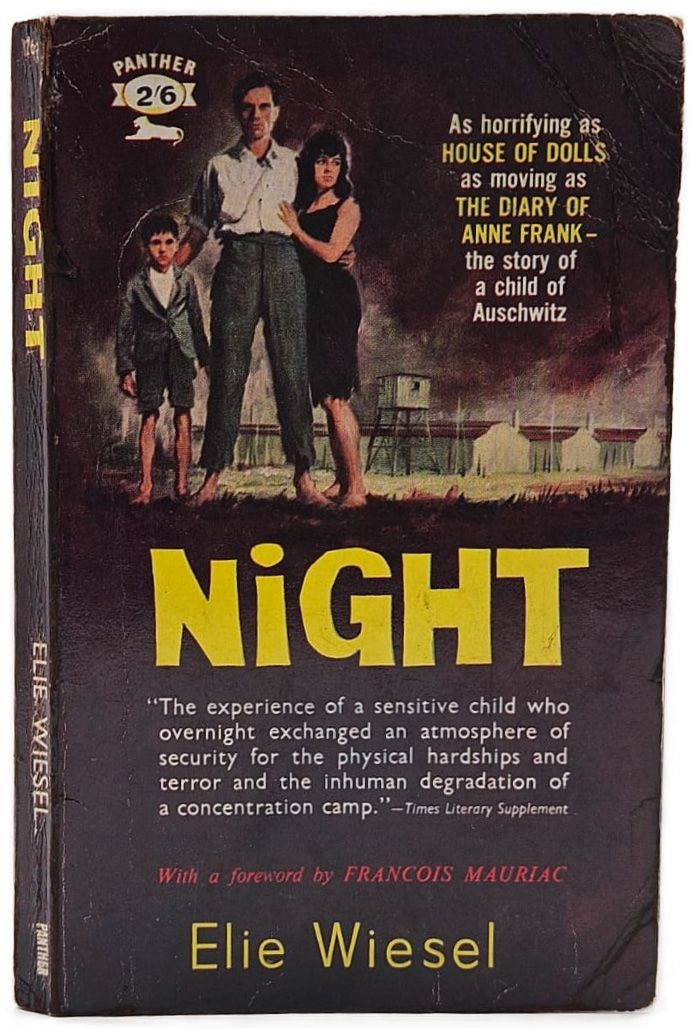
Elie Wiesel – An Unknown Edition of His Celebrated Book ״Night״, Signed by the Author - An unknown British edition of Elie Wiesel’s celebrated book ״Night״ – a copy signed and dated by the author: 8/11/62. Translated from the French into English by Stella Rodway. One of the most important and influential masterpieces of Holocaust literature, documenting Wiesel’s experiences as a young boy deported with his family from his hometown of Sighet in Transylvania to the Auschwitz and Buchenwald concentration and extermination camps. Panther Books, London, 1961. Foreword by the French writer and Nobel Prize laureate in Literature François Mauriac. The important autobiographical work by Holocaust survivor and author Elie Wiesel, recounting his experiences as a young boy who was deported with his family from his hometown of Sighet in Transylvania to the Auschwitz and Buchenwald concentration and extermination camps. The work focuses on the loss of faith, the shattering of youthful innocence, the complex relationship between father and son under inhuman conditions, and the experience of physical and psychological survival. The book was originally written in Yiddish in an expanded version (under the title Un di Velt Hot Geshvign – “And the World Remained Silent”) and was subsequently adapted into French (La Nuit – Night) through the mediation and encouragement of François Mauriac. The present edition, with its colorful cover design characteristic of 1960s paperbacks, represents an early stage in the book’s emergence into international consciousness and its introduction to an English-language readership. ”Never shall I forget that night, the first night in camp, that turned my life into one long night seven times sealed. Never shall I forget that smoke. Never shall I forget the small faces of the children whose bodies I saw transformed into smoke under a silent sky. Never shall I forget those flames that consumed my faith forever. Never shall I forget the nocturnal silence that deprived me for all eternity of the desire to live. Never shall I forget those moments that murdered my God and my soul and turned my dreams to ashes. Never shall I forget it, even if I be condemned to live as long as G-d Himself. Never.” (Elie Wiesel, Night). The book ”Night” is based on Elie Wiesel’s personal experiences as a 15-year-old Jewish boy during the Holocaust and centers on three principal themes: deportation and survival in the camps, the collapse of religious faith and the human spirit, and the complex relationship between father and son. The narrative begins in the town of Sighet in Transylvania. Despite early warnings (such as that of Moshe the Beadle, who survived an earlier massacre), the Jewish community finds it difficult to comprehend the magnitude of the danger. In the spring of 1944, following the German occupation of Hungary, ghettos are established, and before long the inhabitants are deported in overcrowded cattle cars to Auschwitz-Birkenau. Upon arrival, a selection takes place: Elie is immediately separated from his mother and his younger sister Tzipora (who were murdered in the gas chambers) and remains with his father, Shlomo. Elie and his father are transferred to Auschwitz and subsequently to the Buna labor camp. The book describes in detail the numbing daily routine: extreme hunger, forced labor, constant violence at the hands of SS guards and Kapos, and the ever-present fear of another selection. Later, as the Red Army advances in the winter of 1945, the prisoners are forced on a “death march” in bitter cold to Buchenwald. As the appalling physical conditions drive many prisoners to fight one another for a morsel of bread, Elie struggles to care for his sick and exhausted father. At the same time, he describes with painful candor his inner conflict – the desire to sacrifice everything for his father against the basic instinct for self-preservation and the growing sense of burden as his father becomes progressively weaker, until his father’s death at Buchenwald shortly before liberation. Elie, who entered the camp as a religious boy, undergoes a profound crisis of faith. Confronted with the sight of children being burned and executions by hanging in the camp (particularly the hanging of a young boy who struggled for his life for a prolonged period), Elie describes the collapse of his faith in a merciful God, leaving him with a profound sense of abandonment in the face of the silence of heaven. Elie Wiesel (1928–2016) was an author, thinker, human rights activist, and Nobel Peace Prize laureate who became one of the world’s foremost voices of Holocaust remembrance. He was born in Sighet, Romania (then part of Hungary), into a religious Hasidic family and was raised in the traditions of Talmudic and Kabbalistic study. After the war, he arrived in France as part of a group of orphans, studied philosophy at the Sorbonne, and worked as a journalist. In 1955 he moved to the United States,