Bidspirit auction | Program for the Film Lebensborn
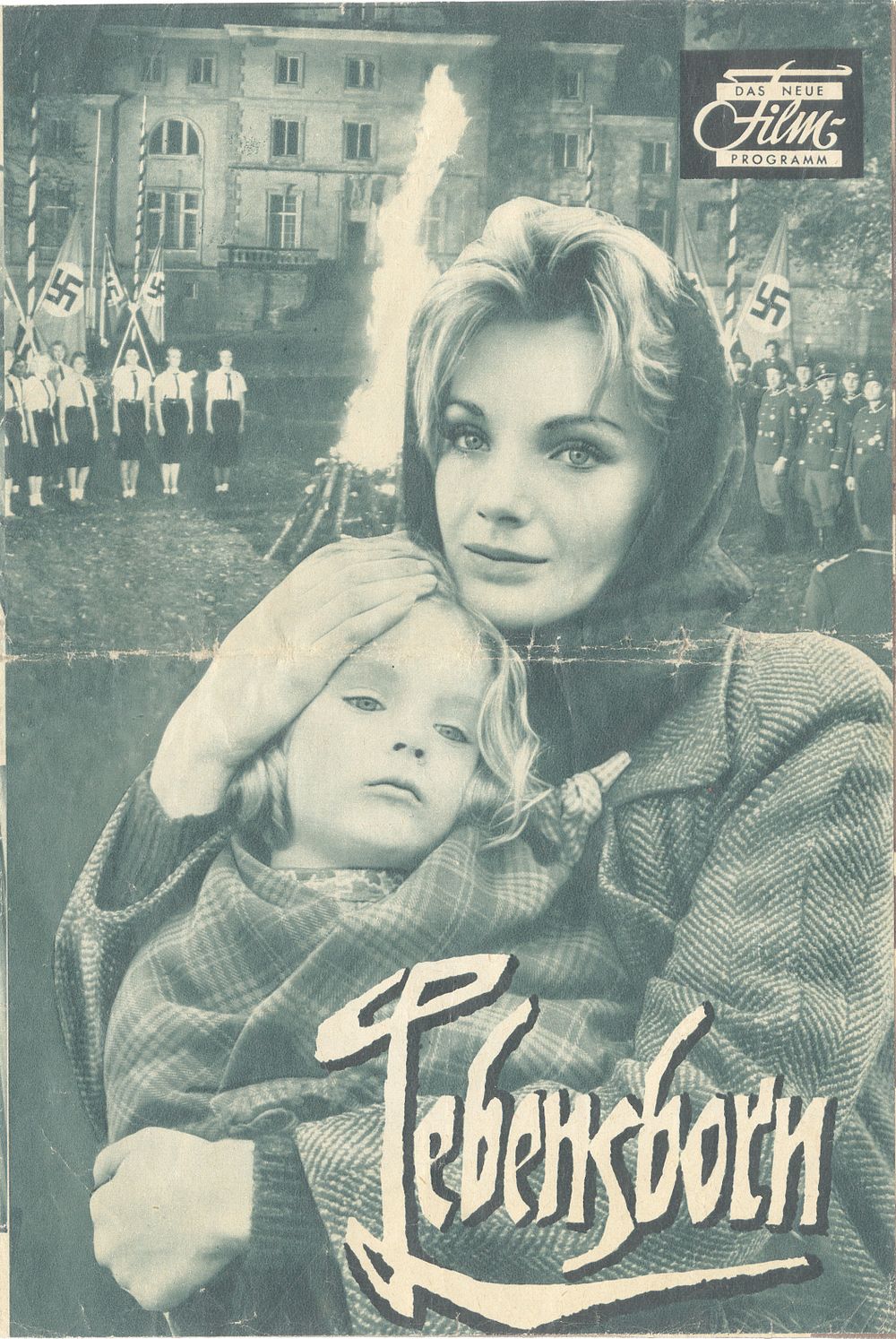
Program for the Film Lebensborn – An Internal German Critique of the Nazi SS Program for the Birth of “Racially Pure Aryan” Children – Shock Cinema - Das Neue Filmprogramm – Program for the Film Lebensborn, a film criticizing the crimes of the Third Reich in connection with the Nazi program for the racial cultivation of the Aryan race. Directed by Werner Klingler and starring Maria Perschy, Joachim Hansen, and Harry Meyen. West Germany, 1961. “In the deranged, sadistic minds of the ‘Thousand-Year Reich, ’ the idea of the ‘Lebensborn’ was conceived - an institution that sought to place the concept of the ‘hereditary propagation of the noble German race’ above the love between two human beings. A group of very young women from the League of German Girls (BDM) also joined this institution in a frenzy of idealism and took part in a supposed course for the renewal of pure German heritage at Sternberg Castle in the Warthegau. These BDM girls were selected to bear children of racial value who, like torchbearers, were intended to secure the future of the nation. At least, this was how SS-Obersturmbannführer Meyer-Westerhoff, with calculated pathos, explained their future mission to the young women. SS physician Dr. Hagen fought with relentless fanaticism to finally be able to put the results of his research into practice. It seemed as though the Devil himself had taken possession of this cold-hearted cynic. Adamit, a recipient of the Knight’s Cross, blindly obedient to the Party and its leader, was utterly loyal.” (From the program). The plot of the film takes place at Sternberg Castle in the Warthegau, which serves as a “Lebensborn” institution for racial breeding and the creation of a generation of “racially pure Aryans.” Young women from the BDM, selected according to their racial characteristics, arrive at the institution, among them Doris Korff (Maria Perschy), the leader of the girls and an ardent believer in Nazi ideology. Meanwhile, decorated Luftwaffe pilot Klaus Steinbach (Joachim Hansen) is exposed to the crimes of the regime, including the abduction of Polish children and the murder of their mothers. After expressing his outrage, he is sentenced to death, but while being transported to his execution, his vehicle is caught in a partisan ambush. He assumes the identity of a slain officer and, under a false name, arrives at the Lebensborn castle, where he poses as an SS officer. There he witnesses the brutal activities of the institution’s director, SS physician Dr. Hagen (Harry Meyen), who conducts genetic examinations on the women. Klaus grows close to Doris and reveals to her the crimes of the Reich and the regime’s exploitation of the young women. Doris begins to become disillusioned with her beliefs, as do several of the other girls, one of whom even commits suicide by jumping from scaffolding. Toward the end of the war, as the Nazi regime collapses and the search for Klaus intensifies, he and Doris attempt to escape. Klaus is shot by SS men and dies in Doris’s arms. Doris survives, gives birth to their child, and seeks to begin a new life amid the ruins of postwar Germany. The program is illustrated throughout with photographic scenes from the film. The front cover features a dramatic close-up of the leading female character embracing a young girl against the backdrop of a fire ceremony held by members of the Nazi youth movement, alongside the film’s title in prominent calligraphic lettering and the series emblem in the upper corner. The photographs document activities within the “Lebensborn” institution, intended for racial breeding and the birth of Aryan children, and include racial and medical examinations conducted by SS physicians, gatherings of girls from the League of German Girls, uniformed formations and ideological ceremonies, alongside profile busts of Hitler and Himmler. The film, released in West Germany in 1961, belongs to the genre of dramatic exposé films of the 1960s dealing with the crimes of the Third Reich. The plot portrays the Lebensborn institutions as they operated during the war – as a cold, brutal, and distorted apparatus that reduced young women to instruments of systematic reproduction in the name of racial doctrine, depriving them of their humanity. The film focuses on the struggle of its principal characters to free themselves from the ideology, preserve their humanity, and escape this oppressive system. The film faithfully depicts the Nazi SS program overseen by Heinrich Himmler for the birth of “racially pure Aryan” children by women selected for this purpose, as well as the frequent abduction of children identified as “Aryan, ” their separation from their parents in the occupied territories, and their forced adoption by German families. The program was originally intended for the “improvement” of the Aryan race.