Bidspirit auction | The Complete Official Text of
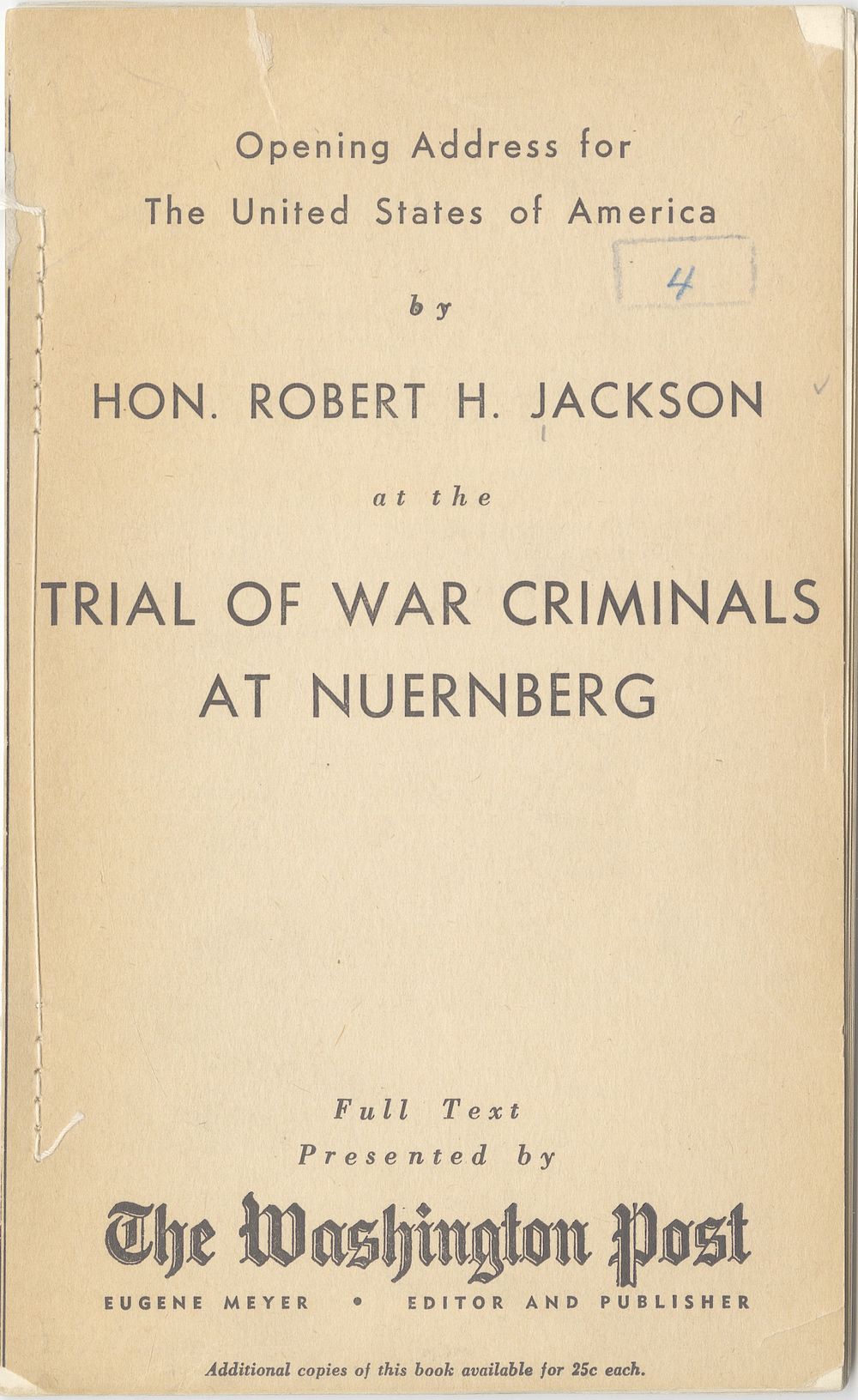
The Complete Official Text of Justice Robert H. Jackson’s Opening Statement at the Nuremberg Trials – Washington, 1945 – First Edition - Opening Address for The United States of America by Hon. Robert H. Jackson at the Trial of War Criminals at Nuernberg – by Justice Robert H. Jackson – Chief United States Prosecutor at the Nuremberg Trials and Associate Justice of the Supreme Court of the United States. Published by The Washington Post. Washington, 1945 – first edition. The complete official text of the historic opening statement delivered by Chief U.S. Prosecutor Robert H. Jackson on November 21, 1945, before the International Military Tribunal at Nuremberg. In addition to the full text of the address, the booklet contains an introductory essay explaining its legal and moral significance, with explicit reference to a Washington Post editorial of December 3, 1944, which introduced the new term “genocide” to define the crimes of the Nazis, as well as to the manner in which Nazi brutality developed among men who regarded themselves as the creators of a “New Order, ” in whose name they permitted themselves to transgress every boundary of human morality. A portrait of Justice Robert H. Jackson appears at the beginning of the booklet. Jackson’s address opens with the famous words: “The privilege of opening the first trial in history for crimes against the peace of the world imposes a grave responsibility. The wrongs which we seek to condemn and punish have been so calculated, so malignant, and so devastating, that civilization cannot tolerate their being ignored, because it cannot survive their being repeated...”. The indictment details the leading defendants (including Hermann Göring, Rudolf Hess, Joachim von Ribbentrop, and others) and the Nazi organizations charged as criminal organizations (the SS, Gestapo, SA, General Staff, etc.), alongside descriptions of brutal methods, forced labor, and the systematic plunder of the Jews of Europe. This address is regarded as one of the most important legal and moral texts of the 20th century, laying foundations for modern international law and the concept of “crimes against humanity.” In his address, Jackson presented the extermination of European Jewry as one of the gravest crimes of the Nazi regime. He emphasized that the persecution of the Jews was not the result of isolated or accidental acts, but rather an organized and systematic program adopted by the leadership of the Nazi Party and implemented through the machinery of the state. Jackson described how this policy developed gradually from the deprivation of rights and economic discrimination, through organized violence, ghettos, deportations, forced labor, and starvation, culminating in mass extermination. According to Jackson, antisemitism also served as an instrument of terror and as a means of preparing the Nazi machinery of repression, while the extermination of the Jews represented the culmination of the criminal process unleashed by the Nazi regime throughout Europe. Jackson further stated that he intended to prove the existence of “a plan and design … to annihilate all Jewish people” – a plan and conspiracy intended to destroy the entire Jewish people. He went on to state that history had never before witnessed a crime committed against so vast a number of victims with such calculated cruelty. He further emphasized the moral stature of the victorious powers, which chose not to execute their defeated enemies without trial, but instead to submit their military power to international law and conduct a public trial in accordance with justice. The address stressed that crimes against peace and humanity are committed by individuals, not by abstract entities such as “states, ” and that criminal responsibility must therefore be imposed personally upon the leaders who planned, initiated, and carried out the aggression. Jackson defined the launching of a war of aggression as the central and gravest crime, since it was this act that gave rise to all the atrocities and evils that followed. The legal case relied primarily upon the official documents of the Nazi regime itself – rather than solely upon oral testimony – in order to leave no room for denial of the atrocities or for claims that they constituted a fabricated narrative of the victors. [4], 56 pages. Good–very good condition.