Bidspirit auction | Issue of the Newspaper Do’ar
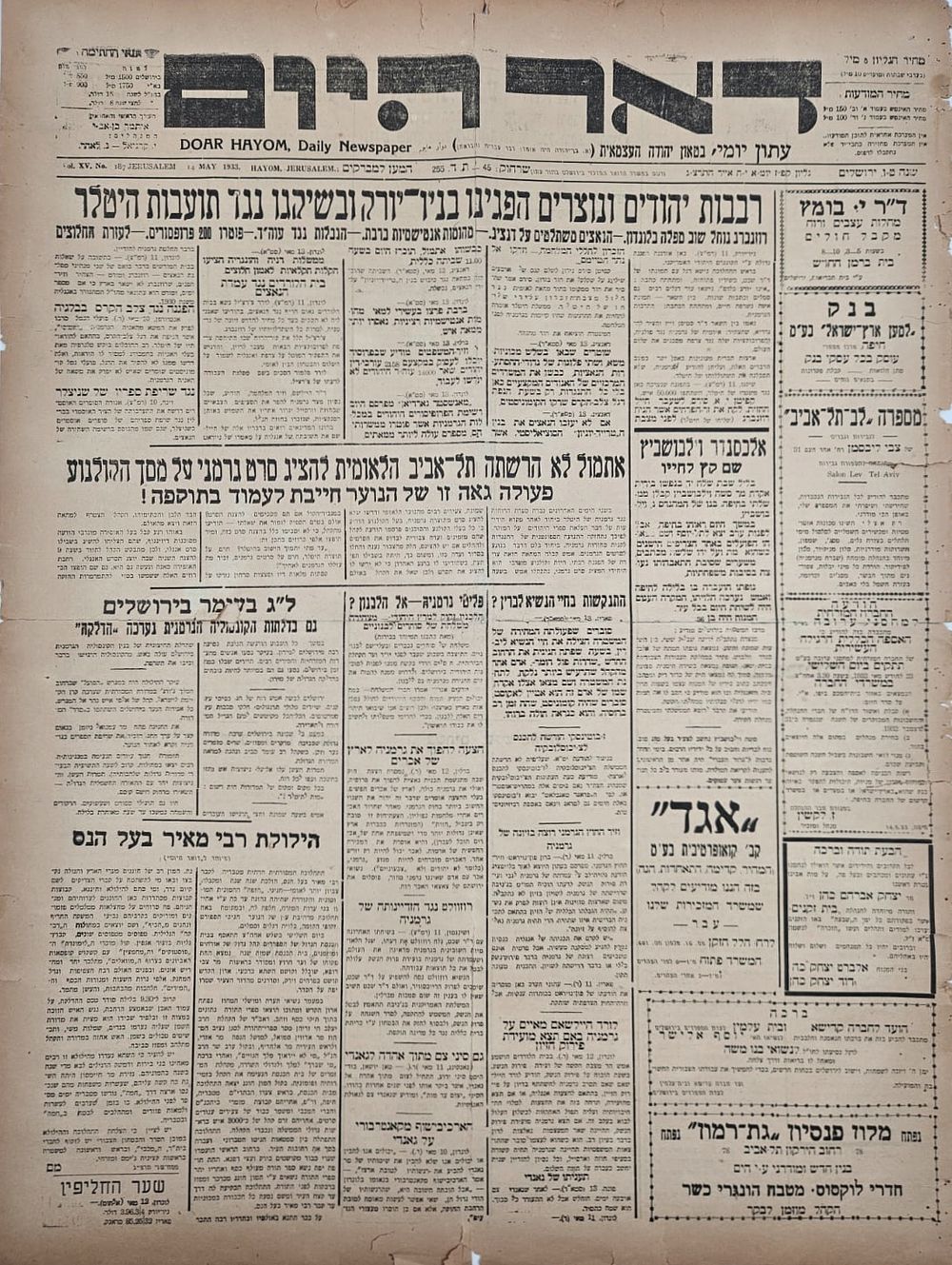
Issue of the Newspaper Do’ar Ha-Yom – Report on Protests Around the World Following Hitler’s Rise to Power - Issue of the newspaper Do’ar Ha-Yom – Organ of Independent Judea, dated May 14, 1933 – following Hitler’s rise to power and shortly before the enactment of the “Law Against the Formation of New Parties, ” which established the Nazi Party as Germany’s sole political party – extensively reporting on demonstrations held around the world against Adolf Hitler and Nazi Germany. An important issue of Do’ar Ha-Yom, founded by Itamar Ben-Avi, reporting on reactions around the world to Hitler’s rise to power and Germany’s transformation into a dictatorship. On the front page, under the headline “Tens of Thousands of Jews and Christians Demonstrated in New York and Chicago Against Hitler’s Atrocities, ” the newspaper reports on a mass demonstration led by Stephen Wise, who declared that world peace was in danger. It also reports on demonstrations against the swastika held in Belgium. In Tel Aviv, after news arrived of the burning of Jewish books in Germany, it was decided to prohibit the screening of German films in cinemas. In one theater, protesters splashed ink on the screens on which a German film was being shown. Another article protests the fact that throughout the world no effective voice of opposition or outcry had arisen against Hitler’s regime – atrocities were taking place in Germany, the entire world was aware of them, yet no one was raising his voice. The issue also reports that Roosevelt was working behind the scenes to bring about the disarmament of Nazi Germany, and more. Hitler’s rise to power in 1933 provoked an unprecedented wave of public outrage: tens of thousands marched through the streets of New York, a widespread consumer boycott of German goods was declared, and masses demonstrated against the tyranny of the swastika. Yet while the streets were in turmoil, world leaders largely chose to look the other way. Western governments, preoccupied with the severe economic crisis and fearful of another war, pursued conciliatory policies, refrained from imposing sanctions, and even permitted Germany to host the 1936 Olympic Games. It is entirely possible that had these civilian protests been translated as early as 1933 into a firm and determined policy by the world powers – from complete diplomatic isolation and a crippling economic boycott to intervention against Germany’s rearmament – the deranged Nazi regime might have been strangled in its infancy, and the greatest catastrophe in human history might have been prevented altogether. 4 pages. Complete issue. Brittle paper. Tears along the fold lines. Reinforcements with pasted paper. Fair condition.