Bidspirit auction | “Last Night the German Reichstag
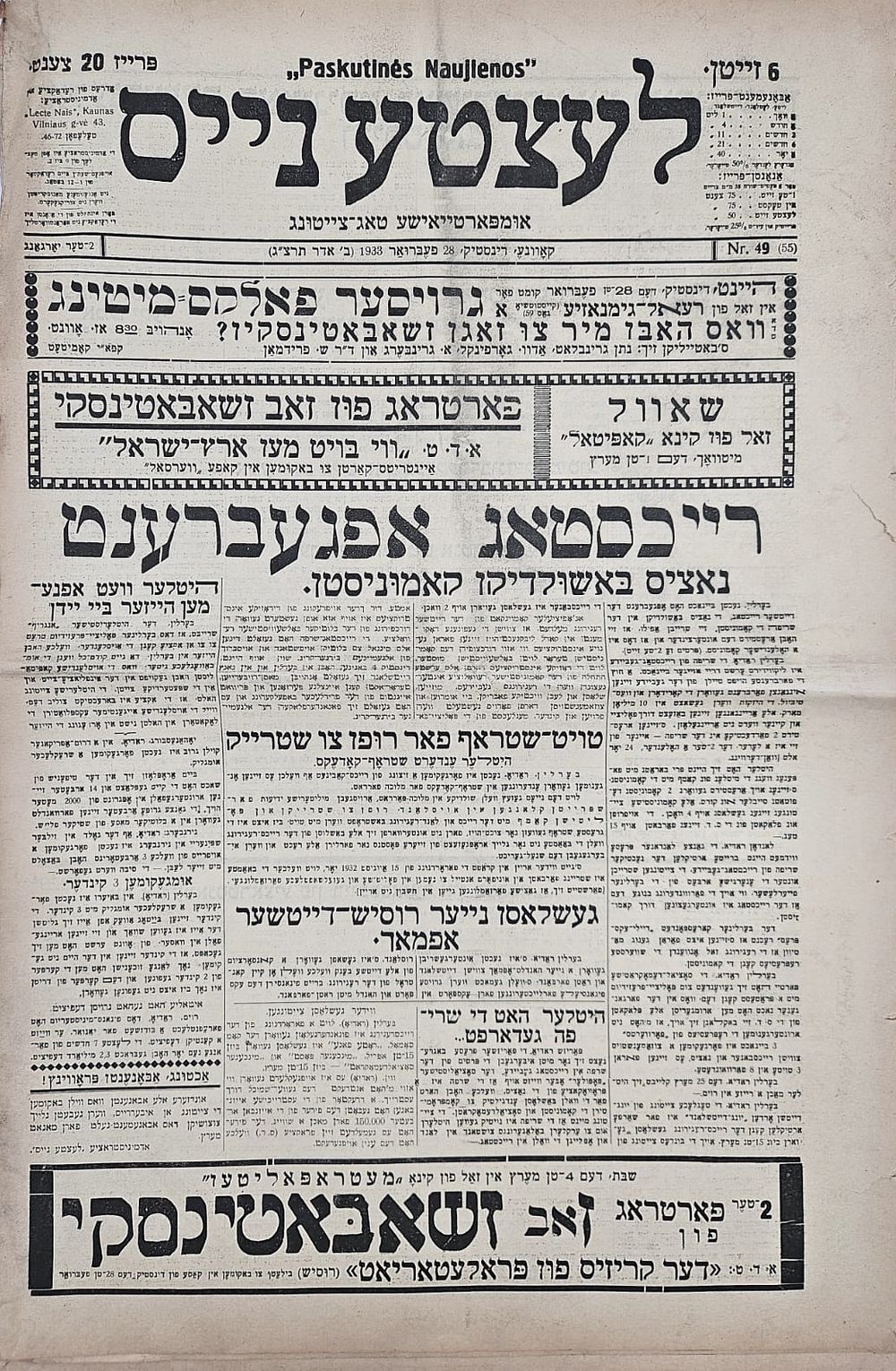
“Last Night the German Reichstag Was Set on Fire” – Issue of the Yiddish Newspaper Letste Nayes, Published the Day After the Burning of the German Reichstag – February 28, 1933 - Reichstag opgebrent, Nazis bashuldikn komunistn – “The Reichstag Burned; the Nazis Accuse the Communists” – Issue of the Jewish Yiddish newspaper Letste Nayes – Umparteyishe Tog-Tsaytung (“Latest News – Independent Daily Newspaper”), Kovno, Lithuania. Special issue dated February 28, 1933, reporting on the burning of the German Reichstag on the day following the fire. “Last night the German Reichstag was set on fire... Berlin Radio reported that the fire was not extinguished until three o’clock in the morning... Hitler consulted with Papen early today regarding measures to combat the Communists... all Communist newspapers have been suspended for four weeks...”. A special issue whose main headline reports the burning of the Reichstag (“Reichstag Burned”) on the night of February 27–28, stating that the damage was estimated at 10 million marks and that the main chamber was completely destroyed. It reports that a Dutchman was apprehended at the scene with incendiary materials and arrested on the spot. The Nazi government officially blamed the Communists and characterized the event as the “signal for a Communist uprising” and an aggressive revolt. The newspaper reports extensive police raids in Berlin, the suppression of Communist and Socialist newspapers, and the arrest of dozens of members of parliament and political activists. Alongside the official Nazi version blaming the Communists, the newspaper, already on the first day after the fire, cites reports and voices from Berlin and Paris expressing suspicion that the incident was a deliberate provocation orchestrated by the Nazis themselves in order to create a pretext for eliminating the political left and dismantling democracy ahead of the forthcoming elections (which were to be held approximately one week later, on March 5). The front page also carries a subheadline concerning a direct measure against the Jewish population: “Hitler vet apnemen di hayzer bay Yidn” – “Hitler Will Confiscate Houses from Jews.” In real time, the newspaper reports preliminary information from Berlin suggesting that the Nazis intended to exploit the manufactured crisis they had created in order to begin attacking Jewish property and confiscating assets belonging to foreign nationals and Jews. The newspaper’s editors, writing on February 28, were not yet aware of the “Reichstag Fire Decree, ” which was signed that very day, nor could they have foreseen the speed with which Germany would be transformed, within a matter of weeks, from a dictatorship in its infancy into a fully centralized totalitarian state.The newspaper further reports on severe penalties and the imposition of the death penalty upon anyone calling for a general strike or attempting to organize workers’ protests in response to the state of emergency, as well as violent incidents and shootings throughout Germany between SS and SA units and political activists. It also refers to speeches delivered by Hitler and Goebbels in the run-up to the parliamentary elections, exploiting the Reichstag fire to portray Nazism as the only defense against the “Bolshevik threat.” The burning of the Reichstag building, the seat of the parliament of the Weimar Republic, on the evening of February 27, 1933, less than a month after Hitler’s appointment as Chancellor (on January 30), was a pivotal event in the Nazis’ rise to power and the consolidation of Nazi Germany. The new regime quickly exploited the event to eliminate its opponents and further consolidate its authoritarian rule while casting aside the remaining constitutional protections of the Weimar Republic. It was the Reichstag fire that provided the Nazis with the pretext they needed to enact far-reaching emergency measures and create the public atmosphere necessary to consolidate their regime. The Reichstag fire thus constituted a critical turning point in Germany’s descent from a liberal democracy into a Nazi dictatorship. Letste Nayes (“Latest News”) was an independent Yiddish daily newspaper published in Kovno, which at the time served as the de facto capital of Lithuania. The newspaper was established in the early 1930s. Unlike most Yiddish newspapers in Lithuania during that period (which were formally affiliated with Zionist movements, the Bund, or Orthodox political organizations), Letste Nayes avoided formal party affiliation and maintained an objective approach in its reporting. 6 leaves. 53 cm. Complete issue. Tears along the edges of the leaves. Good condition.