Bidspirit auction | Der Adler (“The Eagle”) –
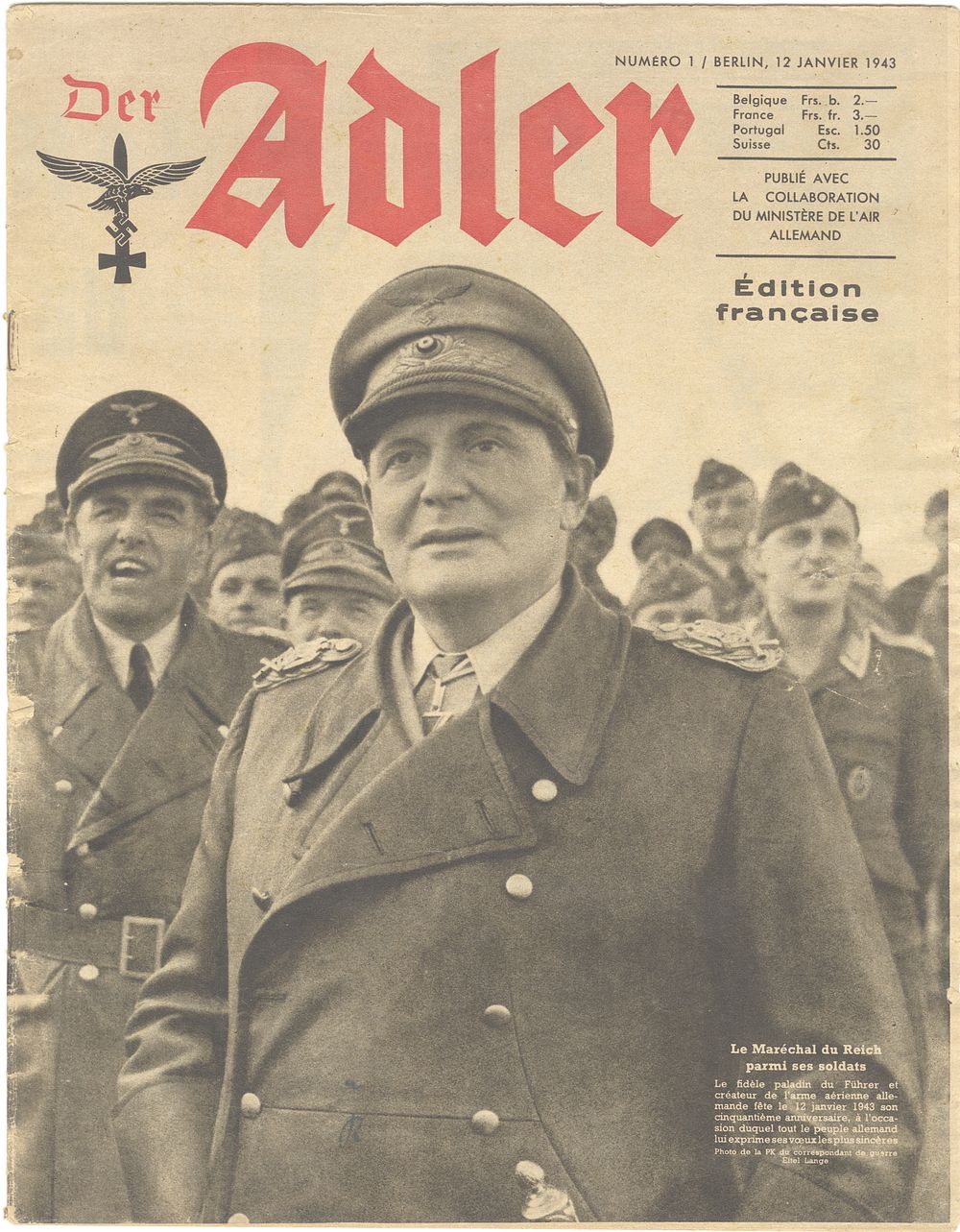
Der Adler (“The Eagle”) – German Luftwaffe Magazine – Special Issue Marking Hermann Göring’s 50th Birthday - Der Adler (“The Eagle”) – the official propaganda magazine of the German Air Force (Luftwaffe), Berlin, January 12, 1943 – special issue marking the 50th birthday of Luftwaffe Commander-in-Chief Hermann Göring, published under the auspices of the German Air Ministry (Reichsluftfahrtministerium). French edition (Édition française), intended for distribution in France and the occupied countries of Western Europe – Issue No. 1. The front page features a photograph of Reich Marshal Hermann Göring, Commander-in-Chief of the Luftwaffe, under the headline: “Le Maréchal du Reich parmi ses soldats” (“The Reich Marshal Among His Soldiers”), together with greetings marking his 50th birthday: “The Führer’s faithful knight and creator of the German Air Force celebrated his fiftieth birthday on January 12, 1943, and on this occasion the entire German people expressed their heartfelt good wishes.” (Photographed by war correspondent [PK] Eitel Lange.) The issue opens with an extensive article on Göring under the headline “The Reich Marshal – On the 50th Birthday of the Founder of the German Air Force.” The issue presents his achievements, leadership, and popularity among his officers and soldiers. Göring is portrayed as personally directing the Luftwaffe’s operational planning. Photographs show him reviewing troops and officers in the field and issuing instructions to the Luftwaffe’s senior commanders, including General Alfred Keller, Field Marshal Hugo Sperrle, General Hans Jeschonnek, and Field Marshal Albert Kesselring. Other photographs show Göring looking out from the window of his special command train (Sonderzug) and waving to crowds of soldiers cheering him at a railway station, and more. The issue continues with an extensive profile tracing the establishment, development, and operational history of the Luftwaffe’s elite guard division, from its origins as a police unit to its transformation into an armored division. The text opens with a heroic portrayal of the first days of February 1933, following the Nazi rise to power. Göring, in his capacity as Prussian Minister of the Interior, established a special police unit (Polizeiabteilung z.b.V. Wecke) to combat the Communists and eliminate centers of opposition in Berlin. Within a short period, the unit evolved from a civilian police and honor guard formation, through its incorporation into the Luftwaffe as a parachute and Führer guard unit, into a powerful ground combat force. The article details the unit’s participation in the various campaigns – the invasion of Poland, Denmark and Norway, the campaign in the West (Belgium and France), the conquest of the Balkans, and subsequently the fierce fighting on the Eastern Front (Bryansk, Kiev, and Radekhiv) against the Soviet Union. This is followed by a propagandistic and technical survey of the Luftwaffe’s mobile command trains (Führungszug / Eisenbahn-Kommandostelle), which served as sophisticated forward headquarters traveling along railway lines in order to provide command and control across the various fronts. Also in this issue is an article praising German technology, chemistry, and industry, which had succeeded in producing synthetic fibers and substitute materials (Ersatz) claimed to surpass natural raw materials such as cotton, silk, and wool in quality and durability, thereby overcoming the Allied economic blockade. The article includes a quotation attributed to Adolf Hitler: “Overcoming obstacles is the greatest triumph in life.” It is accompanied by photographs of senior German officers, Luftwaffe pilots, and members of the anti-aircraft forces who had been awarded the Knight’s Cross of the Iron Cross. The article details developments by the chemical conglomerate I.G. Farben, whose industrial facilities employed Jewish forced laborers during the war. An article dealing with “a new technological career for women” presents the integration of young women into technical, engineering, and scientific positions in the factories and research laboratories of the German company Siemens, with the aim of freeing male manpower for service at the front during the war. Another feature depicts the traditional hospitality extended to German Wehrmacht/Luftwaffe officers and soldiers by a local sheikh in North Africa (Tunisia/Libya), intended to portray warm relations and cooperation with the local population and its leaders. The issue also contains a report on the shooting down of an American four-engine bomber by German anti-aircraft batteries (DCA), accompanied by photographs of the captured American crewmen, and more. The issue is extensively illustrated with photographs throughout. At the time this issue was printed, the Wehrmacht’s Sixth Army was completely encircled and in a desperate situation amid the ruins of Stalingrad. Two months earlier, in November 1942,