Bidspirit auction | “The Butcher of Berlin” –
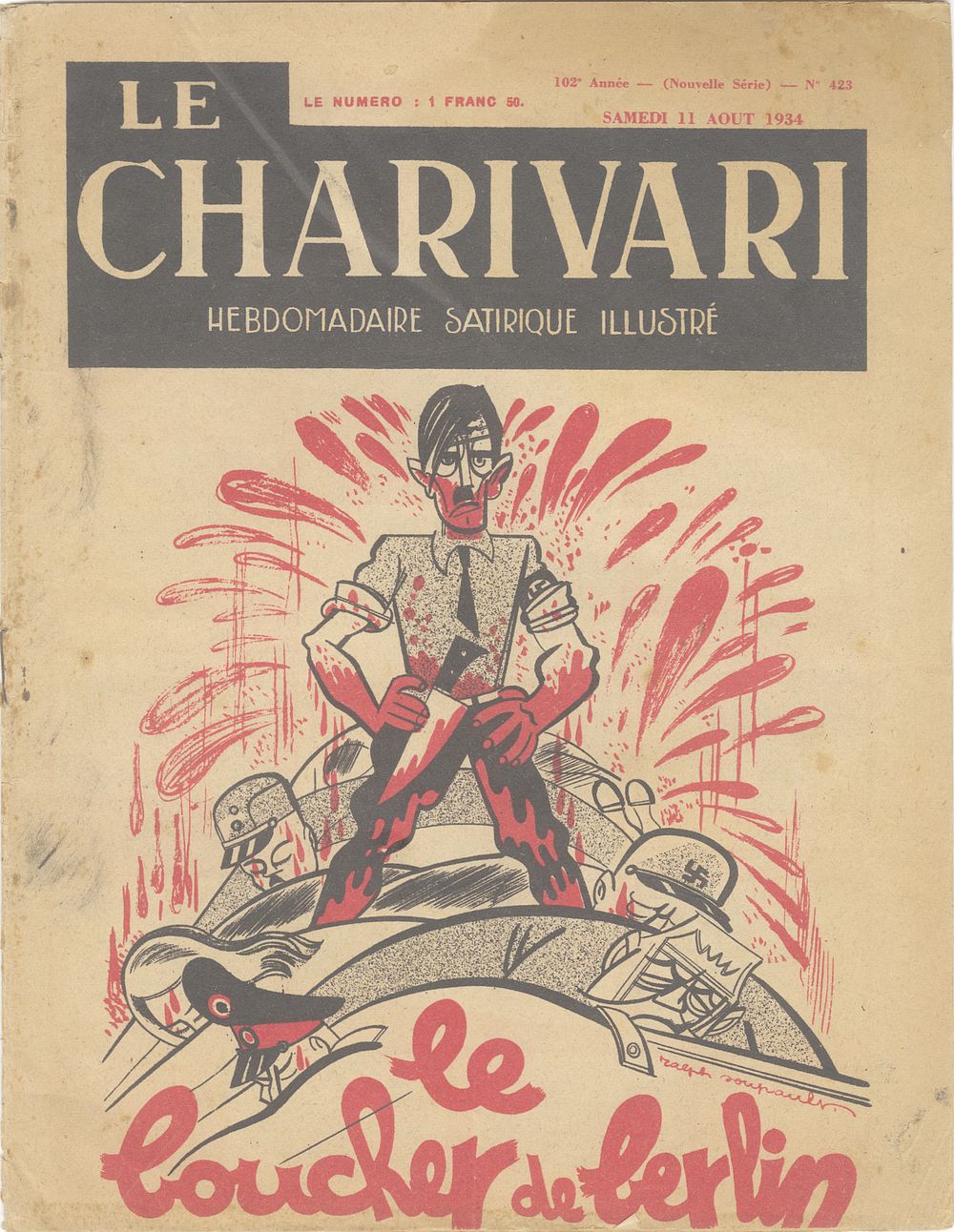
“The Butcher of Berlin” – Issue of the French Weekly Le Charivari Depicting Adolf Hitler as a Murderer Following the “Night of the Long Knives” - Issue of the French weekly Le Charivari, published on August 11, 1934 – its cover depicts Adolf Hitler as a bloodthirsty murderer following the Night of the Long Knives, during which Hitler murdered hundreds of his own men, including leaders of the SA. Rare. The cover illustration, entitled “The Butcher of Berlin, ” features a caricature attacking Adolf Hitler in the aftermath of the “Night of the Long Knives” (which had taken place a month and a half earlier, at the end of June 1934), during which Hitler eliminated the leadership of the SA and his political rivals in order to consolidate his absolute rule over Germany. The illustration, by artist Ralph Soupault, depicts Hitler holding a bloodstained butcher’s knife and standing over a pile of corpses of SA leaders, military personnel, and political opponents, whose bodies are being ground up in a meat grinder. The inner pages at the center of the issue deal with the political earthquake that shook Germany and Europe in the summer of 1934 – the events of the “Night of the Long Knives” and the death of President Paul von Hindenburg (who died on August 2, 1934), which enabled Hitler to consolidate his absolute power once and for all. The article notes that immediately following President Hindenburg’s death, Hitler wasted no time in exploiting the political vacuum, proclaiming himself Führer and Reich Chancellor and binding the army to an oath of personal allegiance to him. The article explains how the army, which had previously viewed Hitler’s actions and the SA militias with distaste, agreed to cooperate fully with the Nazi regime after Hitler eliminated the SA leadership during the “Night of the Long Knives.” The issue also discusses key figures of the regime, particularly Rudolf Hess, who delivered the official address following the purge and pledged absolute loyalty to the Führer, linking Nazi ideology with the army and German nationalism. It also addresses the growing international tensions, including the assassination of Austrian Chancellor Engelbert Dollfuss by Austrian Nazis on July 25, 1934, and the involvement of the German envoy in Vienna, von Rieth. Also in the issue is critical coverage of the major political and financial scandal then shaking France – the Stavisky Affair (L’Affaire Stavisky) – and its alleged close connections with Freemasonry (La Franc-Maçonnerie) at the highest levels of the French government. The article follows the attempts of the Masonic order to undergo an internal “purge” in order to restore its public image, which had been severely damaged following revelations concerning the involvement of senior members of the order in the fraud scandal. Also included is a report on the mysterious figure known as “the Commandant, ” involved with speculators and casino gamblers, in connection with the mysterious death of prosecutor Albert Prince – an affair that shocked France after Prince was reportedly preparing to expose documents relating to the Stavisky corruption scandal. At the center of the issue is a double-page caricature by the illustrator Bib, likewise dealing with the political repercussions of the Stavisky Affair, and more. The Night of the Long Knives, which took place between June 30 and July 2, 1934, was a bloody political purge carried out by Adolf Hitler in order to consolidate his absolute rule over Germany. In a carefully planned operation, Hitler ordered members of the SS and Gestapo to execute dozens, and possibly hundreds, of senior members of the SA, foremost among them its commander Ernst Röhm. The SA, the Nazi Party militia that had helped Hitler rise to power, had come to be regarded by him as an excessively independent power base, overly committed to socialist ideas, and a political threat. Beyond eliminating the SA leadership, Hitler seized the opportunity to settle old political scores and execute conservative politicians and other opponents, including former Chancellor Kurt von Schleicher. The event marked the subjugation of the SA and the ascendancy of the SS under Heinrich Himmler, while sending a clear and unmistakable message to the German military and public that any manifestation of opposition or independence would be met with brutal terror. From this point onward, the law was completely subordinated to the dictator’s will, as Hitler became the undisputed ruler of Nazi Germany. 27 pages. Complete issue. Minor stains to the cover. Good condition.