Bidspirit auction | The Goebbels Diaries 1942–1943 –
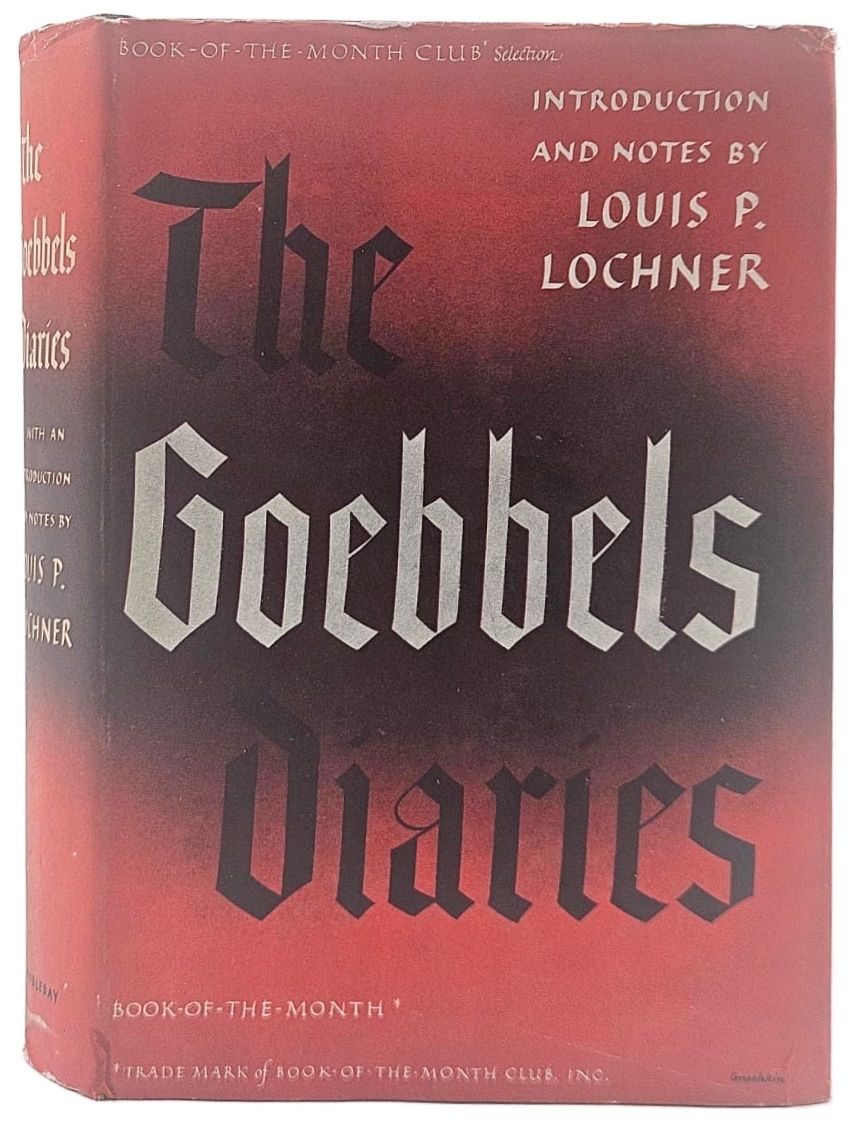
The Goebbels Diaries 1942–1943 – The Personal Diaries of the Nazi Minister of Propaganda – New York, 1948 – First Edition - The Goebbels Diaries, 1942–1943 – a complete transcript of the personal diaries of Nazi Minister of Propaganda Joseph Goebbels, by Louis P. Lochner, published by Doubleday & Company, Inc., Garden City, New York. New York, 1948 – First Edition. English. Accompanied by the original prospectus issued with the book – a four-page booklet by Seidel Candy about Goebbels, the man, and his diary. The personal diaries of Joseph Goebbels, Minister of Propaganda of the Third Reich, translated and edited by Pulitzer Prize-winning American journalist Louis P. Lochner, who served for many years as chief of the Associated Press bureau in Berlin. A publication of extraordinary historical importance, constituting one of the most significant primary and authentic sources for understanding the inner workings, strategic thinking, and decision-making processes at the highest levels of the Nazi regime during World War II. Following the capture of Berlin in 1945, the diaries of Nazi Propaganda Minister Joseph Goebbels were recovered, charred and incomplete, from the ruins of the Nazi Propaganda Ministry by local civilians, who sold them as waste paper. They eventually came into the possession of Lochner, who recognized their historical value, edited and translated them, and brought them to publication. The diary entries cover the critical period from January 1942 to December 1943, during which the tide of the war turned against Germany. His diaries constitute an almost unbearable intimate record of unmitigated evil. Yet they are also among the finest and most precise records of what was taking place at the highest levels of the German leadership during the war. Goebbels was the most skilled and unscrupulous liar in the world. He was also one of a very small group of people in wartime Germany who knew the truth about what was happening and what was being planned. While by day he fabricated his web of lies for the German people and the world, by night he told the truth to his diary. The diary provides a direct insight into Goebbels’s views regarding the war effort, the management of civilian propaganda, and the internal relationships between Hitler and the senior leaders of the Reich. Alongside this is a chilling and explicit record of the planning and implementation of the Holocaust and the persecution of European Jewry as they unfolded, exposing the cynicism and ideological fanaticism that drove the Nazi leadership. The diary clearly reveals how Goebbels bore direct responsibility for the enslavement and murder of millions, guided by a determination to do whatever might preserve Nazism for generations, at any cost to the world. Thus, for example, he wrote in his diary on March 11, 1943: “The evacuation of the Jews from Berlin led to a number of undesirable incidents. Unfortunately, a number of Jewish men and women from privileged mixed marriages were also arrested, thereby causing fear and confusion. The planned arrest of all Jews in a single day proved to be a surprise action because of the short-sighted conduct of industrialists who warned the Jews in time. As a result, we were unable to lay our hands on approximately 4,000 of them. They are now wandering around Berlin without homes, are not registered with the police, and naturally constitute a public danger. I instructed the police, the Wehrmacht, and the Party to do everything in their power to arrest these Jews as quickly as possible...”. Throughout the diary, published here for the first time, we find extensive passages concerning his relations with women; events that took place at Hitler’s opera balls among the senior figures of the Third Reich; the manner in which he ran the Propaganda Ministry, training his staff to disregard facts and concentrate on falsehoods; the techniques of mass psychological manipulation that he employed; the importance he attached to the distribution of propaganda films as a means of instilling Nazi propaganda; the strategy he pursued in controlling German radio broadcasts; diary entries revealing Adolf Hitler’s suspicions toward those closest to him; the manner in which he used German art to disseminate Nazi propaganda; his hatred of the English people; his hatred of the Christian Church; his intervention in matters concerning the various war fronts while completely disregarding the deaths of German soldiers; the manner in which he planned his speeches to influence the masses; and more. The author also included at the beginning of the book earlier passages from Goebbels’s diary expressing his admiration for and obsession with Hitler himself, revealing how, even in those early years, he made efforts to ingratiate himself with his leader: “And those great blue eyes! Like stars. He is glad to see me. I am happy to death.”; “Wit, irony, humor, sarcasm, seriousness, passion,