Bidspirit auction | “I Am Attacked Because I
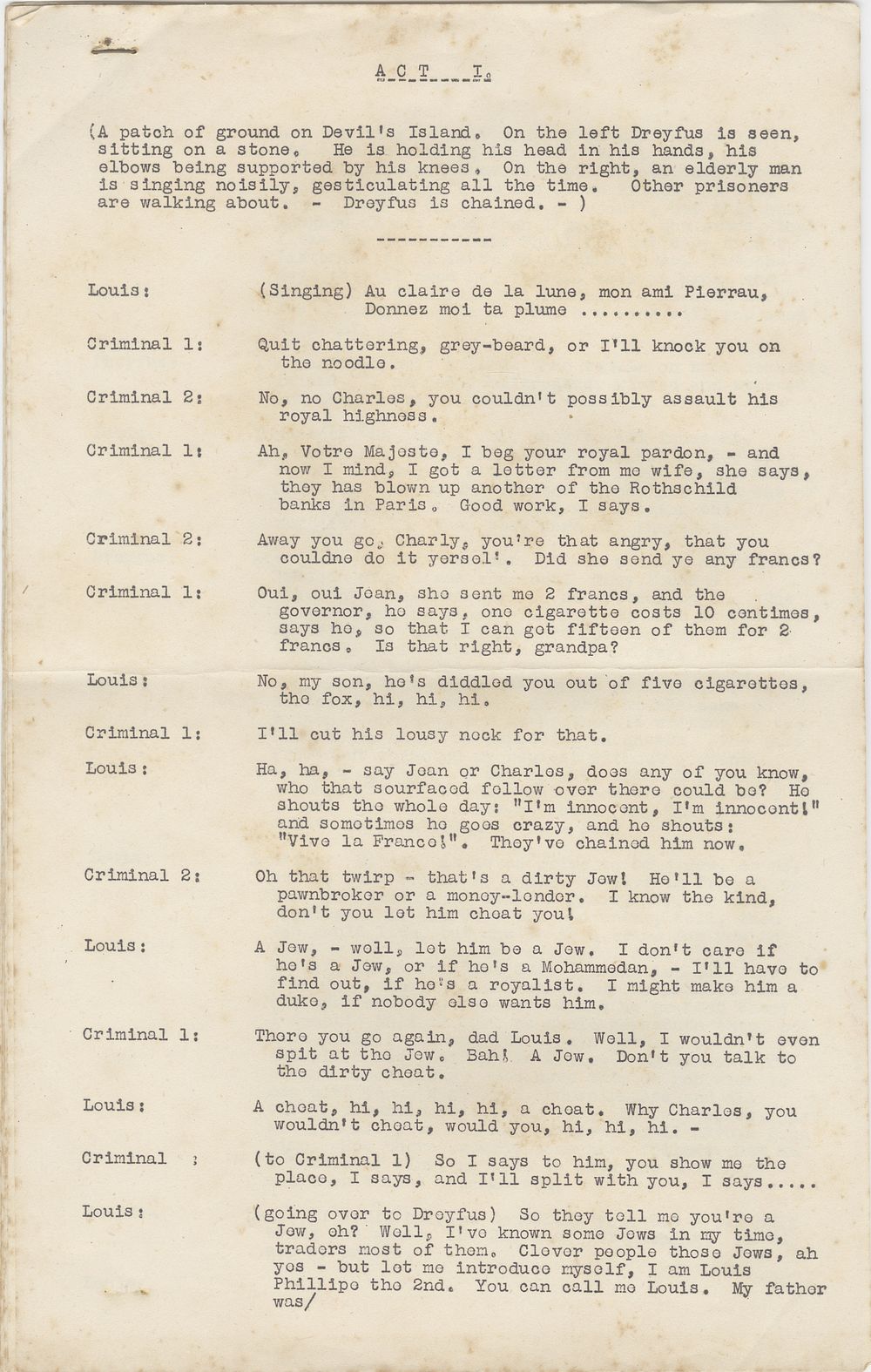
“I Am Attacked Because I Am a Jew...” – The Dreyfus Affair – The Play. [England, ca. 1920s] - Complete transcript of an early play dealing with the Dreyfus Affair. Typewritten. No publisher or printer indicated. [England, ca. 1920s]. A complete English transcript of a powerful three-act play dealing with Dreyfus’s struggle to prove his innocence while imprisoned on Devil’s Island, through to the establishment of his innocence in court, while presenting the Dreyfus Affair as a painful reflection of the persecution of the Jewish people as a whole. The script is structured as a series of dialogues, with the names of the characters appearing on the left (Dreyfus, Louis, Criminal 1, Judge, and others) and stage directions given in parentheses. The play opens with an interesting conversation between Dreyfus and the guard of his cell on Devil’s Island, in which Dreyfus expresses his unwavering belief in his innocence: “I am beaten, kicked and starved. And yet I still maintain that I am innocent...” Dreyfus appears before the court to appeal his sentence, and a substantial portion of the play consists of the charged courtroom proceedings surrounding his innocence. One after another, the prosecution’s arguments are presented, with quotations from the famous “Bordereau” – the coded military document that served as the basis for the false accusation against Dreyfus – followed by the responses of Dreyfus’s attorneys. Against the background of the play, the phenomenon of antisemitism repeatedly emerges. Dreyfus reiterates that although there is no evidence whatsoever supporting the accusations against him, he is being persecuted because he is a Jew. At one of the climactic moments of the play, Dreyfus declares: “I am attacked, because I am a Jew. I am a human being just like you, or you, or any other man. I have lain in the mud with the other officers – I have taken up my rifle with the soldiers, I will let you see my record, and yet I am a Jew. Before I retire from the witness stand, may I quote a passage from Shakespeare: ‘I am a Jew! Hath not a Jew eyes? Hath not a Jew hands, organs, feelings, passions? Fed with the same food, hurt with the same weapons, subject to the same diseases, suffering the same groans, warmed and cooled by the same winter and summer, as a Christian? If you prick us, do we not bleed? If you tickle us, do we not laugh? If you poison us, do we not die? Almighty God, I thank you.’” Gradually, as the evidence is presented throughout the play, the truth emerges and Dreyfus’s innocence becomes clear. Once his innocence has been established as a proven fact, Émile Zola becomes a hero of the play, as his defense of Dreyfus is shown to have been justified. The play then turns to what it presents as the true Jewish problem – the fact that the Jewish nation has no independent political entity of its own. The play concludes with the declaration that, in order to prevent tragic affairs such as that of Dreyfus from recurring, the Jewish people must build an independent homeland in their own land. The play ends with the singing of Hatikvah. 14 leaves. 33 cm. Stains. Good con