Bidspirit auction | The Execution of the War
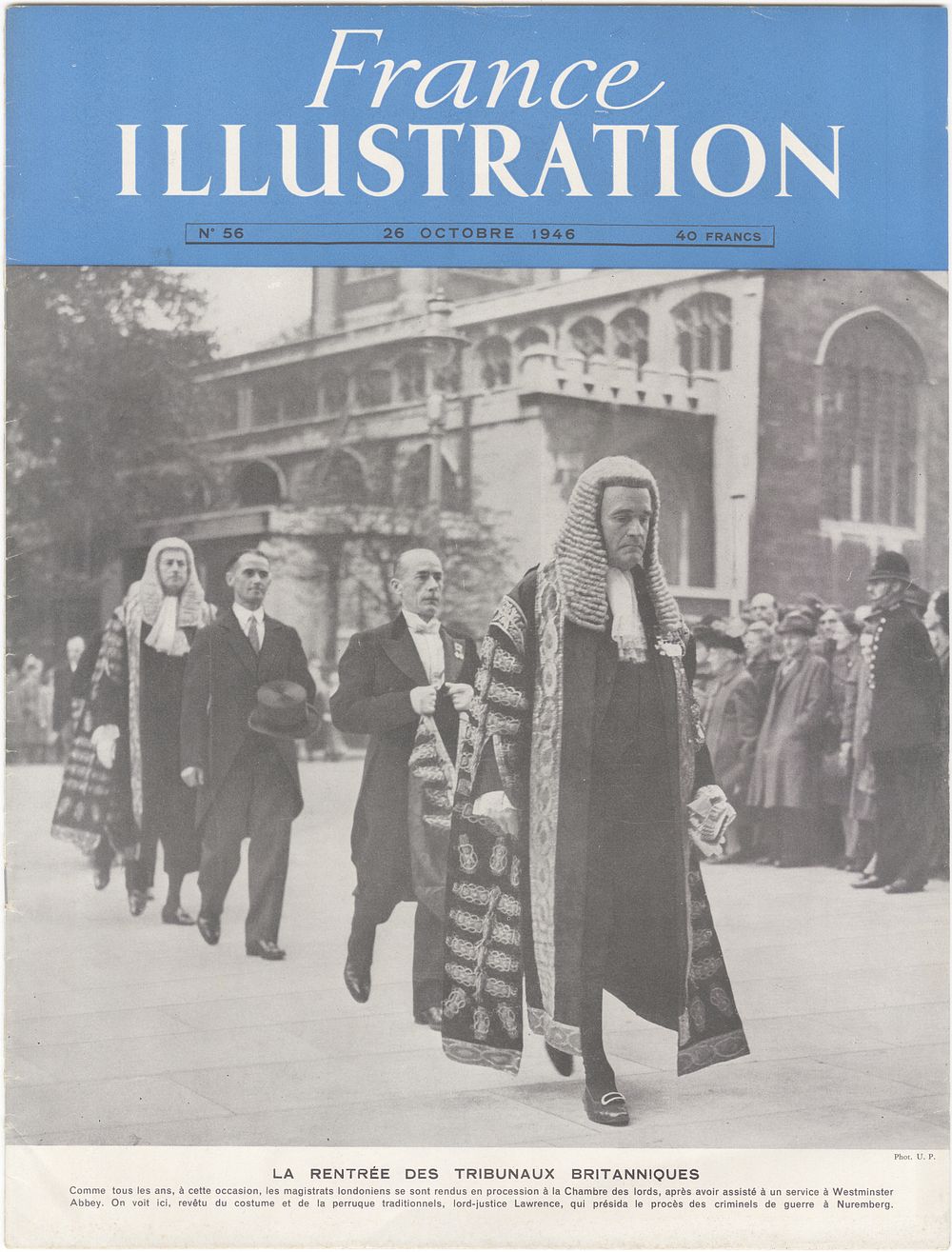
The Execution of the War Criminals Convicted at the Nuremberg Trials – Issue of France Illustration, October 26, 1946 - Issue of the French newspaper France Illustration, dated October 26, 1946, documenting the execution of the Nazi war criminals convicted at the Nuremberg Trials. Historic issue of the French weekly ״France Illustration״, published only days after the execution of the principal Nazi war criminals sentenced at the Nuremberg Trials (executed by hanging on October 16, 1946). The front cover features British judge Lord Geoffrey Lawrence, who presided over the panel of judges at the Nuremberg Trial, returning to court after attending a ceremony at Westminster Abbey, with his attendant holding up his long robe. On the inner pages, under the headline Les Exécutions de Nuremberg – “The Nuremberg Executions, ” the issue reports on Göring’s suicide and the procedure by which the Nazi war criminals were executed: “Ten Nazi leaders sentenced to death by the International Military Tribunal at Nuremberg were executed in accordance with the prescribed terms. Hermann Göring alone succeeded in committing suicide by swallowing the contents of a vial of potassium cyanide. An hour before the executions were due to begin, at 1:00 a.m. on October 16, Colonel Andrus, chief security officer at the Nuremberg prison, was informed of the premature death of the former Reich Air Marshal. At 10:45 p.m., the guard, who had kept him under constant observation and believed him to be asleep, was alerted by his death rattle. The German prison physician, Dr. Pflücker, who was summoned immediately, could only confirm the condemned man’s death. The presence of fragments of glass in his mouth and the characteristic odor of potassium cyanide emanating from him left no doubt as to the cause of death. Upon his arrival at the prison at Mondorf-les-Bains the previous summer, a capsule of this poison had already been found in his possession, and despite the extraordinary precautions taken following the suicide of Robert Ley, he had managed to obtain another capsule and thus escape punishment for his crimes. Between 11:38 and 11:54 p.m., Colonel Andrus read to the other condemned men, in their cells, the sentences handed down on October 1; and he warned them that they would be taken to their execution within the hour... One after another, at ten-minute intervals, following the Reich’s chief diplomat, Keitel, Kaltenbrunner, Rosenberg, Frank, Frick, Streicher, Sauckel, Jodl, and Seyss-Inquart mounted the steps of the gallows and suffered their punishment. All died with dignity, except Streicher, who hurled curses at those present. At 2:52 a.m., just as the final rope was cut, two guards entered the room carrying Hermann Göring’s body on a stretcher. The eleven bodies were then taken to an undisclosed location, where they were cremated. Their ashes were scattered to the winds. Only one series of photographs was taken of the executed men before they were placed in their coffins. These photographs were intended for the historical archives of the four great Allied powers, and none of them was published. But the Inter-Allied Control Council decided otherwise. No doubt it considered that, at a time when so much was being said about the re-education of the German people, the sight of these images could contribute greatly to that purpose. Was it not fitting that the frenzied masses who had once taken part in the ostentatious parades of the masters of the Third Reich should now be able to contemplate them, after their punishment, in the very city of Nuremberg, where they had prepared their people for a war that ended in the greatest catastrophe any nation had known for centuries?” At the center of the page is a photograph of American Master Sergeant John C. Woods, who carried out the executions, preparing the hangman’s noose, alongside additional photographs: an aerial view of the Nuremberg prison; Colonel Burton C. Andrus announcing Göring’s suicide; and a photograph showing some of the forty-five people who were present at the executions. Additional articles in the issue deal with the reconstruction of France after the war, the heroic actions of the French First Army during the liberation of France, the theft of the Duchess of Windsor’s jewels, developments in Algeria, and more. 29 pages. 38 cm. Complete issue. Very good condition.