Bidspirit auction | An Experience of the Events
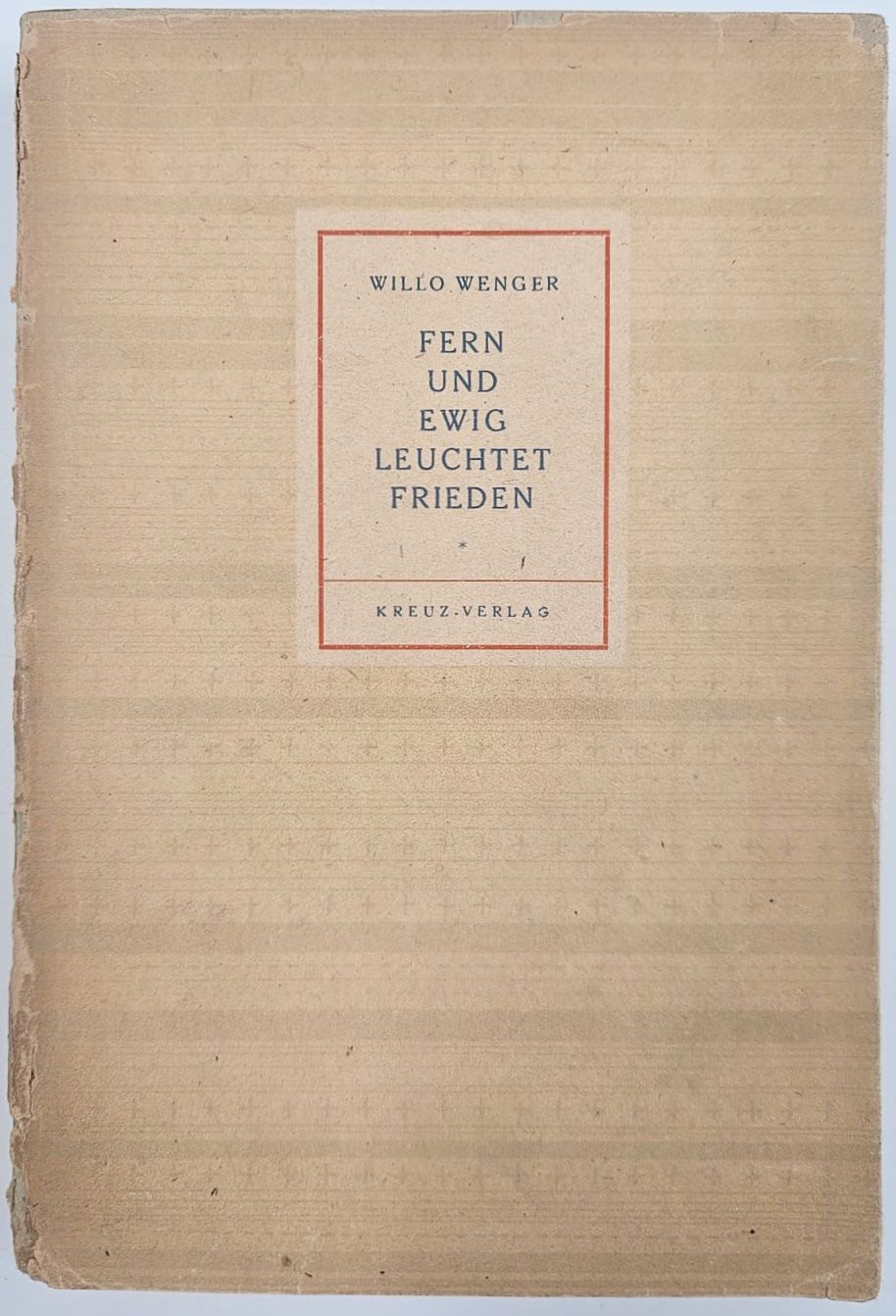
An Experience of the Events of the Period Based on the Reports and Records of a Man Condemned to Death – Testimony of a Concentration Camp Prisoner Sentenced to Death and Saved. Stuttgart, 1946 – First Edition - Fern und ewig leuchtet Frieden: Ein Erlebnis aus dem Zeitgeschehen nach Berichten sowie nach Aufzeichnungen eines zum Tode Verurteilten – Far Away and Forever Peace Shines: An Experience of the Events of the Period Based on Reports and the Records of a Man Condemned to Death. By Willo Wenger. Published by Kreuz-Verlag, Stuttgart, 1946 – First Edition. German. Rare. “If I survived the terrible hardships from the end of 1943 until the middle of 1945 in prisons and concentration camps without despairing or breaking down, during a period when the death sentence imposed upon me threatened to be carried out every day, while around me hundreds, indeed thousands, of such death sentences were being carried out daily and at every hour, then, apart from God’s protection, I owe it solely to the loyalty of four men...”. An early and important testimony concerning persecution under the Nazi regime and the concentration camps, published in Stuttgart in 1946, only a few months after the end of World War II. The book is based on reports and notes written by a man who was sentenced to death by the Nazi regime on charges of “undermining the war effort, ” and provides a first-person account of his journey from the prisons of the Third Reich to the inferno of the Mauthausen–Gusen concentration camp system. The book is divided into three principal sections: “The Trial” (Der Prozess) – the legal proceedings against him and how he escaped execution at the last moment; “Between Death and Life” (Zwischen Tod und Leben) – his imprisonment in Gestapo prisons with a death sentence hanging over his head; and “Inferno” – his experiences as a concentration camp prisoner. The author was arrested in late 1943, brought to trial, and sentenced to death. In the opening sections of the book, he describes the experience of sitting in his prison cell knowing that the sentence could be carried out at any moment. From his cell he hears the escort detail arriving to take other condemned prisoners to the place of execution, and describes the constant terror and helplessness of a man who had become, in his own words, a “defenseless object” of a terror state driven by a ruthless will to destroy. At the same time, he emphasizes that his opposition to the regime arose from his recognition of the danger that Nazi rule posed to Germany itself, and describes his refusal to accept the accusation that he was a “traitor to the fatherland.” His death sentence was ultimately not carried out, thanks to skilled attorneys who succeeded in having it commuted to imprisonment, and after a period in Gestapo prisons he was transferred to the Mauthausen–Gusen concentration camp system. Here the author describes the most harrowing part of his ordeal: grueling forced labor, starvation, beatings, disease, humiliation, mass death, and the prisoners’ daily struggle to remain alive. He recounts how his body deteriorated day after day under the combined effects of exhausting labor and meager food rations, until he reached a state of extreme exhaustion and physical collapse. Within the world of the camp, where hunger and forced labor drove prisoners to the brink of death, a group of veteran prisoners operated secretly to assist their fellow inmates and attempted to save those whose lives were in immediate danger. The author himself survived thanks to their intervention, and after recovering to some extent, he too became involved in this system of mutual aid. In the section dealing with his imprisonment in the concentration camp, he also describes the bitter fate of the Jewish prisoners – the severe physical abuse they endured and their struggle to survive despite everything. Toward the end of the war, after the countless ordeals in the camp described in his book, he finds himself in the camp infirmary, utterly exhausted and extremely weak. His comrades secretly manage to obtain a little soup and bread for him in a final attempt to keep him alive. One of them tells him sorrowfully that they cannot help everyone and that his end is probably near. Before long, against this background, Nazi Germany begins to collapse: thousands of people continue to arrive each day from concentration camps being evacuated, contradictory and senseless orders follow one after another, and reports spread among the prisoners that the American and British armies have already crossed the Rhine, while the Red Army has crossed the Oder and is approaching Berlin. The book thus documents from within the final stage of the concentration camp system – a moment when Nazi rule was already disintegrating, yet the machinery of imprisonment and death continued to operate – while Wenger ultimately manages to survive with the last of his strength. The author’s name, Willo Wenger,