Bidspirit auction | The Tasks of the Communist
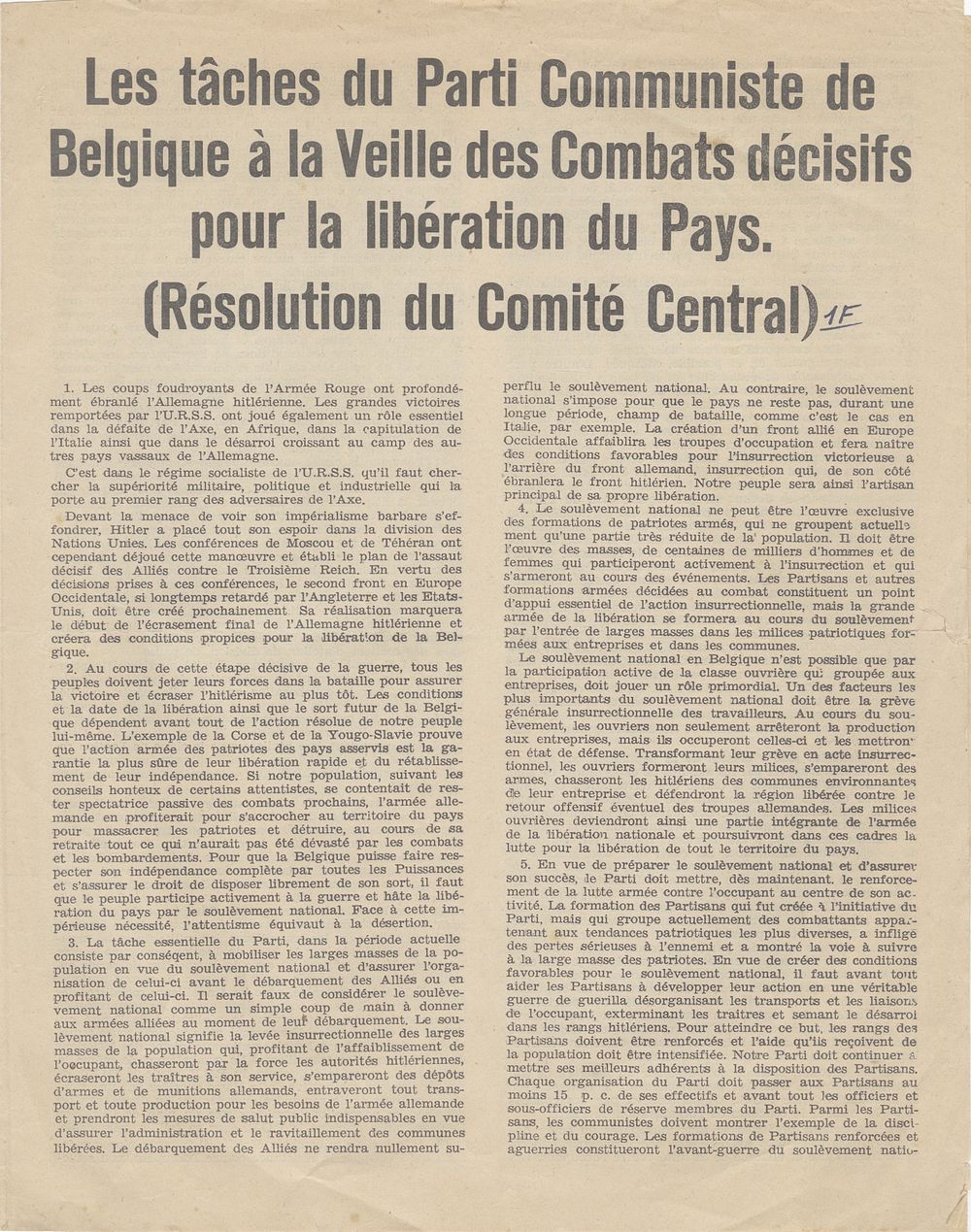
The Tasks of the Communist Party of Belgium on the Eve of the Decisive Battles for the Liberation of the Country – Official Document – Plan of Action for the Defeat of the Nazi Occupier in Belgium - Les tâches du Parti Communiste de Belgique à la Veille des Combats décisifs pour la libération du Pays (Résolution du Comité Central) – The Tasks of the Communist Party of Belgium on the Eve of the Decisive Battles for the Liberation of the Country (Resolution of the Central Committee) – The Belgian Communist Party’s plan of action in preparation for the defeat of Nazi Germany. Spring 1944. Extremely rare. “At this decisive stage of the war, all peoples must commit their forces to the struggle in order to secure victory and crush Hitlerism as quickly as possible. The conditions and date of liberation, as well as Belgium’s future destiny, depend above all upon determined action by our own people. The examples of Corsica and Yugoslavia prove that armed action by patriots in subjugated countries is the surest guarantee of their rapid liberation and the restoration of their independence. If our population, following the shameful advice of certain opportunists, remains a passive spectator of the approaching battles, the German army will take advantage of this to cling to the territory of our country, massacre the patriots, and destroy, during its retreat, everything that has not already been destroyed by the fighting and bombardments. In order for Belgium to have its full independence respected by all the powers and to secure the right to determine its destiny freely, the people must take an active part in the war and hasten the liberation of the country through a national uprising. In the face of this imperative necessity, inaction is equivalent to desertion...”. The detailed plan of action of the Central Committee of the Communist Party of Belgium (PCB), distributed during the final period of the Nazi occupation of Belgium in preparation for the country’s liberation in 1944. The text presents an ideological and strategic analysis and sets out the Party’s operational directives in preparation for a national uprising and armed struggle against the occupying forces. The first section analyzes the international situation, emphasizing the devastating blows inflicted upon Germany by the Red Army and the Nazi defeats in North Africa and Italy, alongside a call for the opening of a “Second Front” in Western Europe. The document then warns against passivity and waiting, arguing on the basis of the experience of Corsica and Yugoslavia that only active resistance by the population could guarantee Belgium’s independence: “In order to prepare for the national uprising and ensure its success, the Party must, from this moment onward, place the strengthening of the armed struggle against the occupier at the center of its activities. The partisan movement, created on the initiative of the Party but now comprising fighters belonging to the most diverse patriotic tendencies, has inflicted heavy losses upon the enemy.” The operational section contains explicit directives for the mass mobilization of the population to undermine the German war effort, including the seizure of weapons depots, disruption of transportation and war production, and the takeover of local administrative authorities. Workers are likewise called upon to transform strikes in factories into armed struggle and to establish patriotic militias. The document also calls for an intensification of guerrilla operations against the Nazis and their collaborators. Particular emphasis is placed on the urgent need to establish partisan units within factories in order to protect workers against Nazi repression and to form the nucleus of future workers’ militias. Alongside this is a call for rapid armament through the seizure of enemy weapons, the location of German ammunition depots, and the opening of concealed arms caches belonging to organizations that had refrained from participating in the armed struggle. The document also deals extensively with increasing resistance to compulsory labor conscription in Germany, calling for young people in hiding to be organized within special committees of the “Independence Front” (Front de l’Indépendance) in order to integrate them into the active struggle. Particular emphasis is placed on the central role of youth in the resistance and on strengthening the Young Socialist Guards (J.G.S.), while joining forces with Christian youth and sports organizations in a single patriotic front. The importance of unity and comradeship in struggle among Communist and Socialist workers and the trade unions is likewise emphasized, while elements attempting to divide the movement are denounced. The document concludes with an emphatic call to intensify resistance on every front and to ensure the determination of the working class in the decisive battles for the liberation of the country.