Bidspirit auction | War Crimes at the Breendonk
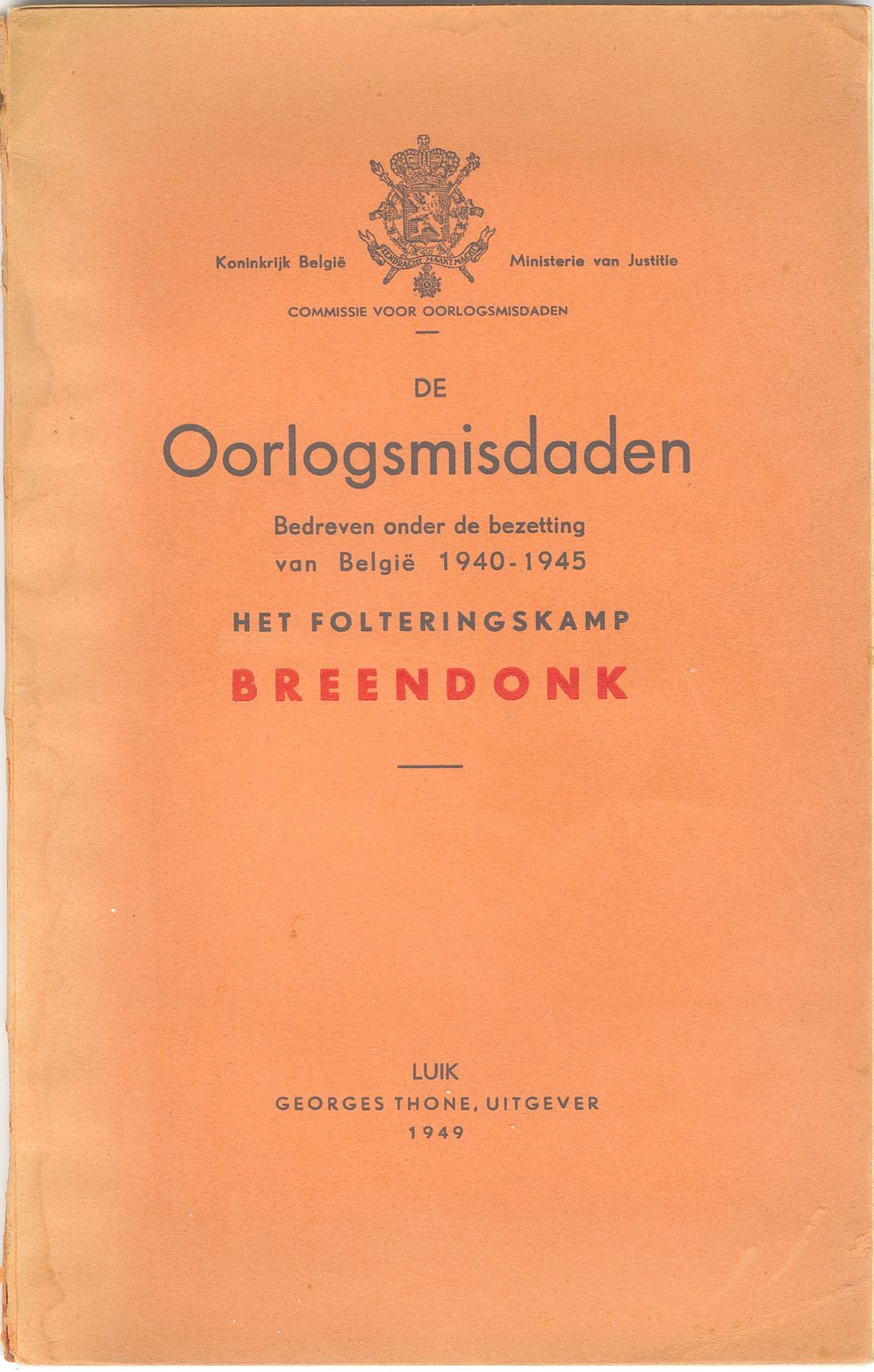
War Crimes at the Breendonk Torture Camp – Official Report. Belgium, 1949 - De Oorlogsmisdaden bedreven onder de bezetting van België 1940–1945 – Het Folteringskamp Breendonk – War Crimes Committed During the Occupation of Belgium, 1940–1945 – The Breendonk Torture Camp. Official document published by the “War Crimes Commission” (Commissie voor Oorlogsmisdaden) of the Belgian Ministry of Justice. Liège [Belgium], 1949. A detailed report on the atrocities, war crimes, and acts of torture perpetrated by the Nazis at the Breendonk camp. A summary of the findings of the Belgian commission of inquiry established to investigate and document the atrocities. The report provides a detailed survey of the camp’s operation between 1940 and 1945. It describes the physical structure of the fortress, surrounded by a water-filled moat; the regime of abuse, starvation, and systematic torture imposed by SS personnel and Belgian collaborators; and the legal evidence gathered for the prosecution and conviction of the camp commanders in the Belgian war-crimes trials following liberation. The report details the harsh conditions of imprisonment within the concrete fortress, which was surrounded by a deep water-filled moat and divided into overcrowded detention cells without ventilation or heating. A substantial section describes the regime of forced labor intended to break the prisoners physically, including manual excavation of earth and the carrying of heavy loads within the fortress trenches while subjected to severe beatings by the guards. The systematic interrogation and torture methods employed in the camp’s notorious torture “bunker” are also described. The document contains testimonies and legal findings concerning prisoners being suspended by their arms, electric shocks, finger clamps, strangulation, and brutal beatings to the point of unconsciousness, carried out under the command of camp commander Philipp Schmitt and his German and Belgian subordinates. It also documents the execution of at least 185 prisoners by shooting and hanging within the fortress grounds, as well as the deportation of more than 3,500 prisoners to concentration and extermination camps in the East, including Auschwitz, Buchenwald, and Ravensbrück. Among other subjects, the report deals extensively with the condition of the Jews in the camp, their inferior status – the special markings they were forced to wear on their clothing, and more – and describes how the abuse inflicted upon the Jews was the most severe of all. The Jews were the only prisoners in the camp who were arrested because of their origin rather than as “political prisoners.” The report also provides extensive details concerning the serious diseases that spread throughout the camp, the various forms of forced labor, the methods of torture employed by the Nazis in the camp, the number of victims, and more. The report is accompanied by harrowing photographs of the torture facilities and the various sections of the camp, as well as diagrams and maps showing the precise location of each area within the camp. The commission consisted of six members appointed by the Belgian government, who investigated the Nazi crimes committed at the camp with the aim of bringing to justice Nazi war criminals who remained at large after the war and had been involved in the atrocities perpetrated at Breendonk. Breendonk had previously served as a fortified military base of the Belgian army, situated between the cities of Antwerp and Brussels in Belgium. During the German occupation of Belgium in World War II, it was used as a detention camp in which Jews from the Belgian Jewish community were also imprisoned. On September 20, 1940, the first prisoners arrived at the fortress. Belgian Communists, members of the Resistance, hostages seized by the Germans, Jews from the Belgian Jewish community, and criminal offenders were imprisoned there. During the first year of the camp’s existence, Jews constituted approximately half of its prisoner population. They were held separately from the other prisoners. Among those imprisoned in the fortress were Rabbi Salomon Ullmann, Chief Rabbi of the Belgian Jewish community, and leaders of the Association of Jews in Belgium. Prisoners remained at the fortress for an average of approximately three months before being deported to concentration camps in Germany, Austria, and Poland. The prisoners suffered harsh living conditions, starvation, denial of medical treatment, and brutal treatment by the camp staff, and were subjected to forced labor. The Germans also conducted interrogations, torture, and executions by hanging at the fortress. Various “political” prisoners were interrogated in the camp under severe torture. The fortress’s first German commandant, Philipp Schmitt, was brought to trial in Belgium in 1949, convicted, sentenced to death, and executed in 1950. 102 pages + [8] photographic plates. Minor wear to the cover. Good condition.