Bidspirit auction | Testimony of a Breendonk Camp
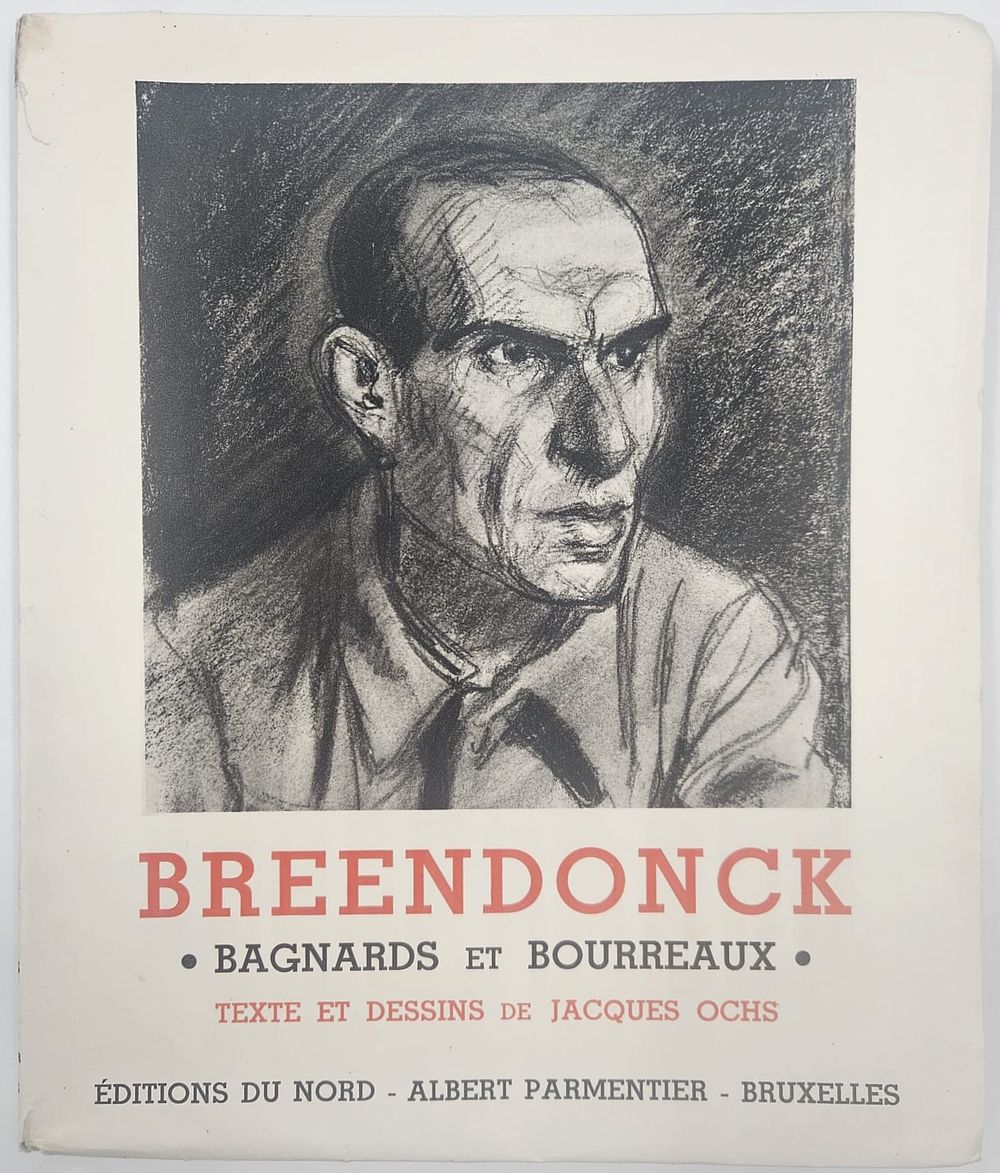
Testimony of a Breendonk Camp Prisoner and Portraits of Prisoners He Drew in the Camp – Copy Signed by the Author - BREENDONCK – Bagnards et Bourreaux – Breendonk: Prisoners and Executioners, by Jacques Ochs. Éditions du Nord – Albert Parmentier, Brussels, 1947 – First Edition. The testimony of Belgian Jewish fencer Jacques Ochs, a prisoner at the Breendonk camp, accompanied by portraits of prisoners and other figures from the camp which he drew while himself a prisoner there – copy signed by the author. The author, Jacques Ochs [1883–1971], was a Belgian-Jewish fencer and Olympic champion (Stockholm, 1912). In addition, he was a painter and caricaturist for the French daily Le Figaro, as well as a professor of art and director of the Museum of Fine Arts in Liège. He was arrested by the Gestapo because of his Jewish origin and his activities, and was imprisoned in the Breendonk concentration and torture camp between 1940 and 1942. During World War II, following the German occupation of Belgium, Ochs was imprisoned at Fort Breendonk. While in the camp, despite conditions of extreme physical exhaustion, he succeeded, at the risk of his life, in drawing portraits of his fellow prisoners as well as of the camp commanders and SS guards. Approximately two years after his release, the author published in the present book both his testimony concerning the years of his imprisonment at Breendonk and the portraits of his comrades in struggle and suffering, alongside penetrating portraits of the camp commanders and Nazi guards. Ochs was arrested in 1940, while serving as director of the Academy of Fine Arts in Liège, on the charge of having spoken publicly against Adolf Hitler. Following a five-hour interrogation by Gestapo officers, he was transferred to a cell in Saint-Léonard Prison, and from there to Breendonk. In his testimony, he describes in detail the forced labor at construction sites around the camp, as well as the torture and suffering endured by the prisoners. In his book, he explains what the Breendonk camp was: “Everywhere you look: kicks, belt buckles, protruding bones, swollen heads, broken teeth, dysentery, hunger, suicides, cases of madness – this is Breendonk.” The second part of the book contains 39 portraits of prisoners and scenes drawn by Ochs in the camp. Most of those depicted were prisoners who met their deaths at Breendonk. In the main text, while describing the suffering they endured, Ochs recounts the experiences of these individual prisoners, and whenever he refers to a particular prisoner, he gives the number corresponding to that person’s portrait, thus enabling the reader to see the actual face of the prisoner about whom he is giving testimony. Ochs made the drawings in the camp while the events were taking place, and they were miraculously preserved until after the war. The printing process and the reproduction of the original drawings in the book were carried out under the artist’s personal supervision. In the introduction to the book, the author writes that he struggled deeply with the decision whether to record his testimony, fearing that doing so would bring back the horrific scenes he had witnessed as a prisoner at Breendonk. Ultimately, however, he decided to write his account for future generations and in memory of the prisoners he had drawn who had since died. The portraits he created were later used as important legal evidence in identifying Nazi war criminals and collaborators during the trials held in Belgium following liberation. Breendonk had previously served as a fortified military base of the Belgian army, situated between the cities of Antwerp and Brussels in Belgium. During the German occupation of Belgium in World War II, the Nazis used it as a detention camp in which Jews from the Belgian Jewish community were also imprisoned. On September 20, 1940, the first prisoners arrived at the fortress. Belgian Communists, members of the Resistance, hostages seized by the Germans, Jews from the Belgian Jewish community, and criminal offenders were imprisoned there. During the first year of the camp’s existence, Jews constituted approximately half of its prisoner population. They were held separately from the other prisoners. Among those imprisoned in the fortress were Rabbi Salomon Ullmann, Chief Rabbi of the Belgian Jewish community, and leaders of the Association of Jews in Belgium. Prisoners remained at the fortress for an average of approximately three months before being deported to concentration camps in Germany, Austria, and Poland. The prisoners suffered harsh living conditions, starvation, denial of medical treatment, and brutal treatment by the camp staff, and were subjected to forced labor. The Germans also conducted interrogations, torture, and executions by hanging at the fortress. Various “political” prisoners were interrogated in the camp under severe torture. The fortress’s first German commandant, Philipp Schmitt,