Bidspirit auction | In the Hell on Earth.
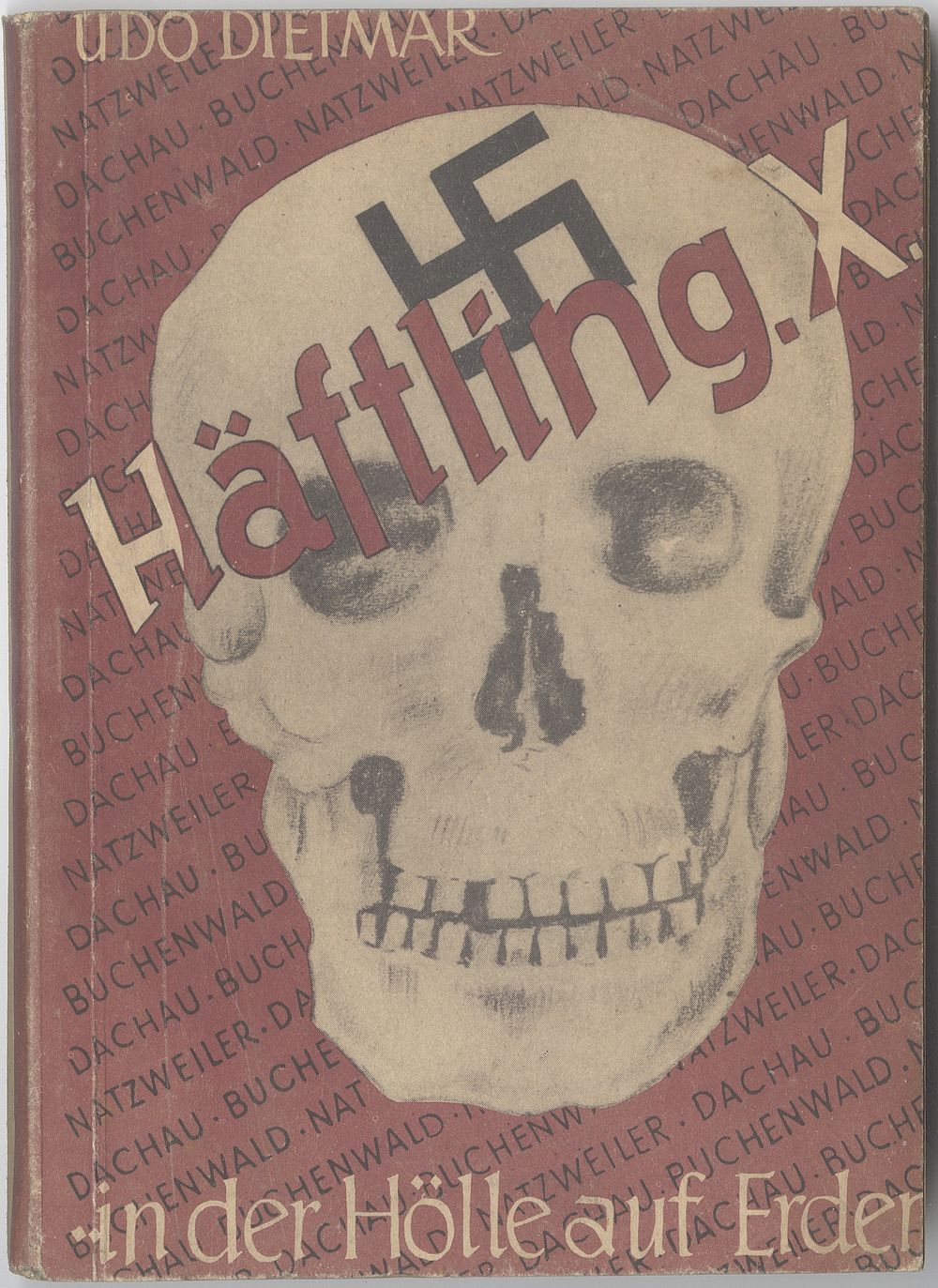
In the Hell on Earth. Weimar, 1946 – First Edition - In der Hölle auf Erden – In the Hell on Earth, by Udo Dietmar, a survivor of the Buchenwald and Dachau concentration camps. Mainz edition, 1946 – First Edition, with minor variations in the cover design and content (differing from the Weimar edition; see Dynasty Auction 27, Lot 173). One of the earliest testimonies published about the Buchenwald and Dachau concentration camps. Paul was active in the Communist resistance. He was first arrested in 1934 after quoting Marx and Engels at a memorial gathering and was sent to a penal camp in the Emsland marshes. Following his release, he was arrested again in 1940 and imprisoned in the police prison in Cologne. In August 1943 he was deported to the Natzweiler concentration camp; in September 1944 he was transferred to Dachau; and in December 1944 to Buchenwald, where he survived until liberation in April 1945. In the book, he recounts his personal story, beginning with his being taken from his parents’ home by SS men and transported to the camps, while revealing horrifying details of daily life in the concentration camps. The author also reveals previously unknown details about Auschwitz, which he learned from fellow survivors who joined him in providing testimony for the writing of the book. In the introduction, the author writes: “Dachau, Buchenwald, Mauthausen, Auschwitz, Lublin, Bergen-Belsen... Ravensbrück... names written in blood... innocent blood, filled with the cowardly and brutal murder of countless human beings merely because they were not National Socialists... These names embody history’s gravest accusation against a people... No words can express the immense suffering of the victims... As one of the surviving witnesses, I wish to reveal the truth about what happened in those camps before my own eyes and upon my own flesh, so that the world may recognize the true face of Nazism, and to open the eyes of those who still harbor even the slightest doubt concerning the horrifying radio reports of what took place there... The truth is harsh and painful, but it has the power to heal those who seek the truth... This book was written in memory of the 51,000 comrades who were with me in Buchenwald, and the tens of thousands murdered in Dachau, with whom I walked shoulder to shoulder, year after year, along a road of terror that seemed endless... The cruelty I am about to describe in my book is beyond comprehension...”. The book, one of the earliest detailed testimonies published about the concentration camps and filled with descriptions that are extremely difficult to read, recounts in minute detail the author’s daily experiences in the camps: the severe torture he endured personally; close friends murdered only a few meters away from him; and, in one passage, a form of torture in which prisoners were placed inside a rotating concrete mixer. He documents the operation of the crematoria, the executions he witnessed on a daily basis, the brutal manner in which the camps were run by SS commanders, Nazi soldiers celebrating their birthdays alongside the bodies of prisoners who had just been murdered, the relentless daily starvation, and much more, revealing numerous details that were still largely unknown to the wider world at the time. Udo Dietmar was apparently a pseudonym. Research based, among other sources, on documents from the Dachau and Buchenwald archives identified him as Walter Paul (1910–1974), a native of Gelsenkirchen. This identification was published only decades after the book first appeared. Cross-referencing of available information suggests that Paul was persecuted as a homosexual. It has been proposed that the continuing stigma against homosexuals in postwar Germany may explain why he published his testimony under a pseudonym, although this has not been conclusively established. The cover design features an enormous skull, a swastika above it, and the title Häftling X, with the names of the three camps – Natzweiler, Dachau, and Buchenwald – repeated again and again in the background. This cover was designed for the Mainz edition published by Rheinischer Volksverlag in 1946, with minor variations from the Weimar edition issued that same year. (The University of Giessen lists both versions.) This is the first edition of the book, which over the years was published in numerous editions and translated into many languages. 152 pages. Good–very good condition.