Bidspirit auction | Non-Traditional Haggadah – The Zionist
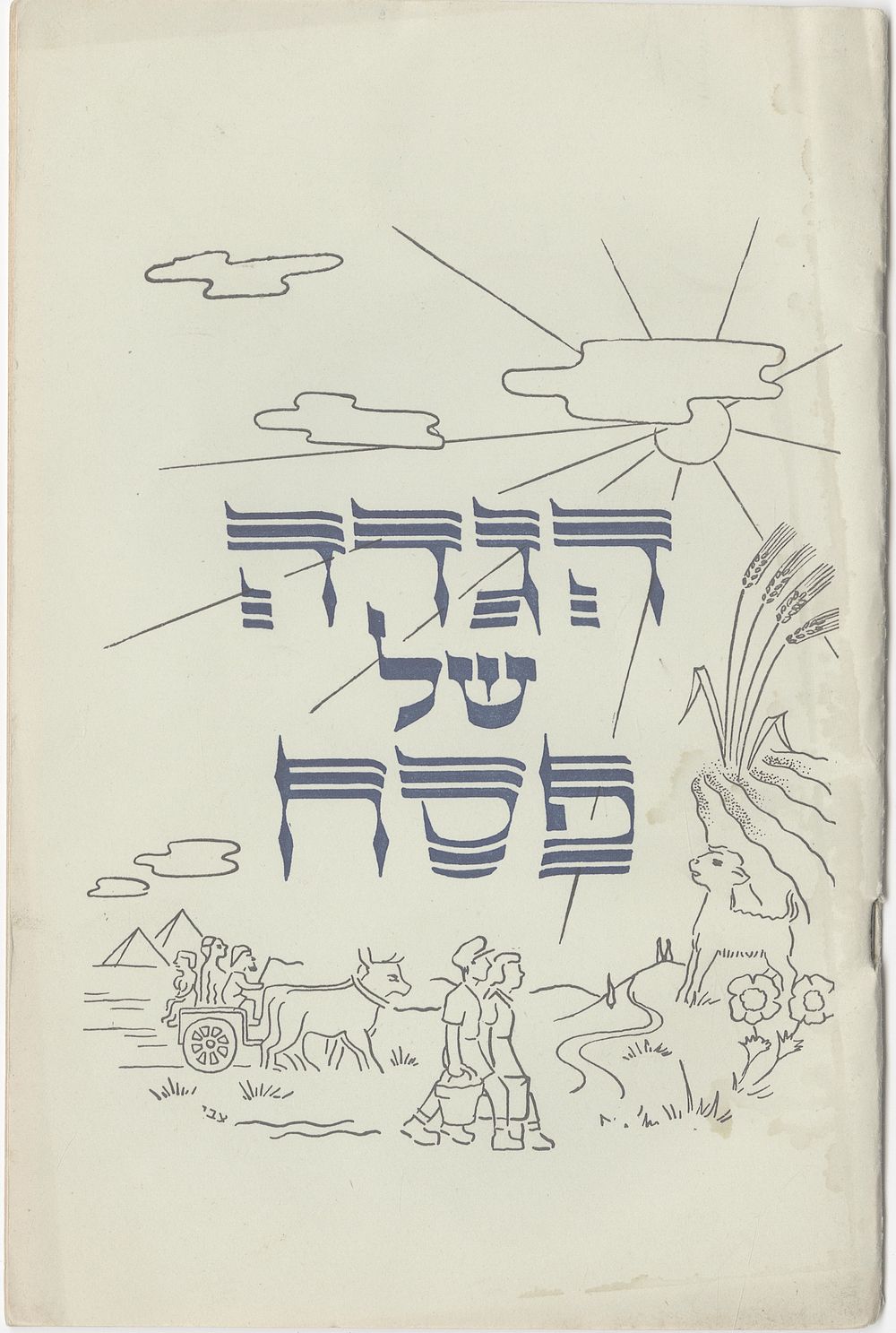
Non-Traditional Haggadah – The Zionist Youth Farm. Jerusalem, [1952] - Non-Traditional Haggadah – The Dr. Israel Goldstein Zionist Youth Farm – Original Passages Dealing with the Holocaust, Illegal Immigration to Eretz Israel, the War of Independence, and the Liberation of Jerusalem – Written and Illustrated by Meir Z.; printing blocks by Pikowski; “Gesher” Press, Jerusalem, 5712 [1952]. At the beginning of the Haggadah is a dedication from the Zionist Youth Farm to the Schwartz family. A non-traditional Eretz-Israel Haggadah created at the Zionist Youth Farm in Jerusalem, combining the story of the Exodus from Egypt with the chapters of Jewish national revival experienced by the most recent generation – the Holocaust, illegal immigration to Eretz Israel, immigration to the country, the War of Independence, and the liberation of Jerusalem. Alongside passages from the traditional Haggadah are original texts and numerous illustrations, transforming the Exodus from an ancient historical model into the story of the national redemption of the generation of 1948. At the beginning of the Haggadah, Passover is presented as a festival composed of historical layers accumulated over the generations: the ancient spring festival, the Passover of Egypt, and the Passover of successive generations of the Jewish people. Particularly striking is the adaptation of Vayehi BaChatzi HaLayla (“And It Came to Pass at Midnight”), in which the night of the Exodus from Egypt is replaced by the night of the battle for Jerusalem during the War of Independence. Jerusalem is described under heavy siege, with the road from the coastal plain blocked and food supplies dwindling: “Jerusalem, the eternal capital of Israel, is under heavy siege. The road from the coastal plain is blocked, and the city’s food supplies are running short. Efforts are being made to break the siege and liberate the capital. In those days, Haganah units resolved to clear the New City of Jerusalem of enemy forces. Our neighborhood was designated as the first objective...” - The Haganah units set out to clear the New City of Jerusalem of enemy forces, and the account concludes with the decisive moment: “The outcome was determined on Passover night. The Katamon neighborhood was liberated by the Haganah.” Another original section recasts the story of the Exodus as a Zionist parable. Moses, leaving Pharaoh’s house and encountering the Hebrew slave being beaten, is portrayed as rediscovering his belonging to his people; his striking of the Egyptian and flight into the desert become the starting point of his national awakening. The passage concludes with the assertion that individual freedom is not enough: one must “fight the battle for justice without ceasing, until the time came for him to become the redeemer of his people and a teacher of righteousness to mankind.” One of the most interesting passages in the Haggadah explicitly links the Exodus from Egypt with the fate of European Jewry: “When Israel went forth from Egypt, the House of Jacob from those who enslaved them, ” followed by: “Today the sea saw and fled, the road turned backward. The mountains skipped like rams, the hills like young sheep.” The Jewish communities of the Diaspora are subsequently portrayed as awakening to return to Eretz Israel, and the departure from exile is presented as a direct continuation of the Exodus from Egypt. Another section, entitled “We Were Slaves – Now We Are Free, ” shifts the focus of the Haggadah to the Holocaust and national revival. The ancient memory of enslavement is juxtaposed with the “days of bloodshed” experienced by the most recent generation, followed by immigration to Eretz Israel, illegal immigration, and the struggle for independence. In this way, the Haggadah transforms the traditional formula, “In every generation, a person must regard himself as though he personally came forth from Egypt, ” into the lived historical experience of a generation that had just passed through destruction, displacement, and war and had reached the State of Israel. The passage “In Every Generation” is likewise interpreted in a contemporary context: “A person must regard himself as though he personally came forth from Egypt” appears alongside images of building the country, agricultural labor, and settlement, while other pages of the Haggadah incorporate motifs of sheaves of grain, vineyards, pioneers, immigrants, and convoys. The illustrations and typography themselves form part of the message: traditional symbols of the Seder are juxtaposed with landscapes of Eretz Israel and pioneering labor, presenting the biblical past and the Israeli present as a single historical continuum.