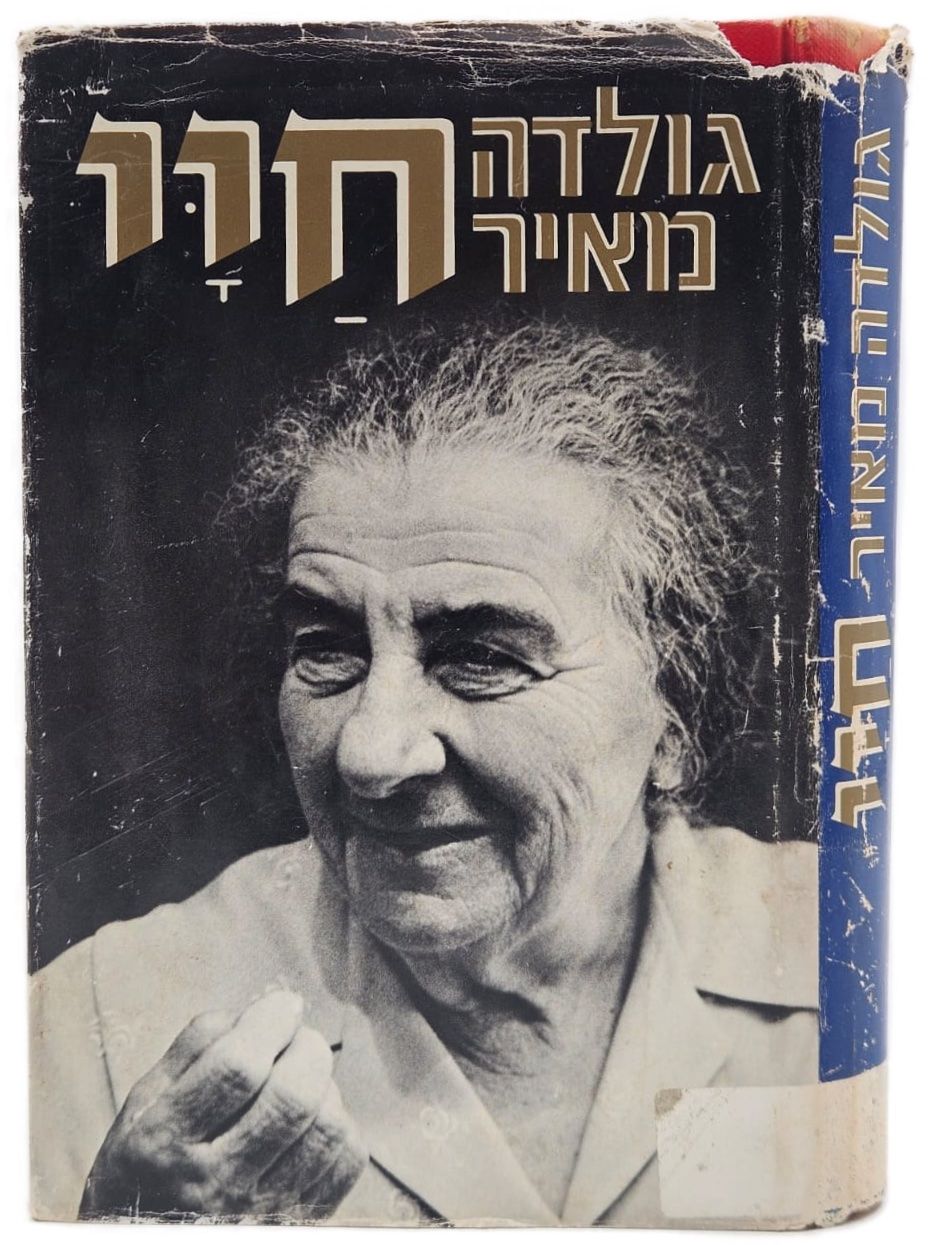
Bidspirit auction | Golda Meir – My Life
Golda Meir – My Life – Presentation Copy Inscribed to Diplomat Aryeh Levavi - Golda Meir’s Autobiography, My Life – Ma’ariv Library, 1975 – Presentation Copy Inscribed and Signed to Israeli Diplomat Aryeh Levavi: “To Mr. Aryeh Levavi, with appreciation, Golda Meir.” The personal and moving life story of Israeli Prime Minister Golda Meir, from her childhood in Russia to her emergence as one of the leading political figures of her era. In the book, Meir describes her role as Prime Minister of Israel, as a woman and a mother, and the way in which her personal story became, in many respects, the story of Israel itself. She recounts her relationships not only with prominent Israelis with whom she worked closely, such as David Ben-Gurion and Moshe Dayan, but also with world leaders including John F. Kennedy, Richard Nixon, Henry Kissinger, Charles de Gaulle, and Harold Wilson. She also discusses openly Israel’s right to exist, the saga of the British Mandate, the Arab question and the implications of this critical issue, including the problem of the Arab refugees. Written in the first person, the book traces her path from childhood in Russia and Milwaukee, her immigration to Eretz Israel and pioneering life in Merhavia, through her activities in the Histadrut and the Zionist struggle during the British Mandate, the establishment of the State of Israel and her historic mission as Israel’s first diplomatic representative in Moscow, and finally her years as Minister of Labor, Foreign Minister, and Prime Minister of Israel. Beyond her personal recollections, the book is effectively an account of the establishment and development of the State of Israel from the perspective of a woman who for decades stood within its innermost circle of decision-makers. The final chapters are devoted to her premiership and the Yom Kippur War – the gravest crisis of her years in office – about which she writes from the perspective of her years following retirement. One of the most fascinating chapters in the book deals with the historic events preceding the declaration of the independence of the State of Israel. Under the heading “We Have a State, ” Meir recounts the rescue of orphaned children from the displaced persons camps and their immigration to Eretz Israel despite British opposition. She describes the severe and brutal measures employed by the British against the Jewish immigrants deported aboard the Exodus: “If I live to be a hundred, I shall never erase from my mind the terrible sight of hundreds of fully equipped British soldiers wielding clubs, pistols and grenades against the wretched refugees aboard the Exodus, among them 400 pregnant women determined to give birth in Eretz Israel...” She also recalls the mounting Arab threat following the UNSCOP report: “We were not prepared for war at all, ” she writes. Meir also describes a series of secret meetings she held with Ben-Gurion, in which they discussed how to secure a majority at the United Nations in favor of establishing a Jewish state, as well as the tense hours on the day of the Declaration of Independence. She reveals fascinating details about the preparations for the ceremony: the windows of the hall at the Tel Aviv Museum where the ceremony was held were concealed for fear of an attack; Herzl’s portrait was hung especially for the occasion that day; there were difficulties with the orchestra’s performance of Hatikvah, despite having been prepared in advance; and, above all, she recalls the profound emotion that overwhelmed her and everyone present: “My eyes filled with tears and my hands trembled. We had done it. We had brought the Jewish State into existence – and I, Golda Mabovitch Meyerson, had lived to see the day.” She recounts that this was the first time she had ever heard Ben-Gurion’s voice choke with emotion as he read the Declaration of Independence, and how she was certain that the moment he finished reading the proclamation, the newly established state would immediately have to repel the impending Arab attack, and more. The recipient of the book, Aryeh Levavi (1912–2009), was an Israeli diplomat and Director-General of the Ministry of Foreign Affairs. Born in Lithuania, he moved with his family to Germany following the 1917 Revolution, where he was active in the Habonim movement. In 1932 he immigrated to Eretz Israel, and in 1935 received a master’s degree in philosophy from the Hebrew University of Jerusalem. Between 1936 and 1938 he served in the Jewish Settlement Police and was a member of the editorial staff of Davar. He subsequently traveled to Germany for several months as an emissary of the Histadrut and the HeHalutz center, with the aim of persuading German Jews to leave the country. In 1938 he was expelled from Germany under a deportation order signed by Adolf Eichmann. Upon his return to Eretz Israel, Levavi joined the Political Department of the Jewish Agency. Following the establishment of the State of Israel,