Bidspirit auction | Der Stürmer – Antisemitic Propaganda
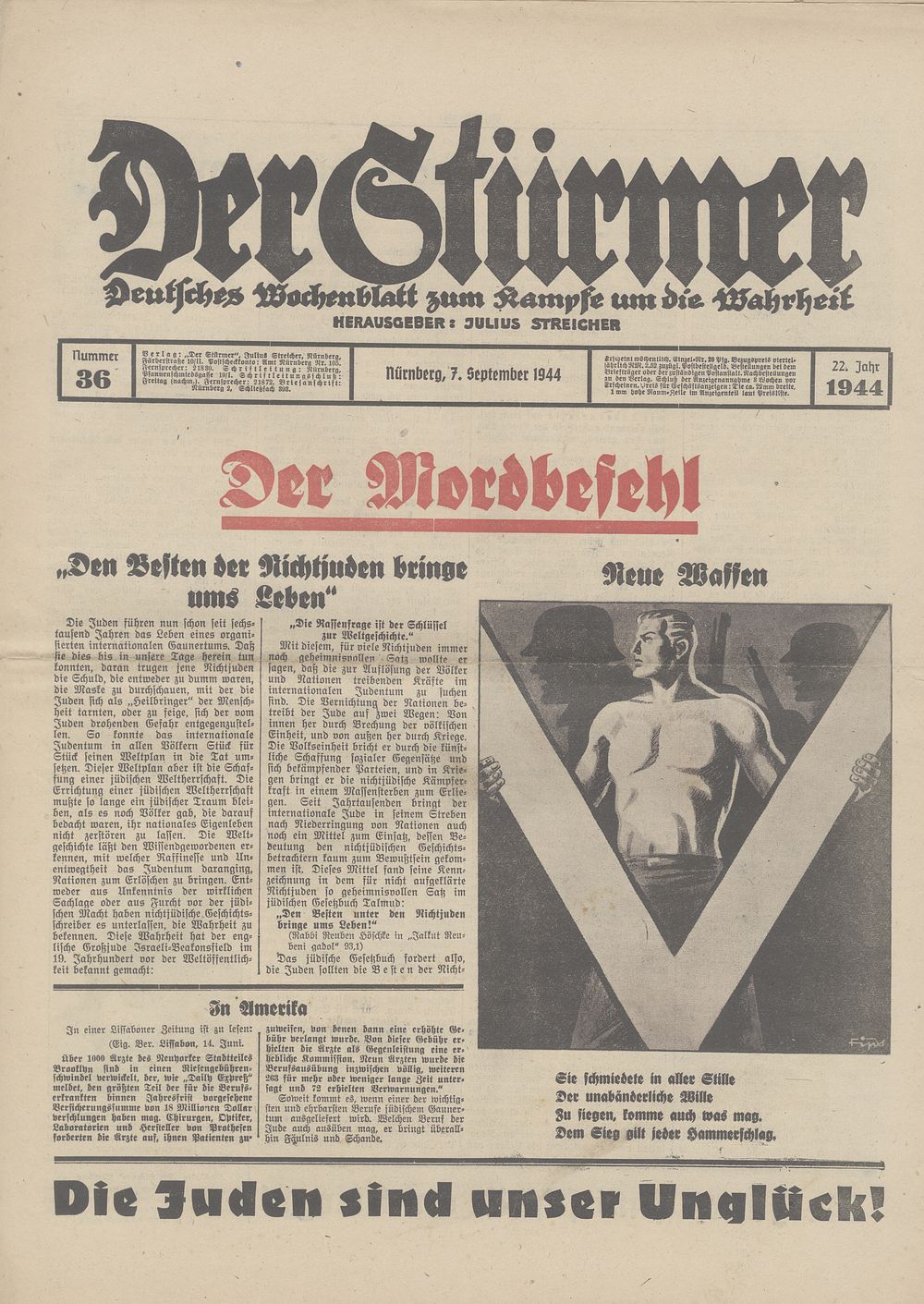
Der Stürmer – Antisemitic Propaganda Issue Explicitly Calling for the Killing of Jews. September 1944 - Der Stürmer – Deutsches Wochenblatt zum Kampfe um die Wahrheit [Der Stürmer – German Weekly for the Struggle for Truth], edited by Julius Streicher. Antisemitic incitement issue explicitly calling for the killing of Jews – the type of publication that contributed to the conviction of the newspaper’s editor, Julius Streicher, at the Nuremberg Trials. Nuremberg, September 7, 1944. German. A particularly virulent issue of the Nazi antisemitic propaganda weekly Der Stürmer, published during the final stages of World War II, when the extermination of European Jewry was already underway. At the top of the front page, in red lettering, appears the headline Der Mordbefehl – “The Murder Order.” Beneath it is the statement “Den Besten der Nichtjuden bringe ums Leben” – “Kill the best of the non-Jews, ” attributed by the newspaper to a Jewish source. From this, Der Stürmer develops one of its central themes of incitement: the false claim that Judaism itself commands the killing of non-Jews. The message goes beyond portraying the Jew as an enemy; it seeks to convince the reader that Jewish belief requires its adherents to destroy non-Jews and that the struggle against Jews is therefore an act of self-defense. At the bottom of the front page appears the newspaper’s notorious recurring slogan: “Die Juden sind unser Unglück!” – “The Jews are our misfortune!” The article “The Murder Order, ” written by Julius Streicher himself, continues on the inside pages and reaches an even more extreme level of incitement. A large headline declares: “Den Besten unter den Nichtjuden bringe ums Leben!” – “Kill the best among the non-Jews!” Streicher presents a purported chain of Jewish sources as evidence that Jews are commanded to destroy those around them, using it to transform the victim into the murderer: while the Jews of Europe themselves were being murdered en masse, the newspaper portrayed them as plotting the destruction of humanity – clearly intended to justify their elimination at a time when reports of mass extermination were becoming increasingly widespread. At the bottom of the page appears another slogan: “Die Juden sind schuld am Kriege!” – “The Jews are to blame for the war!”. One of the most virulent passages in the issue, under the heading Der Mord in Konitz – “The Murder in Konitz, ” revives the blood libel. The affair, originating in an unsolved murder committed in 1900 in Konitz, West Prussia, is exploited here to present the accusation of Jewish ritual murder as fact. Alongside it are photographs of Jews accompanied by degrading and mocking captions, deliberately emphasizing facial features and physical deformities in an attempt to instill in the reader feelings of disgust and fear toward Jews. On the same page appears a photograph of Hungarian Jews wearing yellow badges, under the heading “Judentypen aus Ungarn” – “Jewish Types from Hungary.” Beneath the photograph of a Jewish boy is the caption: “He wants to become a rabbi one day”; another image presents “curly-haired Levi, ” another “the deformed-faced Abraham, ” and so forth. The photograph takes on an especially chilling significance in light of the date of the issue: only a few months earlier, hundreds of thousands of Hungarian Jews had been deported to Auschwitz, most of them murdered immediately upon arrival. A full page of caricatures continues the same message through extreme antisemitic imagery: the Jew is depicted as an obese giant bearing a Star of David and a dollar sign, towering over the ruins of Europe. Another caricature portrays Jews supposedly nurturing Soviet Communism with “blood, ” while yet another links Wall Street, the Jews, and the Soviet Union. In this way, the newspaper merges two central obsessions of Nazi propaganda – “Jewish capitalism” and “Jewish Bolshevism” – portraying completely opposing forces as products of the same alleged worldwide Jewish conspiracy. The date of this issue is particularly significant: September 7, 1944. Paris had been liberated less than two weeks earlier; the German army was retreating through France and Belgium; Romania had already switched sides to join the Allies; the Red Army was advancing from the east; and the Polish uprising was underway in Warsaw. At the same time, the extermination of the Jews continued: in August–September, tens of thousands of Jews remaining in the Łódź Ghetto were deported to Auschwitz, and in September deportations from Slovakia were also resumed. Precisely as German defeat drew closer, Der Stürmer did not moderate its message but intensified it – portraying the Jews as responsible for the war and as an existential threat that had to be eliminated. The historical significance of this issue extends beyond ordinary antisemitic propaganda.