Bidspirit auction | Antisemitic Issue of Kladderadatsch –
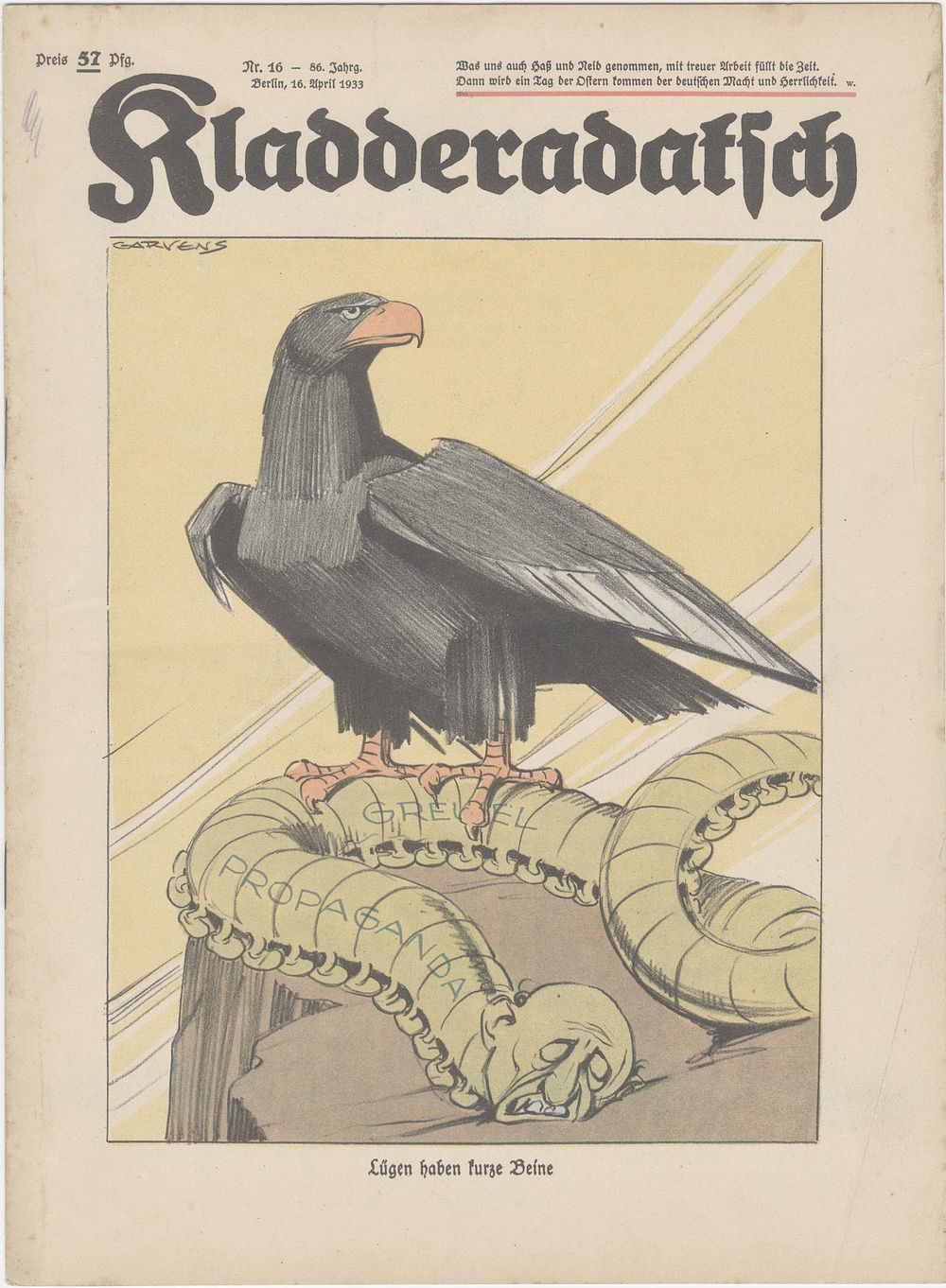
Antisemitic Issue of Kladderadatsch – Denying the Persecution of the Jews and Accusing Them of Spreading False Propaganda – April 1933 - Kladderadatsch – Antisemitic Issue from the Early Months of Hitler’s Rule: The Beginnings of the “Atrocity Propaganda” Campaign, Accusing Jews of Spreading Lies About Their Persecution by the Nazis; Lion Feuchtwanger and the Portrayal of the Persecution of the Jews as a Fabrication – Berlin, April 16, 1933. An issue of the German satirical weekly Kladderadatsch, published less than three months after Adolf Hitler’s rise to power, featuring caricatures and texts that clearly reflect the newspaper’s alignment with the new regime and its adoption of Nazi antisemitic propaganda. The front cover features a large caricature by Garvens under the heading “Lügen haben kurze Beine” – “Lies Have Short Legs.” The German eagle stands over a worm in the form of a stereotypically depicted Jew, bearing the words “Greuel” [“atrocities”] and “Propaganda.” The caricature refers to the term Greuelpropaganda – “atrocity propaganda” – employed by the Nazis to discredit reports circulating outside Germany concerning violence and persecution perpetrated by the new regime. The significance of the cover is particularly striking in view of its date: the nationwide Nazi boycott of Jewish businesses and professionals had taken place on April 1, 1933, only two weeks before this issue appeared, and was itself presented by the Nazis as a response to alleged Jewish “atrocity propaganda” abroad. The most blatant expression of antisemitism in the issue is a full page devoted to the Jewish writer Lion Feuchtwanger. In the upper section he is depicted beneath the caption “als Jud Süß in Deutschland” – “as Jud Süß in Germany, ” gathering into a sack coins pouring down upon him. Below, he appears alongside an image of corpses and a bearded Jew, bearing the words “Judenpogrom in Deutschland” – “Pogrom Against Jews in Germany, ” beneath the caption “als Jud Mieß im Ausland.” The caricature portrays Feuchtwanger as a Jew who enriched himself in Germany and then spread atrocity stories abroad about the persecution of Jews. While the caricature mocked reports of persecution as fabrication, Feuchtwanger’s home had already been ransacked by the Nazis while he was outside Germany, and within weeks his books would be burned in the Nazi book burnings. The same propaganda mechanism recurs on a page headed “Greuel-Quellen” – “Sources of the Atrocity Stories.” It reproduces purported letters and correspondence of the London firm Joelson & Co., through which the newspaper seeks to “prove” that reports of persecution in Germany were commissioned and manufactured abroad. Rather than confronting the reports themselves, the issue presents them as the product of a hostile campaign against Germany – precisely the argument employed by Nazi propaganda to justify the boycott against the Jews earlier that same month. Another caricature, entitled “Stinkbombardement” – “Stink-Bombardment, ” depicts a swastika flag being bombarded from above with “bombs” labeled Greuellügen – “atrocity lies.” Below stands a man explicitly identified in the caption as “Der deutsche Jude” – “the German Jew, ” who says: “Stop throwing those stink bombs! They are landing right on my head!” The message is again the same: it is not Nazi persecution that endangers the Jews of Germany, but Jews and critics abroad who publicize reports of that persecution. Responsibility is thus shifted from the persecutor to the victim – a central theme of the propaganda that accompanied the anti-Jewish boycott of April 1933. The references to concentration camps are also particularly noteworthy. On another page appears a humorous piece entitled “Im Konzentrationslager” – “In the Concentration Camp.” The very appearance of the term as the subject of a joke in a newspaper in April 1933 is highly significant: the Dachau concentration camp had opened only a few weeks earlier, in March 1933, as one of the principal instruments for suppressing the regime’s political opponents. Rather than portraying the camps as instruments of political terror, Kladderadatsch was already incorporating them into its routine humor and normalizing their very existence. The spirit of the entire issue is encapsulated in the long poem “Deutsche Ostern” – “German Easter, ” which opens the issue. The poem celebrates what it presents as the revival of German national identity: “For the first time in years, Germans have once again come to recognize the German way, ” it declares, before portraying a united people casting off the past and rising anew. The poem concludes with a call for “resurrection” and invokes Bismarck as a symbol of the German spirit reborn. It is, in effect, a celebratory ideological statement for Easter, presenting the political transformation of 1933 not as the seizure of power by a political party but as the national and spiritual rebirth of the German people.