Bidspirit auction | “Mr. Einstein Is Not Returning
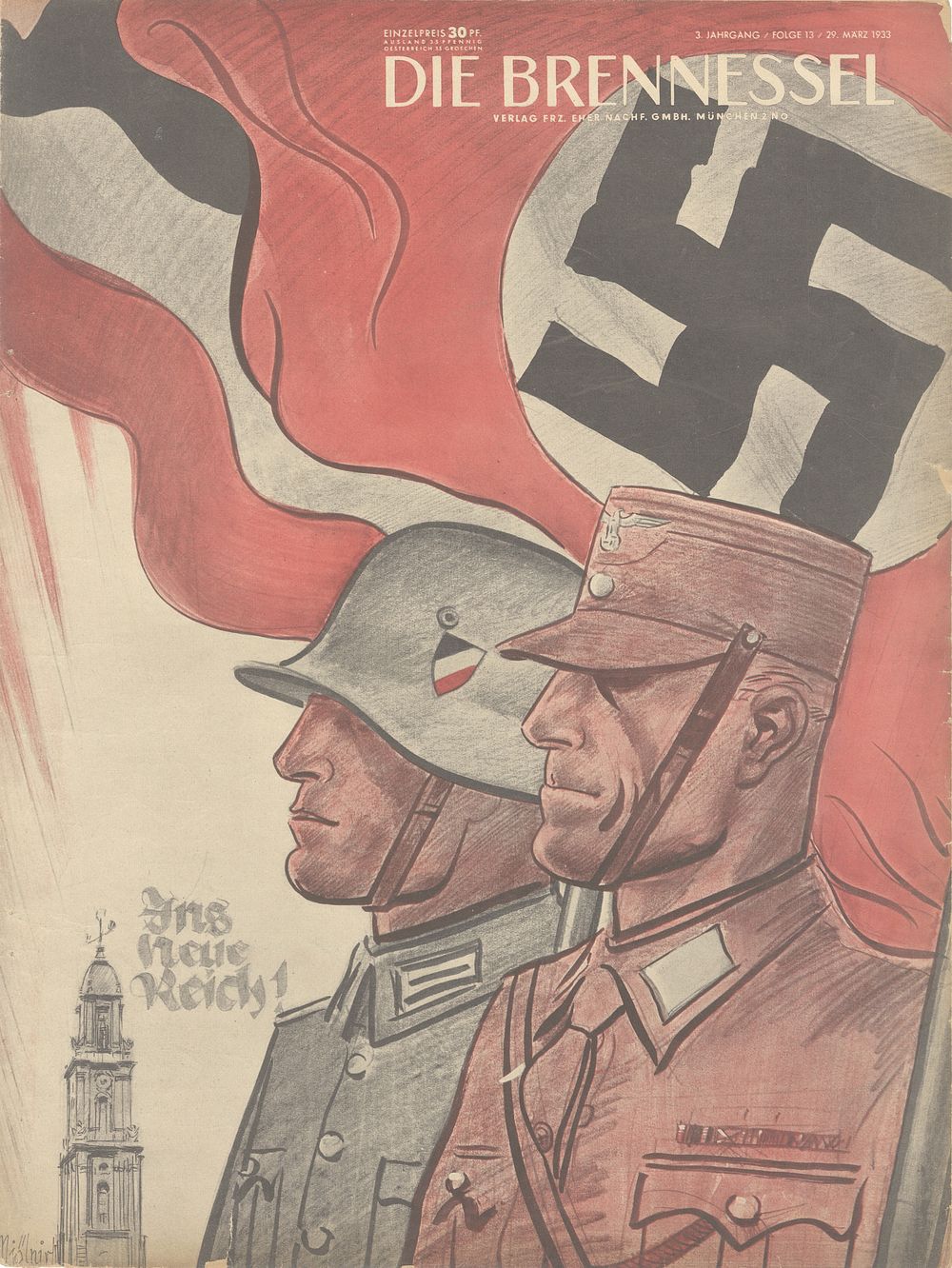
“Mr. Einstein Is Not Returning to Germany!” – Die Brennessel – Nazi Propaganda Issue from the Early Months of Hitler’s Rule - Die Brennessel – Nazi Party propaganda weekly published by Franz Eher Nachf., the central publishing house of the NSDAP. Nazi propaganda issue from the early months of Hitler’s rule: Einstein and the Jews portrayed as enemies of Germany; ridicule of alleged “lies” about the Nazis; Marxism and the free press depicted as enemies of the Reich – Munich, March 29, 1933 – only days after the passage of the Enabling Act and shortly before the nationwide boycott of German Jews. The cover of the issue vividly reflects the moment of transition to the new regime. Beneath the headline “Ins neue Reich!” – “Into the New Reich!” – two members of the nationalist-Nazi forces are shown, one wearing a steel helmet and the other a brown uniform, with a swastika flag flying behind them. The cover appeared only eight days after the “Day of Potsdam” on March 21, 1933, the ceremony at which the Nazis sought to present Hitler’s rule as both a continuation and a renewal of the Prussian-national tradition. At the beginning of the issue appears a piece mocking Albert Einstein, attacked both as a Jew and as an intellectual who had taken a stand against Nazi Germany. Einstein, who was outside Germany when Hitler came to power and announced that he would not return as long as the new regime remained in place, is personally targeted here. An entire page is headed “EIN STEIN FÄLLT UNS VOM HERZEN!” – a pun on Einstein’s name, meaning approximately “A Stone Is Lifted from Our Hearts!” – followed by the declaration: “Children, oh, how lucky we are! Mr. Einstein is not returning to Germany! You don’t believe me?... He promised it himself... We hope that the word Mr. Einstein used here is entirely correct and not merely relative...” The passage mocks his declaration that he would not return to Germany as long as the “present conditions” continued, presenting his departure not as a loss to Germany but as a relief. Later in the issue, another piece mocks Einstein under the heading “Der Ehrenindianer, ” portraying him derisively as having embarked on a campaign of vilification against Germany after leaving the country: “Einstein incites hatred... If a Jew goes on a rampage against Germany in the streets, he must accept being called a swine, ” the text states. On another page appears a large caricature entitled “Bei der marxistischen ‘Wiener Arbeiterzeitung’” – “At the Marxist Wiener Arbeiterzeitung” – depicting the newspaper’s staff wearing gas masks while preparing its issues. The caption explains that the employees “müssen die Angestellten Gasmasken tragen, um nicht an den gedruckten Lügen über das nationale Deutschland zu ersticken” – “are forced to wear gas masks so as not to suffocate from the printed lies about National Germany.” Critical reports in the press outside Germany are presented not as information to be confronted, but as “lies” disseminated by Germany’s enemies. The same mechanism appears in the poem “Pressedienst am Kunden” – “Press Service for the Customer.” Its protagonist bears the stereotypically Jewish name “Itzig Kohn, ” and is portrayed sitting and writing reports about Nazi actions. Among the phrases that appear is “Nazis massakrieren” – “Nazis carry out massacres” – as part of the mockery of reports concerning Nazi violence. The text links him to the Jewish Centralverein and portrays reports of violence, suffering, and murder as the product of a Jewish propaganda apparatus. Already during the first weeks of Nazi rule, arrests, beatings, and acts of terror against political opponents and Jews were taking place throughout Germany, while the weekly instructed its readers to regard reports of these events as hostile Jewish fabrications. The United States is likewise a target of ridicule in the issue. In the caricature “Der betrügerische Bankier in den U.S.A.” – “The Fraudulent Banker in the U.S.A.” – a banker being arrested in New York protests that these are “positively German conditions, ” in an attempt to portray American criticism of repression in Germany as hypocritical. Another caricature depicts Munich strewn with corpses and claims that this is how the city would have looked had Minister Stützel’s order to open fire been carried out – portraying the Nazis as victims of violence during the Weimar period. The issue also attacks the Catholic Centre Party and the Vatican. The significance of this issue lies particularly in its date and in the combination of messages appearing throughout its pages. This is not a propaganda publication from a period when the Nazi dictatorship was already a long-established fact, but an issue from the very weeks in which it was being constructed. Its pages reveal how satire was placed at the service of Nazi propaganda and, already in March 1933, used to create a complete worldview: Hitler and the Nazi movement represent the “New Reich”;