Bidspirit auction | Ravensbrück – Testimony of Micheline
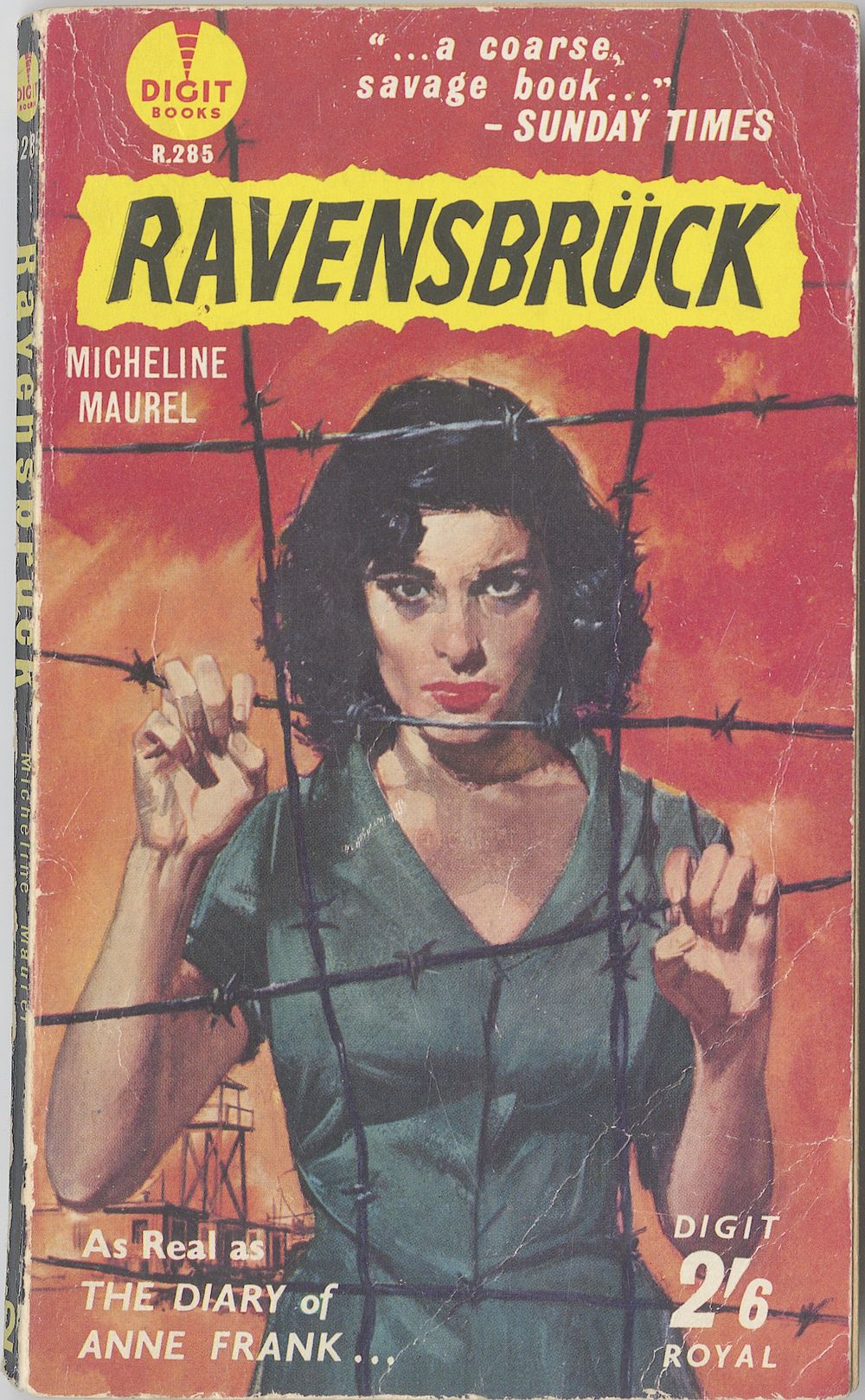
Ravensbrück – Testimony of Micheline Maurel, a Survivor of Nazi Germany’s Largest Women’s Concentration Camp – London, 1958 – Paperback Edition Preceding the Official First Edition - Ravensbrück – Testimony of French Resistance Fighter Micheline Maurel on Her Twenty Months of Imprisonment in Ravensbrück and its Neubrandenburg Subcamp. By Micheline Maurel, translated from the French by Margaret S. Summers, foreword by François Mauriac. Published by Digit Books / Brown, Watson Ltd., London, 1958 – Specially designed paperback edition preceding the official first edition (see Dynasty Auction 34, Lot 122). English. Printed on the cover: “As Real as The Diary of Anne Frank.” “It was a fairly ordinary camp; it did not even have its own gas chamber.” Thus writes Micheline Maurel from Neubrandenburg - a branch of the notorious Ravensbrück camp, to which she was dragged by the Gestapo in 1943. She was stripped, her head shaved, and she was given a bowl and trousers that constituted her worldly possessions for twenty terrible months, until she and the other survivors were liberated (and raped) by the Russians.” (From the introduction to the book). “When we got off the train, we were met with clubs, angry shouts, and police dogs. They pushed us and slapped us, lined us up in rows of five, and set us on our way with further blows. The pace imposed was a quick march, almost a run... I think that one of the first shocks, after the beatings and the sight of the police dogs, was the cutting of our hair; and for those who escaped it at that moment, it was seeing the heads of those who had been shorn. They cut our hair, beat us, shoved us, we were crammed into the striped dress without a belt that was always too large or too small...”. An important publication in which Maurel recounts in detail her harrowing experiences, and the daily life in Ravensbrück - the largest women’s concentration and extermination camp in Nazi Germany. Maurel was arrested on charges of organizing underground activity in France and was sent to the camp. Here she describes in detail the harsh living conditions the prisoners were forced to endure in their struggle for survival - the hunger, the beatings, the severe torture the women in the camp suffered daily (“We stood several hundred naked women, a sight that was not unusual in Ravensbrück, waiting for hours for the German doctors to examine us... we remained standing for 11 hours without movement and without food...” ), the forced labor, the violence of the guards, and the daily struggle of the prisoners to survive. During the first three months, Micheline worked in the aircraft factory in Neubrandenburg - the Ravensbrück subcamp located not far from it, under daily beatings inflicted on her and her companions for any movement deemed out of place. She was in the camp at its peak in the autumn of 1943, when it held 22,000 women—Russians, Ukrainians, Poles, Czechs, French, and Yugoslavs, Jewish women from Hungary, and other women—mostly Jews—from camps east of the Oder River. She became well acquainted with the dominant women in the camp. The stories of heroism of these women are also presented here in her memoirs. Among other things, Maurel describes in detail the difficult months of 1944, during the period of peak overcrowding in the camp and the reduction of food rations, which led to outbreaks of dysentery and typhus that claimed the lives of thousands of prisoners. Maurel remained in the camp until its liberation by the Red Army forces in May 1945. In the final chapters, she describes the days of liberation and the harsh treatment of the women by the Russians, who showed no mercy to women who had endured hell for two years and exploited their weakness (after their liberation from the camp, they still carried diseases and were in a very weakened physical state). “My friend Michel said to me, after reading the manuscript of this book, ‘The truth was far worse.’ I know this very well. More than once, while writing it, I came face to face with memories so tightly sealed that they could not be recalled. My thoughts pushed them away...” (From the author’s words). Micheline Maurel [1916–2009], a French writer and poet, a fighter in the Résistance, who was deported to the Ravensbrück camp in 1943. She completed higher studies in classical literature in Lyon. In 1940, she joined the French underground and was part of the “Marco Polo” network. Full of enthusiasm, she remained in Lyon with an agrégation scholarship (a prestigious academic training track), and in the years 1941–1942 taught literature there. On June 19, 1943, she was arrested by the Gestapo and imprisoned in the Romainville fortress. On August 29, 1943, she was deported to Neubrandenburg, a subcamp of Ravensbrück, and was assigned prisoner number 22410. She survived there for twenty months until she was liberated with the advance of the Russian forces in April 1945. In May 1945, she returned to Toulon.