Bidspirit auction | The Rescue of Danish Jewry
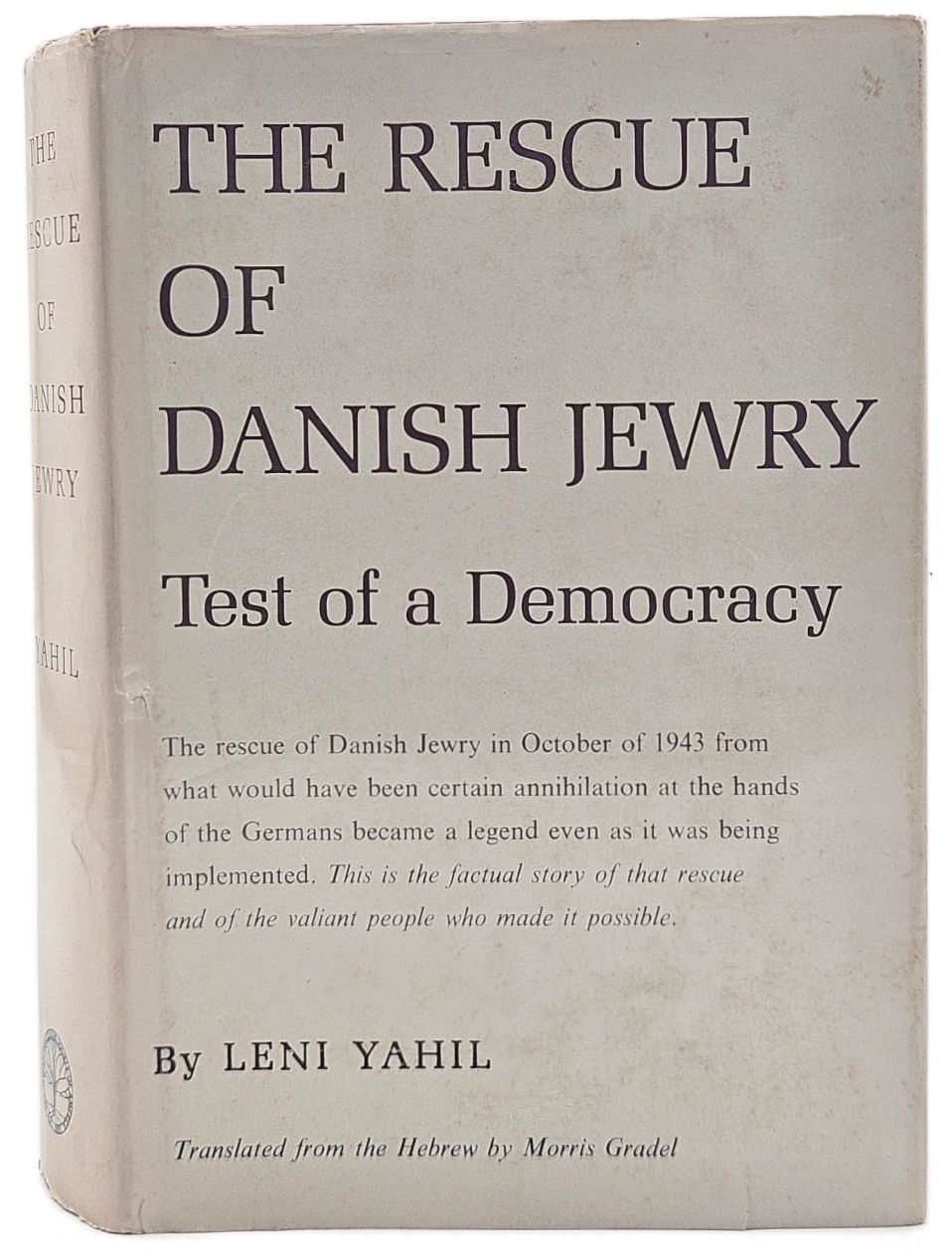
The Rescue of Danish Jewry – Democracy Put to the Test – Leni Yahil’s Important Study on the Rescue of Danish Jewry during the Holocaust – First English Edition - The Rescue of Danish Jewry: Test of a Democracy – The comprehensive study by historian Leni Yahil on the rescue of the Jews of Denmark from the Nazis in October 1943. Translated by Morris Gradel. Published by The Jewish Publication Society of America, Philadelphia – First English edition, first printing, 1969. One of the fundamental and most detailed studies of the rescue of Danish Jewry during the Holocaust. English. “The rescue of Danish Jewry in October 1943 from what would have meant certain extermination at the hands of the Germans became a legend even as it was being carried out. The news, broadcast without delay throughout the free world, aroused the deepest admiration and satisfaction. This is the story of that rescue and of the courageous people who made it possible. Written with exceptional clarity and meticulously researched, the book provides a detailed account of this event. It vividly brings to life the unique dramatic confrontation between antisemitic Nazism and Danish democracy that shook Denmark during the first days of October 1943...” (from the introduction). Leni Yahil’s comprehensive study examines one of the most extraordinary rescue operations of the Holocaust – the operation in the autumn of 1943 in which the great majority of Denmark’s Jews were smuggled to neutral Sweden after the German plan to arrest and deport the country’s Jewish population became known. The book goes beyond the rescue operation itself, seeking to explain how it became possible: the status of Jews in Danish society, the nature of the German occupation, the policies of the Danish government, manifestations of local antisemitism, the political crisis of 1943, the resistance movement, and the mobilization of broad segments of Danish society in the rescue effort. The book traces the developments that led to the crisis of September–October 1943, culminating in its account of the rescue operation, during which Jews were transported in boats and small vessels across the Øresund Strait to the Swedish coast. It was a heroic clandestine operation in which Jews crossed in hundreds of small craft, sometimes fishing boats, motorboats, and even rowboats, from the Danish coast to neutral Sweden. A race against time had begun. Jewish families were hidden in apartments, summer houses, hospitals, and churches, and secretly transported by train, car, and on foot to towns and fishing villages along the coast. Resistance members and civilians established contact with boat owners and fishermen, while the refugees were sometimes led at night through forests or to isolated beaches. In one documented case, Jews were transported by truck concealed beneath blankets, dropped off in a forest, led in groups of ten to the shore, and from there taken by rowboat to fishing vessels waiting at sea. The scale of the operation was remarkable given the short period in which it took place: within little more than three weeks, over 7,000 Jews and approximately 700 non-Jewish relatives were brought to Sweden. Approximately 470 Jews were captured and deported to Theresienstadt. Yahil also examines the actions of the Danish authorities, the population, the resistance, the Church, and various parties in Sweden, as well as the complex conduct of the German authorities in Denmark, foremost among them Werner Best, and the role of the German diplomat Georg Ferdinand Duckwitz in warning of the planned operation. A substantial section is also devoted to the Jews who were unable to escape and were deported to Theresienstadt. Yahil describes the efforts of the Danish authorities to monitor their fate, the parcels and aid sent to them, and the visit of the Danish delegation to the camp in 1944. The book examines the German deception undertaken in preparation for the visit and the creation of a false impression of living conditions in Theresienstadt, and continues with the fate of the Jewish refugees in Sweden and their return to Denmark after liberation. In the introduction to the English edition, written on the twenty-fifth anniversary of the events of October 1943, Yahil emphasizes that, in her view, the rescue of Danish Jewry was not merely a humanitarian episode but a test of the political and moral structure of a democratic society under occupation. Hence the subtitle “Test of a Democracy” – the book examines how the confrontation between Nazi antisemitism and the institutions and values of Danish society affected the fate of the country’s Jews. Yahil’s important study is based on extensive documentation from Danish, German, Swedish, and Jewish sources, including documents relating to the German Foreign Office, the SS, the Danish and Swedish Foreign Ministries, the Nuremberg Trials, and the Yad Vashem archives.