Bidspirit auction | Certificate of the Issuance of
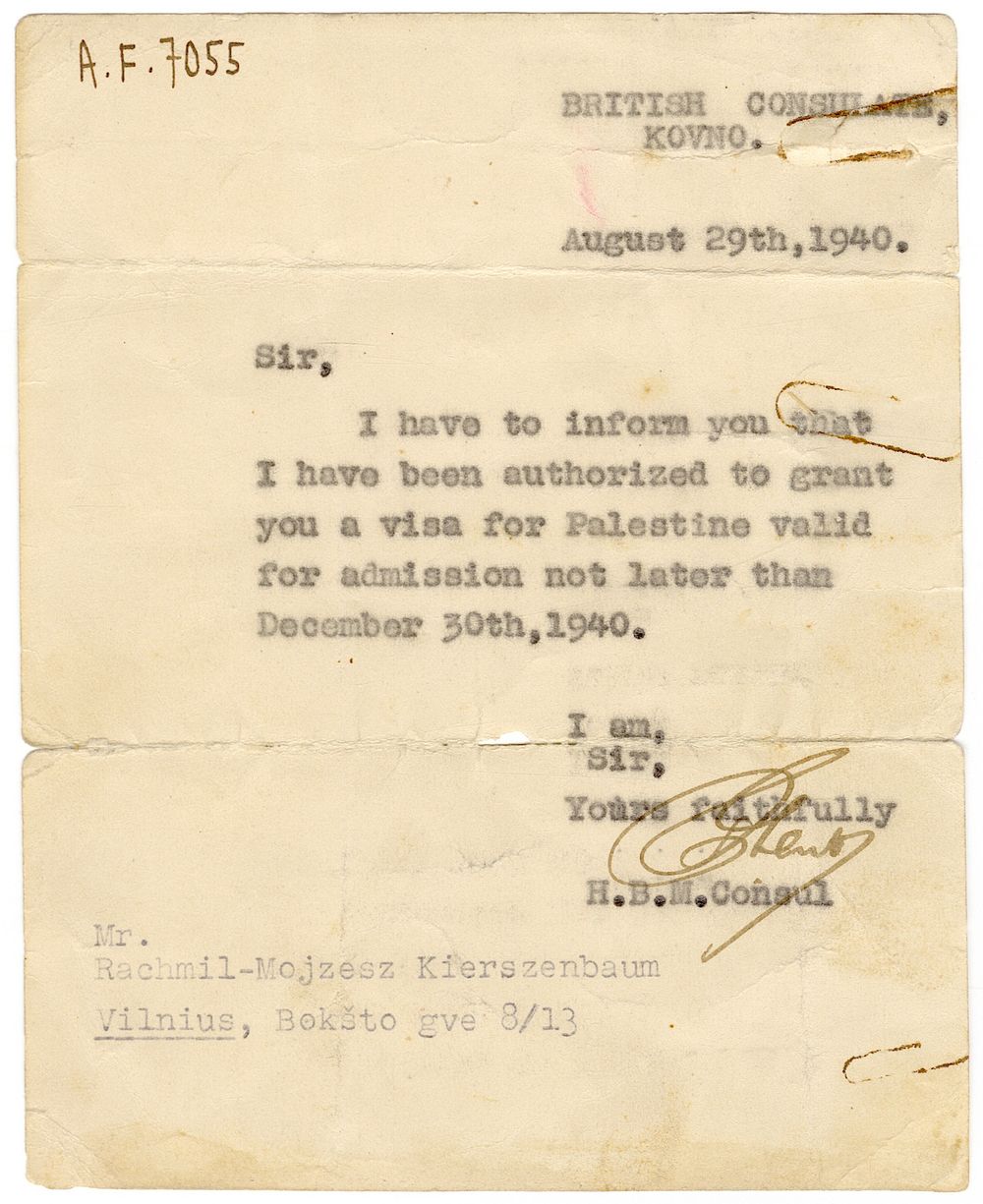
Certificate of the Issuance of an Immigration Visa to Eretz Israel, Signed by Righteous Among the Nations Thomas Preston - August 1940 - Certificate of the issuance of an immigration visa to Eretz Israel (Palestine), issued by the British Consulate in Kaunas (Kovno), Lithuania, signed by the British Consul in Kaunas - Righteous Among the Nations Thomas Preston. The certificate was sent to a Jewish refugee named Mr. Rachmil-Mojzesz Kierszenbaum - Rachmil-Moshe Kirschenbaum, a resident of Vilna, August 29, 1940 - only a few days before the final closure of the British Consulate and the occupation of the region by the Soviets and the Germans. Text of the document: BRITISH CONSULATE, KOVNO. August 29th, 1940. Body of the notice: Sir, I have to inform you that I have been authorized to grant you a visa for Palestine valid for admission not later than December 30th, 1940. - signed by His Britannic Majesty's Consul. I am, Sir, Yours faithfully, Preston's signature H.B.M. Consul (His Britannic Majesty's Consul) Name and address of the addressee (lower left corner): Mr. Rachmil-Mojzesz Kierszenbaum, Vilnius, Bokšto gve 8/13 (Bokšto Street 8/13, Vilna). In June 1940, the Red Army occupied the Baltic states, and in August 1940 Lithuania was annexed by the Soviet Union. The Soviet authorities ordered all foreign embassies and consulates in Kaunas to close their doors by the end of August 1940. The rare document before us was issued on August 29, 1940, just a day or two before the final closure of the British Consulate. In the summer of 1940, thousands of Jewish refugees (many of whom had fled from Poland to Vilna and Kaunas) attempted to obtain travel documents in order to escape Europe, while the Dutch consul Jan Zwartendijk and the Japanese consul Chiune Sugihara issued transit visas (Curaçao/Japan) to save Jews. To obtain a transit visa, the refugees had to prove that they had a final destination - a British visa for Eretz Israel was an especially coveted and highly sought-after final destination. The British severely restricted immigration under the White Paper policy. Official letters of this kind from the British Consulate in Kaunas constituted the ”green light” confirming that the refugee's name had been included in the quota of approved immigration certificates. This letter enabled the refugee to obtain a Japanese/Soviet transit visa and embark on an escape journey via the Trans-Siberian Railway to the Far East and from there to Eretz Israel. Despite the British policy restricting Jewish immigration to Eretz Israel, Preston chose to act according to the dictates of his conscience and issued hundreds of visas and immigration certificates such as the one before us to Jews, at considerable personal and professional risk. Preston operated in Kaunas alongside Chiune Sugihara (the Japanese consul) and Jan Zwartendijk (the Dutch consul). The entry permit to Eretz Israel provided by Preston served as a ”final destination, ” thereby enabling refugees to obtain a Japanese transit visa from Sugihara and leave Europe via the Trans-Siberian Railway. When the Soviets ordered the closure of all foreign diplomatic missions in Kaunas at the end of August 1940, Preston continued to issue travel documents and certificates until the very day the office closed - the document before us is dated August 29, 1940 - one day before the evacuation. He also actively assisted groups of refugees in crossing the Soviet border and reaching Turkey and Eretz Israel. Sir Thomas Hildebrand Preston (1886-1976) - British diplomat - was stationed in Kaunas, then the capital of Lithuania, when Hitler's forces invaded the country. Preston spent more than a decade in Lithuania, which remained an independent state until the Soviet forces invaded in the summer of 1940 as part of the Ribbentrop-Molotov Pact with Germany. He soon understood what the Nazis were planning and instructed his staff to prepare as many entry visas as possible for Jewish refugees. The British diplomat understood at this stage that the lives of the Jews were in danger, and therefore instructed his staff to prepare all the relevant documents that would enable the refugees to leave the country safely for Sweden and Palestine. According to estimates, Thomas Hildebrand Preston signed approximately 1,200 entry visas - 800 within the government quota and another 400 contrary to instructions - thereby saving the lives of more than 1,200 Jews. In September 1940, he fled Lithuania, leaving behind a stack of blank entry visas that had been officially signed, in the hope of helping additional families. In the course of his diplomatic service, he made his way to Turkey and later even reached Cairo. In 1940, his name was included in the Nazi ”Black Book, ” a list of 2,820 individuals designated for arrest by the SS in the event of a German occupation of Britain. His heroic actions in rescuing Jews remained unknown for many years;